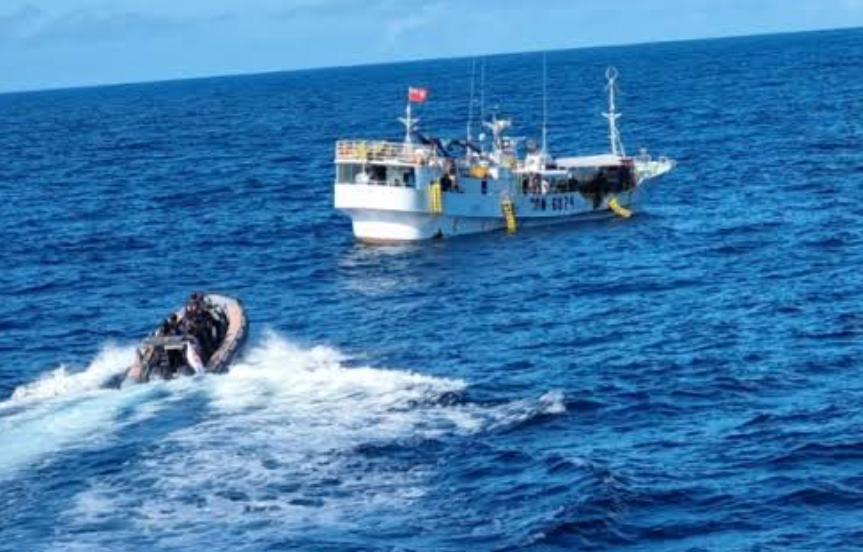
Pacific island authorities have intensified their enforcement operations against illegal fishing, detaining multiple Chinese and Indonesian vessels during a sprawling surveillance operation across one of the world's most resource-rich ocean regions. The Pacific Islands Forum Fisheries Agency reported that four boats were taken into custody or brought to port by authorities in Kiribati, Palau and Papua New Guinea between August 3 and 14, marking part of a broader coordinated crackdown that caught the attention of maritime officials throughout the region. The detained vessels contravened fishing regulations or operated without valid licences, raising fresh concerns about unlawful activities in waters that remain central to the economic survival of small island states.
The enforcement operation, dubbed Operation Island Chief, involved an unprecedented joint effort spanning 11 Pacific nations working in tandem to police the vast ocean expanse. During the two-week initiative, maritime authorities boarded more than 100 vessels across an area encompassing 28 million square kilometres. The operation deployed sophisticated surveillance resources, including aerial reconnaissance conducted by an Australian military aircraft as well as patrol vessels operated by the United States Coast Guard and local Pacific maritime police forces. Such coordinated action represents a significant escalation in regional commitment to combating what officials regard as a persistent and costly problem. Beyond the four formal detentions, authorities identified a further 16 vessels classified as "of interest" during the operation, though the FFA has withheld specific details about these cases.
The strategic importance of this crackdown becomes apparent when considering the scale of tuna resources at stake. The Pacific region accounts for approximately half of the world's entire tuna catch, yet Pacific Island nations themselves process or handle only 15 per cent of this harvest. This disparity underscores a fundamental imbalance in how wealth from the region's marine resources is distributed. The fishing industry generates substantial revenue streams for Pacific economies, with access fees alone contributing US$500 million annually, while export earnings reach US$1.2 billion per year. Beyond these headline figures, the sector sustains the livelihoods of roughly one-third of all Pacific Island households, making effective management and enforcement critical for regional development and food security.
The pattern of operation reflects how modern fishing dynamics have transformed Pacific waters into contested spaces. Distant-water fishing fleets, predominantly from Asian nations, traverse the exclusive economic zones of small island states under licensing arrangements that provide crucial revenue but also create opportunities for circumventing regulations. Most tuna caught in the region is shipped directly to Asian markets rather than processed locally, a structural reality that limits value-added opportunities for island nations themselves. Long-distance operators have become deeply embedded in Pacific fisheries through joint ventures and commercial arrangements with island governments, creating complex diplomatic considerations whenever enforcement actions target particular nationalities or companies.
The sensitivity surrounding identification of Chinese vessels illustrates these diplomatic complexities. China operates substantial fishing fleets throughout the Pacific and has established fisheries joint ventures with several island nations, making public naming of Chinese boats caught breaking rules a delicate matter. This diplomatic calculus extends beyond China, with Taiwan notably having the highest recorded infringement count in the region. Between 2008 and 2026, inspectors for the Western and Central Pacific Fisheries Commission issued 319 penalty notices to Taiwanese vessels, with Chinese boats receiving 278 notices, highlighting that violations transcend any single nationality. Last month Tuvalu authorities apprehended a Chinese vessel illegally fishing while transmitting false location data, a case that drew international attention partly because Tuvalu maintains diplomatic relations with Taiwan rather than Beijing. After 24 days in detention and a fine, the vessel was released, illustrating how enforcement typically proceeds despite political sensitivities.
The broader context for this month's operation involves mounting pressure from Pacific Island leaders to address fisheries governance and revenue capture. An annual meeting of 18 Pacific Island leaders scheduled to convene in Palau beginning August 30 is expected to discuss formulating fresh strategies designed to safeguard fishing rights while simultaneously expanding revenue generation. Climate change increasingly threatens tuna stocks throughout the region, adding urgency to discussions about sustainable management and enforcement. Rising ocean temperatures and shifting fish migration patterns create uncertainty about long-term resource availability, forcing Pacific nations to think strategically about how they can maximise current economic benefits while preserving future productivity.
Enforcement capacity remains a persistent constraint for island nations attempting to police their vast maritime domains. While Operation Island Chief demonstrated what coordinated international action can achieve, sustaining such intensive operations requires sustained cooperation and resource commitments from larger powers. The involvement of Australian and American maritime assets proved essential to the operation's reach and effectiveness, highlighting Pacific Island nations' dependence on external partners for adequate surveillance and patrol capabilities. This dynamic raises questions about how island countries can develop greater autonomous enforcement capacity over time, though geopolitical realities suggest external partnerships will remain essential for the foreseeable future.
The enforcement action carries implications extending beyond the specific vessels detained. It signals to fishing operators throughout the region that Pacific Island authorities, working in concert, are committed to enforcing regulations and will impose meaningful consequences for violations. For Malaysian readers following regional maritime affairs, the operation underscores broader Southeast Asian engagement with Pacific governance issues, particularly given the involvement of Indonesian vessels and the prominence of Asian fishing fleets across Pacific waters. The episode also highlights how small island nations, despite limited individual resources, can collectively assert authority over their maritime domains when united in purpose, a principle with potential application to other regional maritime governance challenges.

