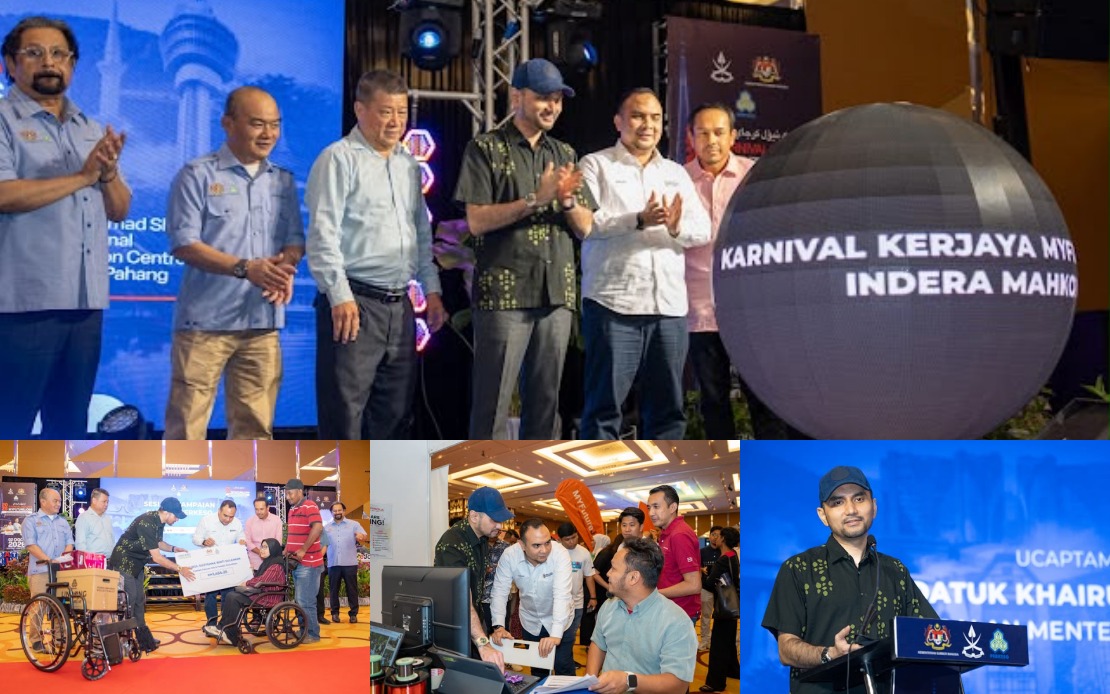
Pahang has emerged as the employment leader on Malaysia's east coast, achieving a labour force participation rate of 65.3% in the first quarter of 2026 while maintaining one of the country's lowest unemployment figures at 1.9%. The state's strong employment performance reflects the effectiveness of targeted government interventions designed to connect job seekers with available opportunities across diverse economic sectors.
The Deputy Human Resources Minister, Datuk Khairul Firdaus Akbar Khan, attributed these encouraging employment outcomes to a suite of coordinated initiatives aimed at broadening access to job placements for all segments of the population. Central to this effort is the MYFutureJobs platform, which operates under the auspices of PERKESO, the Social Security Organisation. Speaking at the opening of the Indera Mahkota MyFutureJobs Career Carnival 2026 in Kuantan, Khairul Firdaus emphasised that reducing national unemployment remains a sustained priority for the government, particularly in creating pathways for younger cohorts entering the employment market.
The career carnival itself demonstrated the scale of opportunities being generated, offering 6,000 job vacancies sourced from 30 employers spanning manufacturing, services, technology and other growth sectors. This single event exemplified the government's strategy of bringing recruitment directly to communities rather than requiring job seekers to navigate fragmented labour markets. The concentration of such large-scale hiring events in Pahang underscores the state's role as an emerging employment hub within the eastern region.
MYFutureJobs has proven remarkably effective since its establishment, with available data showing that between 2023 and July 2026, the platform facilitated employment for 26,877 job seekers specifically within Pahang. This substantial throughput represents genuine placement success, moving beyond mere advertising to tangible outcomes for workers seeking stable livelihoods. The platform's reach has expanded significantly, with PERKESO conducting 1,277 separate interview programmes and career carnivals throughout the state during the same period, demonstrating the organisation's commitment to saturating the market with opportunities.
The infrastructure supporting job creation extends beyond simple placement services. The government recognises that connecting workers with vacancies represents only part of the employment equation. Therefore, the Human Resources Ministry actively promotes complementary training programmes designed to equip workers with skills aligned to contemporary industry demands. This two-pronged approach addresses both supply and demand side challenges, ensuring that available positions match worker capabilities while simultaneously enhancing worker productivity and career advancement prospects.
Ministry officials encouraged persistent participation in these upskilling initiatives, framing them as essential investments in personal development and professional performance. For Malaysian workers navigating rapid economic transformation and sectoral evolution, such training becomes increasingly valuable in maintaining employment security and achieving wage progression. The emphasis on continuous learning reflects acknowledgment that static skill sets carry diminishing returns in dynamic labour markets.
The government's strategy extends beyond urban employment centres to deliberately reach rural and geographically isolated communities through the Sahabat MADANI initiative, which was formally launched at the Pahang event by the Prime Minister's political secretary, Datuk Ahmad Farhan Fauzi. This programme functions as the operational bridge between MYFutureJobs and ground-level community engagement, embedding employment services into grassroots structures where traditional government services may be geographically distant or logistically challenging to access.
Sahabat MADANI transcends conventional volunteer programming by functioning as a community movement explicitly designed to foster togetherness, volunteerism and social responsibility among Malaysian youth. The initiative emphasises humanistic values including mutual respect, compassion and inclusive development, positioning employment services within a broader framework of community solidarity rather than purely transactional economic exchange. This philosophical grounding attempts to create sustainable engagement beyond temporary job-seeking cycles.
The recruitment target for Sahabat MADANI volunteers in Pahang has already reached 2,000 members, representing substantial uptake of the voluntary engagement model. Ahmad Farhan articulated aspirations to expand this volunteer base further, recognising that community-embedded employment initiatives depend fundamentally on sufficient human capital and local knowledge. Volunteers serve dual functions as both practical employment facilitators and as what government officials characterised as "eyes and ears" of the MADANI administration, providing grassroots feedback channels to policymakers.
For Southeast Asian observers watching Malaysia's employment strategies, the Pahang model presents instructive lessons regarding integrated approaches combining digital platforms, physical community engagement, skills development and volunteer mobilisation. The state's success metrics—high participation, low unemployment, substantial placement numbers—suggest that decentralised, multi-layered employment systems may outperform centralised bureaucratic approaches in developing economies with geographic and demographic diversity.
The implications for Malaysia's broader economic trajectory remain significant. High labour force participation and low unemployment figures indicate robust economic dynamism and effective labour market governance. However, sustained success requires continued investment in training infrastructure, geographic expansion of service delivery, and maintenance of volunteer engagement. As regional competition for skilled workers intensifies, Pahang's comprehensive employment ecosystem positions the state competitively while providing a replicable model for other states seeking to optimise labour market outcomes.
Looking forward, the government's articulated commitment to strengthening both MYFutureJobs and Sahabat MADANI suggests that employment service expansion will continue, with particular focus on extending coverage to underserved communities. The convergence of technology-enabled job matching platforms with grassroots volunteer networks represents an innovative institutional arrangement potentially applicable across the region as countries grapple with employment challenges and demographic transitions.

