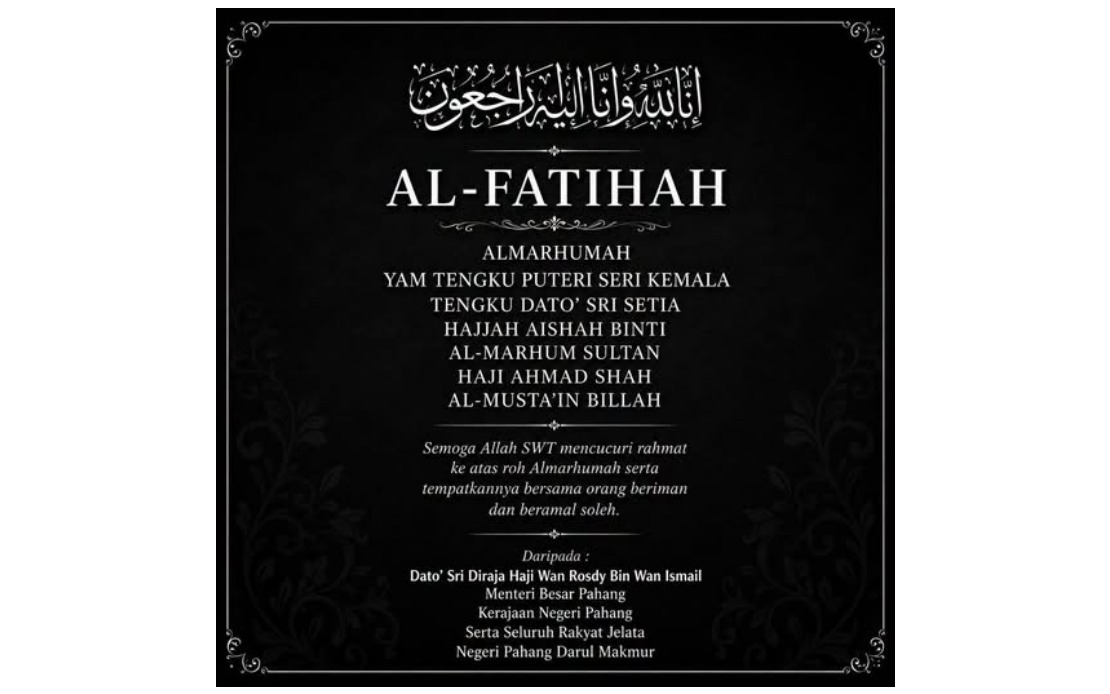
The Pahang State Government has formally expressed its sympathies following the death of Tengku Puteri Seri Kemala Tengku Datuk Seri Aishah Almarhum Sultan Ahmad Shah, who passed away on Tuesday evening at a Kuala Lumpur hospital. Menteri Besar Datuk Seri Wan Rosdy Wan Ismail released a statement acknowledging the significant loss to the state's ruling family and the broader Pahang community.
Tengku Puteri Seri Kemala, the elder sister of the reigning Sultan of Pahang Al-Sultan Abdullah Ri'ayatuddin Al-Mustafa Billah Shah, died at 9.15 pm, marking the end of a life deeply connected to the state's governance and royal affairs. Her passing represents a notable moment in Pahang's contemporary history, as members of the sultanate hold considerable symbolic and ceremonial importance in the state's constitutional framework. The loss of a senior member of the royal household carries weight beyond immediate family circles, touching upon the institutional continuity that defines Malaysia's constitutional monarchy system.
In his public statement, Wan Rosdy articulated the collective grief of the Pahang State Government and the people of the state, emphasising the personal dimensions of the loss for Sultan Abdullah and Tengku Ampuan Pahang Tunku Azizah Aminah Maimunah Iskandariah. The Menteri Besar's formal acknowledgment reflects the protocol-driven nature of state governance, wherein senior political figures are expected to publicly recognise significant moments affecting the royal institution. Such gestures, while ceremonial in nature, reinforce the constitutional bonds between the state government and the sultanate that have undergone considerable evolution in Malaysian politics over recent decades.
The condolence message included traditional Islamic prayers for the deceased, requesting divine mercy for her soul and forgiveness of any transgressions. This spiritual dimension of the formal statement demonstrates how Malaysian political discourse routinely integrates religious observance with matters of state, reflecting the Islamic-constitutional foundations embedded within the nation's governance structures. For readers across Southeast Asia, such practices underscore the unique position of Islam within Malaysia's political and ceremonial frameworks, distinguishing its approach from secular governance models elsewhere in the region.
Arrangements for Tengku Puteri Seri Kemala's funeral proceeded with considerable speed, with interment scheduled at the Pahang Royal Mausoleum in Pekan, the state capital, on the day following her passing. This location holds profound historical significance within Pahang's royal traditions, serving as the burial ground for previous sultans and senior family members. The Pekan mausoleum functions not merely as a cemetery but as a physical repository of royal lineage and continuity, grounding the sultanate's contemporary authority within centuries of dynastic succession and tradition.
The Pahang sultanate represents one of Malaysia's most established royal institutions, with documented histories extending centuries into the pre-colonial period. Tengku Puteri Seri Kemala's position within this lineage connected her to significant moments in both Pahang's specific history and Malaysia's broader constitutional development. The passing of senior royal figures often serves as moments for public reflection upon institutional permanence and generational transitions within systems that many Malaysians regard as foundational to national stability and identity.
For the Sultan Abdullah administration and state government, such losses within the immediate royal family inevitably create periods of ceremonial adjustment and internal reflection. While the day-to-day operations of governance continue uninterrupted, the psychological and institutional significance of losing a senior family member—particularly one with direct connection to the reigning Sultan—carries implications for court dynamics and the broader apparatus of state protocol that surrounds the sultanate. These institutional rhythms, though often invisible to casual observers, structure the functioning of Malaysia's constitutional monarchy in subtle but persistent ways.
Tengku Puteri Seri Kemala's passing also intersects with broader regional conversations surrounding royal succession, institutional modernisation, and the evolving role of traditional monarchies within contemporary Southeast Asian states. Malaysia's sultanate system, while ceremonially prominent, operates within a constitutional framework that has undergone significant refinement since independence. The death of senior royal figures occasionally prompts broader discussions among constitutional scholars and political analysts regarding the sustainability and adaptation of traditional institutions within increasingly urbanised, digitally connected, and demographically changing societies.
The formal nature of Wan Rosdy's condolence statement reflects established protocols governing how state officials publicly acknowledge developments within royal households. These practices, codified through years of constitutional convention and ceremonial practice, ensure that expressions of sympathy follow predictable patterns while maintaining appropriate respect for the affected family. Understanding these protocols provides insight into how Malaysian political culture balances democratic governance with traditional institutions, a tension that defines much of the nation's contemporary political landscape and distinguishes its governance approach from purely secular or purely traditional models elsewhere in Asia.

