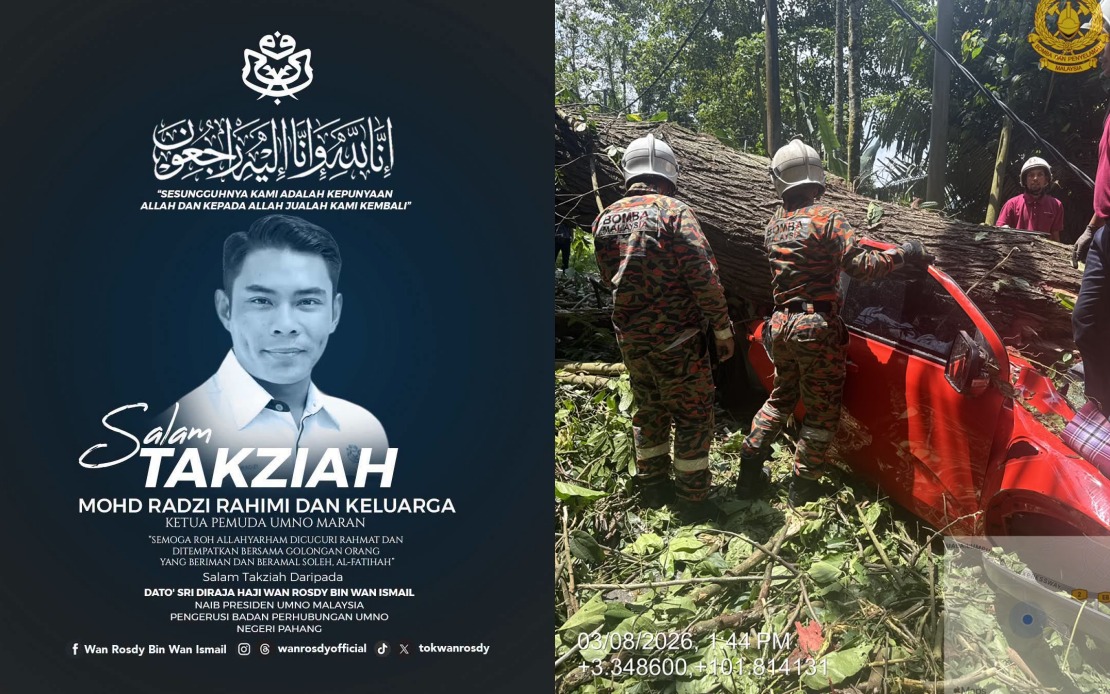
Pahang's political leadership is mourning the loss of Mohd Radzi Rahimi, the Maran UMNO Youth chief widely known as Edy Radzi, who perished in a tragic accident on the old Kuala Lumpur-Bentong road near Janda Baik in Bentong. The incident, which claimed four lives when a tree collapsed onto a four-wheel-drive vehicle, has left the state's UMNO movement reeling from an unexpected blow to one of its rising administrative figures.
Datuk Seri Wan Rosdy Wan Ismail, who serves as both Pahang Menteri Besar and Pahang UMNO Liaison Committee chairman, released a statement characterising Mohd Radzi as a leader whose political philosophy centred on community service and grassroots engagement. In describing the fallen youth organiser, Wan Rosdy emphasised a commitment to putting constituents' needs before personal advancement—a quality he deemed increasingly valuable within party structures attempting to maintain relevance among younger Malaysian voters.
Beyond Mohd Radzi, the collision claimed the lives of Nuriani Mohammad Jafri, her son Muhammad Rizz Hazim, and her younger brother Mohammad Nizam. A child travelling in the vehicle sustained injuries but survived the accident. The tragedy underscores ongoing road safety concerns along recreational routes in Pahang's eastern districts, where tree-fall incidents during unfavourable weather conditions pose persistent risks to motorists.
Wan Rosdy's condolence statement acknowledged ripple effects extending across multiple institutional levels within Pahang's ruling political structure. The loss of Mohd Radzi represents a setback not merely to his immediate family, but to the Maran division's administrative capacity, the state youth wing's leadership pipeline, and the broader provincial UMNO hierarchy. Such mid-level vacancies within party structures can disrupt continuity in local organising efforts and constituent liaison work that form the backbone of grassroots political operations in Malaysian states.
The Menteri Besar extended formal sympathies on behalf of the Pahang UMNO Liaison Committee, invoking religious and cultural frameworks for processing collective grief within Muslim-majority political organisations. His public statements sought to position the incident as a moment demanding patience and spiritual fortitude from bereaved families—language reflecting conventions within Malay-Muslim political discourse when addressing deaths among party members and public figures.
National UMNO Youth leadership also mobilised formal responses to the tragedy. Datuk Dr Muhammad Akmal Saleh, heading the party's youth wing at federal level, offered condolences echoing sentiments expressed by state administrators. His invocation of Islamic prayer formulas—requesting divine forgiveness of the deceased's transgressions and acceptance of virtuous actions—reflects how religious observance integrates into official mourning protocols within Malaysian political structures, particularly in statements addressing UMNO's predominantly Muslim membership base.
The incident highlights vulnerabilities within Malaysia's transportation infrastructure, particularly along older road networks serving recreational areas. The Bentong corridor, connecting Selangor's suburban zones to Pahang's hill stations, experiences steady traffic from weekend leisure travellers and holiday commuters. Environmental hazards including unstable tree growth and weather-related debris present ongoing management challenges for highway authorities, yet comprehensive prevention strategies remain inconsistently implemented across regional networks.
Mohd Radzi's profile as a youth-focused administrator carries particular significance given UMNO's ongoing efforts to rejuvenate its appeal among under-40 voters. The party's traditional dominance has faced sustained erosion from generational shifts in voting behaviour, particularly in urban constituencies and among Malay-Muslim professionals seeking alternative political vehicles. Youth leaders demonstrating community-oriented approaches and modern administrative sensibilities represent valuable institutional assets for parties attempting organisational renewal.
The accident underscores the unpredictability of daily risks facing Malaysian citizens, cutting across socioeconomic and institutional boundaries. While Mohd Radzi occupied a position of moderate administrative prominence within state structures, his death alongside three ordinary citizens—including a child—illustrates how sudden environmental hazards spare no demographic category. This democratic quality of tragedy often galvanises temporary discussions regarding infrastructure maintenance and environmental safety protocols, though sustained policy momentum frequently dissipates following initial media attention cycles.
Pahang's UMNO apparatus now faces questions regarding succession planning within its youth division and broader administrative arrangements. Smooth transitions in mid-level leadership positions prove essential for maintaining party cohesion and preventing capability gaps that adversaries might exploit. The state's political environment, dominated by UMNO and its Barisan Nasional alliance but facing periodic challenges from Perikatan Nasional coalitions, demands consistent institutional functioning to retain electoral advantages and constituency management capacity.
The tragedy reverberates within broader national conversations regarding transportation safety, environmental hazard management, and the human costs of infrastructure inadequacy. While individual incidents attract temporary political attention, systematic improvements require sustained budgetary allocation and inter-agency coordination that political cycles often interrupt. Pahang's experience reflects challenges confronting Malaysian states attempting to balance economic development imperatives with protective infrastructure investments.

