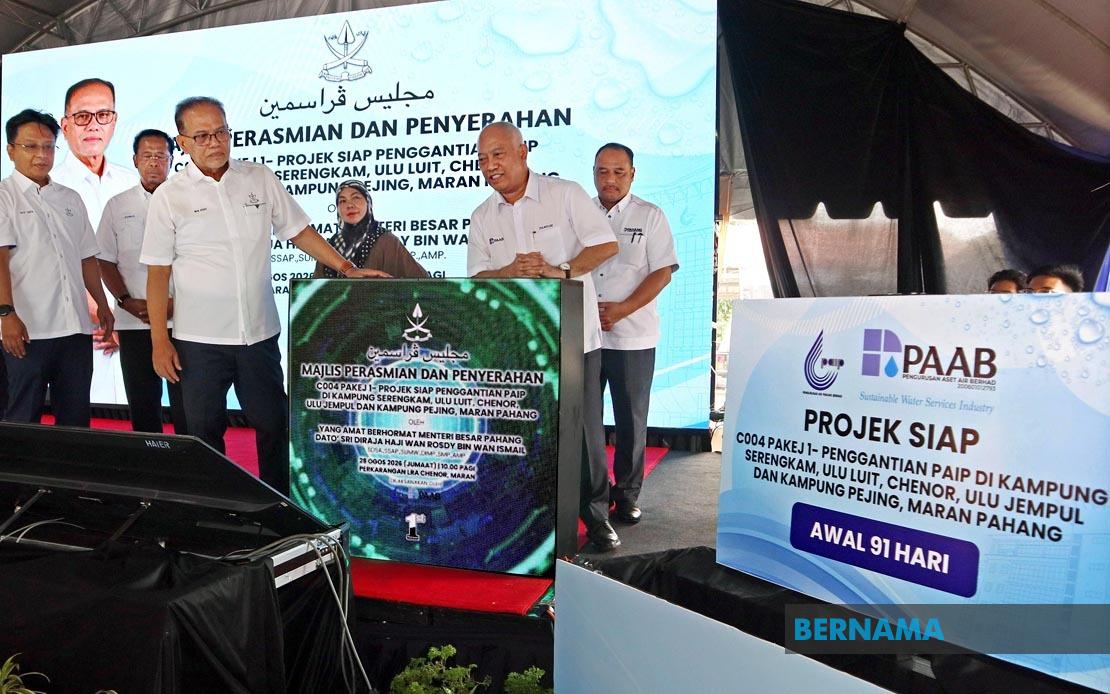
The Pahang government is committing to a methodical approach in resolving the recurring problem of shallow waters in Sungai Pahang, with particular attention to settlements including Kampung Pesagi in Maran district. Menteri Besar Datuk Seri Wan Rosdy Wan Ismail outlined the state's determination to address the issue through a phased strategy, though he emphasised that any intervention must rest on solid technical groundwork rather than hasty decision-making.
The administration is currently awaiting comprehensive documentation from responsible agencies detailing the river's current state across affected zones. This information-gathering phase represents a deliberate effort to establish baseline conditions before outlining specific remedial pathways. The Menteri Besar stressed that understanding the precise nature and extent of the shallowing problem across different stretches of the waterway will determine which solutions prove most viable in practice.
Wan Rosdy indicated he would present the collated findings to the state executive council for thorough examination and refinement. This bureaucratic step, rather than unnecessary delay, reflects the government's view that coordinated decision-making at the highest state level ensures consistency and resource allocation across initiatives. The process acknowledges that addressing river conditions requires alignment between multiple departments and potential stakeholders before implementation begins.
The shallow-water predicament carries economic ramifications extending beyond environmental concerns. Communities residing along Sungai Pahang depend on the waterway for livelihood activities, transportation, and resource access, meaning the shallowing directly undermines their economic security and daily operations. The Menteri Besar's emphasis on considering short-term, medium-term, and long-term responses suggests recognition that this is not a single-fix problem but rather one requiring layered interventions at different timeframes.
Parallel to addressing the river issue, Pahang is advancing infrastructure modernisation that could indirectly support regional development and potentially attract investment toward sustainable solutions. The state government has prioritised water supply improvements, with four districts already achieving resolution rates exceeding ninety percent. Maran district is anticipated to reach similar success levels imminently, reflecting progress on basic service delivery that complements larger environmental strategies.
Energy infrastructure expansion is also reshaping Pahang's development profile. Tenaga Nasional Berhad's planned construction of a 500kV Transmission Main Intake Substation in Kampung Awah represents a substantial investment of approximately RM350 million, scheduled for completion by 2030. This facility will anchor a stronger electrical network linking strategically positioned nodes across the East Coast region, establishing grid resilience for future power demands.
The transmission infrastructure project directly benefits Pahang's economic positioning by enhancing the state's appeal to prospective investors who require dependable energy supply. A more robust power system reduces operational uncertainty for manufacturing and technology sectors, potentially catalysing job creation and widening the tax base. For Malaysian policymakers monitoring regional development, Pahang's integrated approach—combining river management with energy and water infrastructure—demonstrates how diverse sector improvements can compound into comprehensive state transformation.
The Menteri Besar framed infrastructure development as foundational to prosperity generation and quality-of-life improvements. This perspective aligns with national economic thinking that prioritises basic services before higher-value economic activities can flourish. When communities enjoy reliable water, electricity, and functioning transport corridors, they become more productive and attract commercial interest.
The Sungai Pahang situation also reflects broader Southeast Asian challenges with river management in increasingly urbanised and industrialised basins. Malaysia's experiences—both successes and ongoing difficulties—provide learning opportunities for neighbouring countries grappling with similar waterway degradation driven by upstream development, sedimentation, and changing precipitation patterns. Regional cooperation on watershed management and shared best practices could enhance environmental outcomes across borders.
For Malaysian stakeholders, Pahang's measured approach offers a template: establishing factual baselines through technical assessment before designing interventions, coordinating responses across government levels, and integrating environmental action with economic development priorities. The state's willingness to invest substantially in infrastructure while addressing existing environmental deficits suggests confidence in combined growth and sustainability strategies.
The timing of these announcements reflects Pahang's positioning amid national development cycles and budget allocation periods. As states compete for investment and recognition, demonstrating active engagement with resident concerns—whether water depth or energy provision—reinforces administrative credibility. The Menteri Besar's public acknowledgment of the Sungai Pahang issue and transparent commitment to solutions serves both governance and political functions.
Moving forward, the state's focus will sharpen once the technical report arrives, triggering executive council deliberations and potential resource commitment. Whether solutions involve dredging, flow management, upstream interventions, or integrated watershed approaches will depend largely on findings about causation and feasibility. What remains clear is that Pahang recognises addressing environmental assets like Sungai Pahang as inseparable from broader development and resident welfare objectives.

