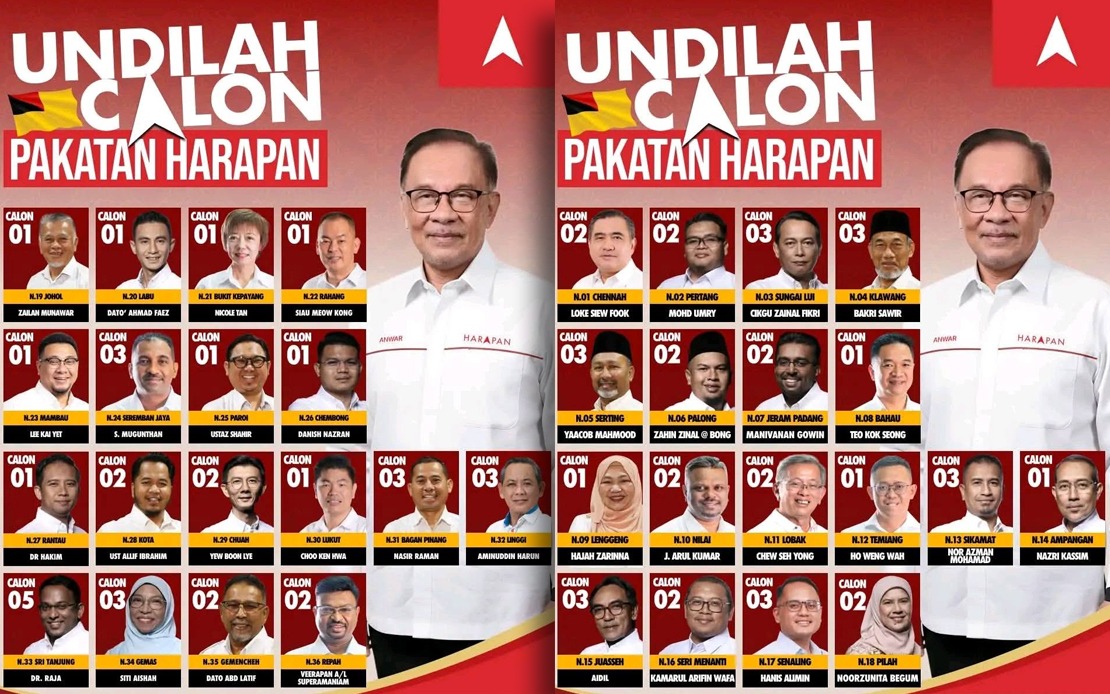
Pakatan Harapan is pursuing an ambitious mandate in the Negeri Sembilan state election scheduled for August 1, targeting a minimum of 23 seats from the 36-seat assembly to establish what coalition leaders describe as a genuinely stable governing platform. Deputy chairman Anthony Loke, who also serves as DAP secretary-general, articulated this strategy during a party gathering in Seremban on July 19, emphasizing that whilst 19 seats would technically deliver a simple majority, such a narrow margin invites unnecessary political vulnerability and administrative fragility.
The mathematics underlying PH's strategy reveals important calculations about electoral sustainability. The coalition currently holds 17 assembly seats, leaving them four seats short of a simple majority. By targeting 23 seats, PH would accumulate a buffer of four seats beyond the bare minimum, providing insulation against potential defections, unexpected absences, or shifts in political circumstances that could otherwise jeopardize their hold on government. This strategic cushion reflects lessons learned from previous state administrations across Malaysia where narrow majorities have proven politically unstable, occasionally collapsing under pressure or requiring constant negotiation to maintain legislative support.
Loke grounded the 23-seat target in empirical analysis rather than mere aspiration, referencing demographic studies and voter behaviour research across the state's constituencies. Such data-driven targeting suggests PH conducted granular constituency-level assessments identifying specific seats deemed winnable based on voting patterns, demographic composition, and local issues. This methodological approach stands in contrast to more generalized campaign messaging, indicating the coalition's confidence in understanding which geographic areas and voter populations represent realistic opportunities for electoral gains.
The coalition's broader political narrative centres on continuity under Menteri Besar Datuk Seri Aminuddin Harun, whom Loke characterized as an ethical administrator with a humble leadership style untainted by corruption or abuse of office. This personalization of the campaign around a specific leader serves multiple purposes: it provides voters with a clear, identifiable face for governance; it offers an implicit contrast to opposition alternatives; and it emphasizes the risks to ongoing projects and administrative momentum should leadership change. By framing the election as a referendum on maintaining proven competence rather than pursuing wholesale political change, PH seeks to convert administrative incumbency into electoral advantage.
Crucially, Loke articulated PH's governing philosophy as explicitly multiracial and inclusive, emphasizing commitment to serving all Negeri Sembilan residents irrespective of ethnic or religious background. This rhetorical positioning carries particular weight in a state like Negeri Sembilan, which possesses significant Malay-Muslim majorities in certain constituencies alongside substantive Chinese and Indian communities in urban and commercial centres. By stressing inclusive governance and cross-community representation, PH attempts to position itself as capable of bridging demographic divisions rather than pursuing narrow communal interests, a positioning that could prove decisive in swing constituencies with mixed populations.
Integration with federal political narratives formed another dimension of Loke's messaging, as he directed attention toward Prime Minister Datuk Seri Anwar Ibrahim's international diplomatic initiatives. According to Loke, Malaysia's strengthened relationships with major powers including China, the United States, India, Türkiye, Brazil and Russia have yielded tangible economic and strategic benefits, including stable energy supplies and expanded trade opportunities. This upward linkage from state-level elections to national governance performance serves to remind voters that state administrations operate within broader federal contexts; state-level voting choices thus indirectly reflect on satisfaction or dissatisfaction with national leadership.
The energy security argument carries particular resonance for Malaysian voters, who remain acutely conscious of global fuel market volatility following international disruptions and shortages experienced by other nations. By attributing Malaysia's relative insulation from such crises to diplomatic competence and relationship management, Loke frames international relations as directly affecting daily living standards and economic stability. This connection between abstract foreign policy and concrete household concerns—fuel availability, energy costs, economic continuity—potentially increases the salience of national leadership performance in voters' electoral calculus.
For Negeri Sembilan specifically, the election assumes significance beyond the state's inherent importance. The state's geographic proximity to the Klang Valley and its role as a commuter region mean that connectivity improvements between Seremban and Kuala Lumpur carry direct implications for thousands of voters' daily lives. Loke's emphasis on development continuity under stable governance resonates with these practical concerns: infrastructure projects, road improvements, public transportation enhancements, and urban planning initiatives require sustained political focus across multiple electoral cycles to reach completion and maturation.
The timing of the election, held between federal parliamentary sessions and ahead of anticipated federal developments, positions the Negeri Sembilan contest as a potential bellwether for broader coalition health. Electoral success or underperformance could significantly influence perceptions of PH's political momentum and public support, reverberating through calculations in other states potentially facing their own electoral transitions. A decisive PH victory meeting or exceeding the 23-seat target would validate Anwar Ibrahim's leadership and his coalition's ability to build substantive electoral mandates; conversely, falling short would invite questions about government popularity and coalition cohesion.
The opposition's response and alternative vision remain subjects for consideration as the campaign intensifies over the following weeks. How Perikatan Nasional or other opposition alliances position themselves in response to PH's multiracial inclusivity messaging, administrative performance record, and international relations arguments will substantially shape the electoral contest's trajectory. Competition over which coalition better represents Negeri Sembilan's diverse interests, can deliver stable governance, and aligns with broader national political directions will ultimately determine whether PH achieves its stated 23-seat objective or faces disappointment.

