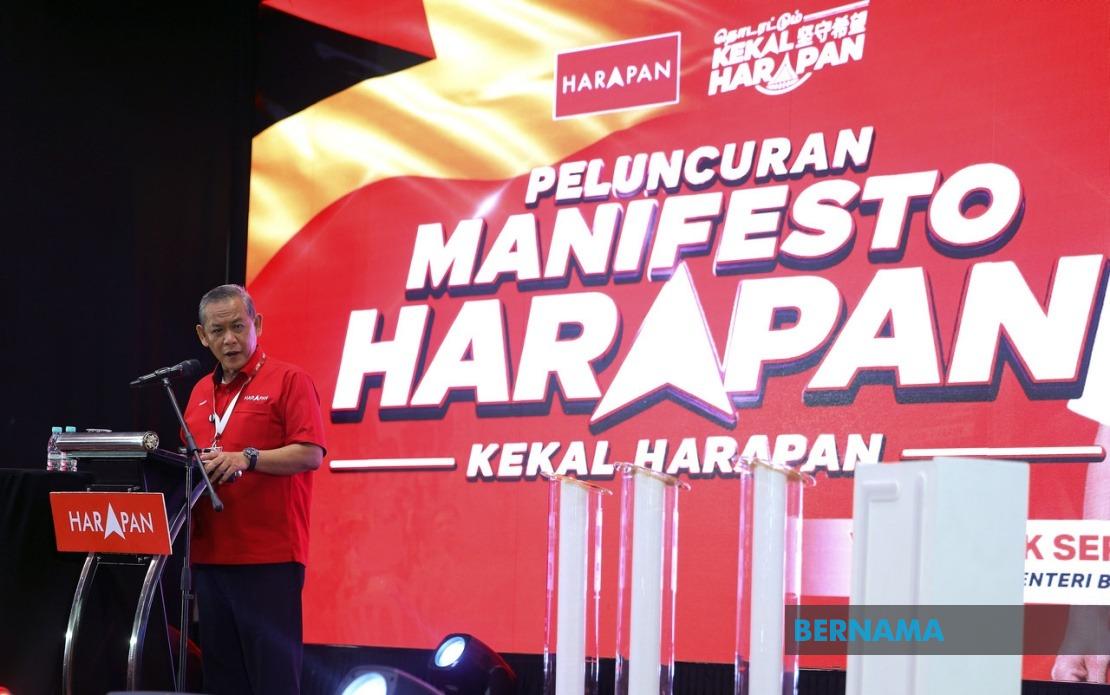
Pakatan Harapan has set out an ambitious electoral roadmap for the 16th Negeri Sembilan state election, placing governance reform and economic opportunity at the heart of its campaign. Launched by Menteri Besar Datuk Seri Aminuddin Harun in Seremban, the manifesto carries the thematic banner 'Negeri Sembilan Kekal Harapan', signalling the coalition's intention to maintain its incumbent hold over the state through a comprehensive platform addressing diverse voter concerns.
The coalition's 10-point platform represents a deliberate attempt to address multiple constituencies simultaneously. Beyond traditional pledges of clean governance and stability, the manifesto specifically emphasises employment generation as an economic driver, committing to create 30,000 high-income job opportunities. This employment focus reflects broader regional anxieties about youth unemployment and wage stagnation across Malaysia, particularly acute in smaller states where economic diversification remains limited. For Negeri Sembilan voters, the figure signals PH's recognition that political loyalty increasingly hinges on tangible economic prospects rather than ideological alignment alone.
Housing affordability emerges as another cornerstone commitment, with the manifesto pledging 20,000 affordable homes and concurrent resolution of land-related disputes. This dual approach acknowledges that housing accessibility remains a critical flashpoint in Malaysian politics, especially among younger voters and growing urban populations. By coupling new construction with title resolution, PH appears cognisant that housing policy extends beyond mere unit provision to encompass the legal and regulatory frameworks that have historically frustrated purchasers. The commitment also hints at potential land management reforms, an increasingly sensitive matter in Negeri Sembilan where agricultural holdings and customary claims intersect with urbanisation pressures.
The enhancement and strengthening of the 'Skim Sejahtera Rakyat' demonstrates PH's reliance on welfare-oriented messaging to consolidate support among lower-income segments. The welfare scheme represents a direct conduit to voters prioritising material security, and PH's emphasis on this programme suggests the coalition intends to defend its social spending record while countering opposition claims of fiscal mismanagement. Within the context of Malaysia's broader political economy, this commitment reflects deeper competition between coalitions to position themselves as guardians of welfare provision against market-driven alternative visions.
Education features prominently in the manifesto, with the pledge to ensure quality education for all addressing anxieties about declining school standards and the perceived erosion of meritocratic advancement. This commitment resonates particularly with middle-class voters who view education as essential to intergenerational mobility and national competitiveness. For Negeri Sembilan specifically, where secondary and tertiary institutions have traditionally drawn students from surrounding states, framing education as a priority stake stakes PH's claim to governing in the interest of families' long-term prospects rather than immediate material distribution alone.
The manifesto's tourism and cultural heritage sector development planks reflect efforts to position Negeri Sembilan as an economic node within Malaysia's regional tourism network. By committing to develop these sectors, PH signalises recognition that state economic sustainability increasingly depends on diversification beyond traditional resource extraction and manufacturing. The cultural heritage dimension particularly addresses concerns among community leaders about preservation amid rapid commercialisation, framing tourism development as compatible with cultural stewardship rather than purely extractive.
Agriculture modernisation and food security commitments acknowledge Negeri Sembilan's agrarian constituencies while projecting PH as economically forward-thinking. Rather than defending traditional smallholder farming as a lifestyle choice, the manifesto frames agricultural evolution as essential to national food sovereignty and farmer income security. This framing attempts to unite progressive agricultural stakeholders with voters concerned about rural economic viability, suggesting technological adoption rather than subsidy dependency as the pathway forward.
Infrastructure investment and healthcare provision round out the programme, establishing foundational state capacity. These commitments, while relatively standard electoral fare, nonetheless signal PH's continued commitment to improving service delivery quality as distinct from opposition posturing around austerity or alternative governance models. Healthcare in particular carries political salience given COVID-19's residual impact on public health perceptions and ongoing concerns about rural medical accessibility.
The manifesto's youth, women, and family empowerment strand indicates PH's strategic recognition that electoral mathematics increasingly favour mobilisation around demographic identity and lifecycle stage beyond traditional class or ethnic categorisation. By isolating these constituencies for special commitment, the coalition implicitly concedes that generic economic growth messaging alone proves insufficient to consolidate support among voters experiencing distinct constraints—childcare costs, workplace discrimination, or limited entrepreneurial pathways—requiring targeted policy responses.
Yet the manifesto's apparent comprehensiveness simultaneously raises sustainability questions. The cumulative financial commitment embedded within these 10 pledges—job creation subsidies, housing programmes, welfare expansion, infrastructure outlays—demands revenue streams and fiscal discipline that have historically challenged Malaysian state governments. PH's ability to translate manifesto language into implemented policy will substantially determine whether the Negeri Sembilan electorate perceives the coalition as delivering material improvement or engaged in recurring rhetorical circularity.
The timing and presentation of this manifesto within broader Malaysian political dynamics carries significance extending beyond Negeri Sembilan's borders. As a state election preceding potentially significant national political shifts, voter response to PH's programme and alternative coalition offers will provide early indicators of coalition strength and vulnerability in preparation for future federal competition. Negeri Sembilan's electoral outcome thus acquires importance as a leading indicator of national political sentiment regarding coalition performance, governance quality, and economic management—factors likely to dominate calculations in subsequent electoral contests.

