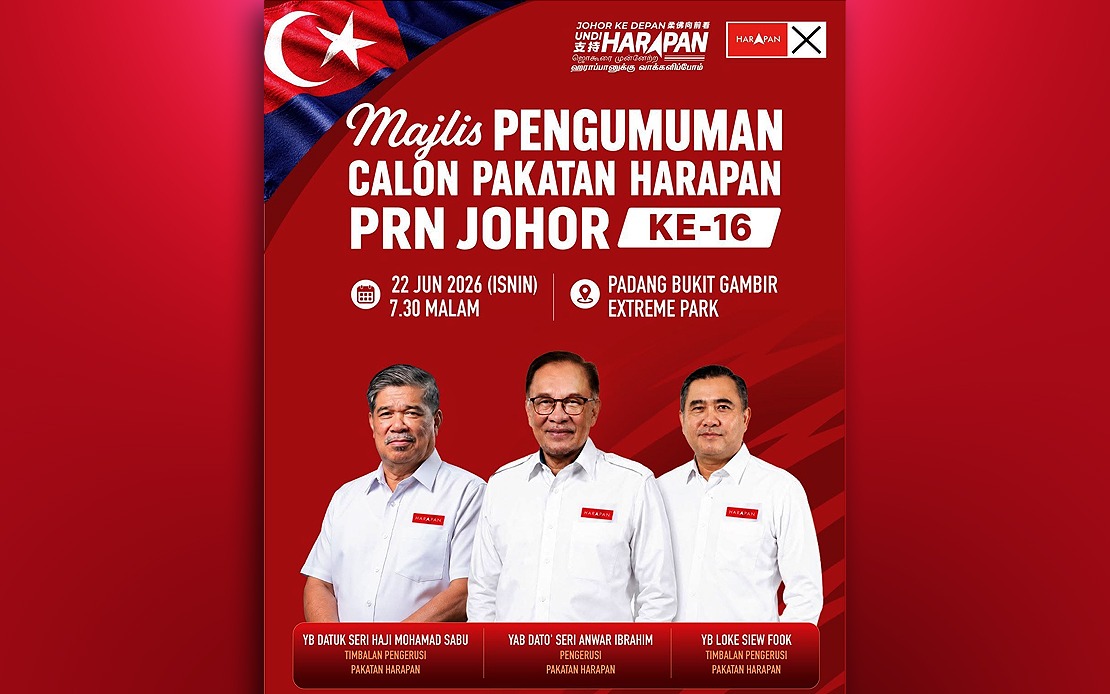
Pakatan Harapan plans to release its election manifesto for the Johor state contest within days of the nomination period concluding this Saturday, according to PKR vice president Datuk Seri Amirudin Shari. Speaking at a candidate announcement event in Tangkak, Amirudin indicated that the coalition would not delay in presenting its policy platform to voters ahead of the July 11 polling day. The manifesto, branded "Johor Ke Depan", will function as a detailed roadmap for developing the state should the opposition coalition secure the electoral mandate required to form government.
The policy framework being prepared by PH's manifesto team is positioned as a document of proven delivery rather than mere aspiration. Drawing explicitly from the coalition's administrative experience in Selangor, Penang and Negeri Sembilan, the manifesto aims to demonstrate that PH's proposals are rooted in tangible achievements spanning multiple state governments. This strategy reflects the opposition's confidence that its track record in managing different Malaysian states provides credible evidence of competence and ability to implement promises. For PH, the manifesto becomes less a campaign pledge and more a continuation of governance models already tested and refined across diverse regional contexts.
The timing of the manifesto release reflects strategic campaign choreography. With the Election Commission having scheduled June 27 as nomination day, PH's decision to unveil its manifesto shortly thereafter creates a media moment distinct from the initial candidate announcement phase. This separation allows the coalition to build distinct campaign narratives: first introducing candidates and party leadership, then following with detailed policy substance. Such sequencing gives voters distinct phases through which to evaluate the opposition's readiness for office, beginning with personnel and culminating with programmatic vision.
The Johor election represents a significant contest in the Malaysian political calendar, carrying implications beyond the state itself. As the second-largest state economy and a crucial electoral battleground, Johor's outcome will shape the trajectory of national politics heading toward the next general election. For PH, success here would strengthen its federal opposition credentials and demonstrate renewed competitiveness in a state long dominated by Barisan Nasional. The manifesto thus serves not only local voters but also sends signals to the broader Malaysian electorate about PH's readiness to govern at the highest level.
Amirudin's comments reflect broader PH positioning that challenges the notion of untested opposition promises. Rather than presenting new theories of governance, the coalition emphasises continuity of models proven effective elsewhere. This rhetorical approach mirrors how PH has sought to distinguish itself from Perikatan Nasional and other rivals—by claiming accumulated experience managing diverse state administrations with competing interests and complex populations. The manifesto becomes evidence of this comparative advantage in the governance marketplace.
The electoral calendar provides compressed timeframes for campaign messaging. With early voting scheduled for July 7 and polling day on July 11, the roughly two-week window between nomination and balloting requires efficient communication of policy positions. PH's manifesto becomes a central tool for condensing complex governance philosophy into accessible voter messaging. The coalition faces the challenge of explaining how Selangor's development model, shaped by specific urban and industrial characteristics, might transfer to Johor's distinct economic and demographic realities. The manifesto must address this translation challenge while maintaining thematic coherence.
The presence of top PH leadership at the candidate announcement—including coalition chairman Datuk Seri Anwar Ibrahim, DAP secretary-general Anthony Loke, and Amanah president Datuk Seri Mohamad Sabu—underscores the election's significance within PH's strategic priorities. Such high-level mobilisation indicates that the coalition views Johor as central to its political calculations, justifying investment of leadership attention and institutional resources. The manifesto's development involves similarly senior figures, suggesting that policy priorities reflect deliberation at the coalition's strategic apex rather than routine electoral activity.
For Malaysian voters, particularly those in Johor, the manifesto's emphasis on PH's administrative track record invites comparison shopping between different governance models. The coalition's strategy essentially posits that voters should evaluate options not through ideological frameworks alone but by examining what different political forces have actually accomplished where they hold office. This empiricist approach attempts to shift campaign discourse toward measurable governance outcomes—development spending, infrastructure projects, service delivery metrics—rather than personality-driven or identity-based politics. Whether such framing resonates depends partly on public perception of PH's actual record in states where it currently governs.
The manifesto's branding as "Johor Ke Depan"—Johor Forward—carries implicit messaging about momentum and progress. Such framing positions the coalition as oriented toward future development rather than restoration of past arrangements or preservation of existing power structures. For PH, which governs from opposition to the Johor establishment and the state's historical alignment with Barisan, the forward-looking brand subtly challenges incumbent assumptions about Johor's political destiny. The language choice reflects careful consideration of how PH wishes voters to psychologically frame the electoral choice.
For Southeast Asian observers of Malaysian politics, Johor's election illuminates broader patterns of coalition politics and opposition strategy in the region. PH's emphasis on comparative governance experience reflects how regional oppositions increasingly compete not on ideological grounds alone but by offering alternative administrative competence. As opposition coalitions across Southeast Asia seek to dislodge incumbent governments, the question of whether they can credibly demonstrate superior governance capacity becomes central to electoral viability. PH's Johor manifesto thus becomes a case study in how regional opposition movements attempt to overcome scepticism about their ability to manage state institutions effectively.
The Election Commission's three-phase calendar—nomination, early voting, and polling—structures how campaign intensity will escalate. The manifesto's release in the immediate post-nomination phase positions it at the campaign's opening salvo, offering the framework through which voters will interpret subsequent PH messaging and candidate rhetoric throughout the condensed campaign period. This early policy positioning allows time for public reaction, media analysis, and comparative evaluation before voting begins. For PH strategists, the manifesto represents an opportunity to capture initial campaign narrative momentum during the window when voter attention is highest.