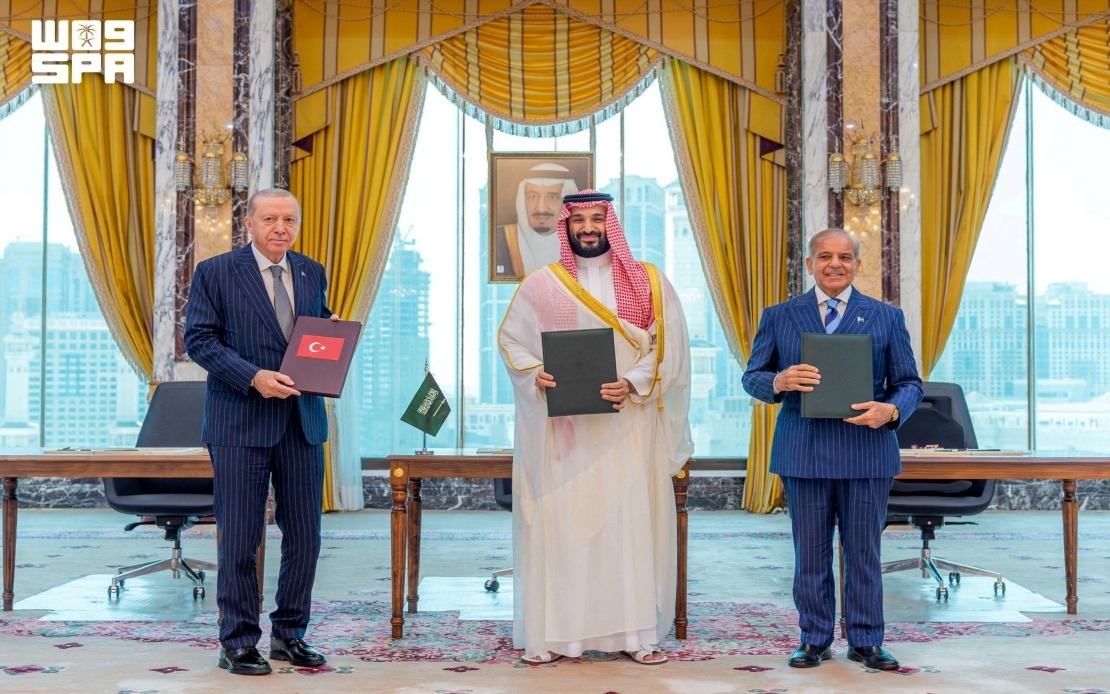
Three major Muslim-majority powers have formalised a sweeping defence alliance in a move that reshapes the security architecture of the Middle East and South Asia. Pakistan Prime Minister Shehbaz Sharif, Saudi Crown Prince Mohammed bin Salman bin Abdulaziz Al Saud, and Turkish President Recep Tayyip Erdogan signed the Joint Defence Agreement at Al Safa Palace in Makkah following their trilateral summit on Friday, establishing binding commitments to treat military aggression against any signatory as an attack on all three nations.
The agreement represents a significant elevation of security ties among countries that have long maintained bilateral partnerships but now seek to institutionalise coordinated defence mechanisms. By inserting a mutual defence clause into the arrangement, the three signatories have created a framework that mirrors traditional military alliances seen in other regions, fundamentally altering the calculus of deterrence in their respective strategic domains. The pact formalises what has been an increasingly convergent security posture among Islamabad, Riyadh, and Ankara as they navigate overlapping security challenges and geopolitical competition.
Under the new arrangement, both the scope and intensity of defence cooperation are expected to expand substantially. The agreement explicitly commits the three states to developing joint defence capabilities, strengthening strategic deterrence mechanisms, and enhancing operational readiness across their respective armed forces. This collaborative approach suggests plans for coordinated military training, shared intelligence arrangements, and potentially joint procurement initiatives that could yield significant cost savings and operational efficiencies. The emphasis on integrating defence capabilities indicates intention to move beyond symbolic gestures toward tangible military interoperability.
Pakistan brings substantial military weight to the partnership as one of only nine nuclear-armed nations globally, commanding significant conventional forces across air, land, and naval domains. The country's geographical positioning spanning South Asia and the Indian Ocean region, combined with its geostrategic importance along key shipping lanes, enhances the alliance's reach. Pakistan's long-standing security relationship with Saudi Arabia, reinforced through years of military cooperation and personnel deployments, provides an established foundation upon which this formalised arrangement can be built more rapidly than would be possible among entirely unfamiliar partners.
Saudi Arabia's participation anchors the pact within the Gulf region and Middle East broadly, where Riyadh maintains dominant regional influence and leads the Gulf Cooperation Council. The kingdom's advanced military infrastructure, substantial defence procurement budgets, and strategic relationships across the region give the alliance significant soft power and diplomatic leverage. Saudi Arabia's role as a custodian of Islam's holiest sites and its position as a leading oil producer further amplifies the symbolic and practical significance of formalising this trilateral commitment at the Makkah summit venue.
Türkiye's inclusion reflects its growing profile as a regional power with demonstrated military capabilities, particularly in drone and conventional warfare technologies. The country's NATO membership, control over the strategically crucial Bosphorus Strait, and substantial influence in the Eastern Mediterranean, Middle East, and Central Asia bring unique advantages to the partnership. Turkish defence capabilities and indigenous weapons development programmes complement Pakistani and Saudi strengths, creating a more comprehensive collective deterrent against potential adversaries.
Official statements from Saudi Arabia's deputy public diplomacy minister, Rayed Krimly, emphasised that the agreement represents a defensive posture rather than provocative escalation. This careful messaging indicates awareness among the three nations that such alliances can be perceived as threatening by neighbouring countries or rival powers. The clarification that the pact neither menaces regional security nor escalates existing tensions reflects concern about adverse reactions from Iran, India, or other strategic competitors who might view the alliance as hostile to their interests.
The timing of this formalised agreement builds upon earlier bilateral arrangements between pairs of these countries. Pakistan and Saudi Arabia previously signed their own defence agreement in September of last year, establishing mutual defence obligations in response to external aggression. That pact provided the foundation upon which this broader trilateral framework now rests, suggesting a deliberate progression from bilateral to multilateral security architecture rather than an abrupt shift in alignment.
For Malaysia and other Southeast Asian nations, this Middle Eastern and South Asian realignment carries indirect but important implications. Enhanced military cooperation among Pakistan, Saudi Arabia, and Türkiye affects regional power balances that influence broader international affairs, including maritime security in the Indian Ocean region where many Southeast Asian countries maintain critical trade routes and fishing grounds. The demonstrated commitment to collective defence mechanisms demonstrates that security partnerships based on shared religious identity and geopolitical interests remain potent forces in contemporary international relations.
The alliance also reflects broader shifts in how nations structure security relationships outside traditional Western-led frameworks. As countries increasingly pursue partnerships aligned with their civilizational, religious, and strategic interests, the emergence of new security blocs based on Islamic world solidarity becomes more pronounced. This development resonates across Muslim-majority nations throughout Southeast Asia, where questions of identity, alignment, and independent foreign policy remain central to ongoing political debates.
From a regional stability perspective, the formalisation of this trilateral defence arrangement introduces new variables into calculations affecting Middle Eastern security dynamics. The presence of Pakistan's nuclear arsenal as part of a collective defence framework raises questions about escalation thresholds and crisis management procedures that will require careful diplomatic attention. The success of this alliance will depend significantly on whether the three nations can establish robust communication mechanisms and confidence-building measures to prevent miscalculation during periods of heightened tension.
Looking forward, observers will monitor whether this agreement translates into concrete military exercises, joint procurement arrangements, or expanded personnel exchanges. The strength of any alliance ultimately depends on demonstrated commitment through resource allocation and operational planning. Whether Pakistan, Saudi Arabia, and Türkiye invest substantially in making this defence pact operational or whether it remains largely symbolic will determine its true strategic significance for regional security architecture in coming years.

