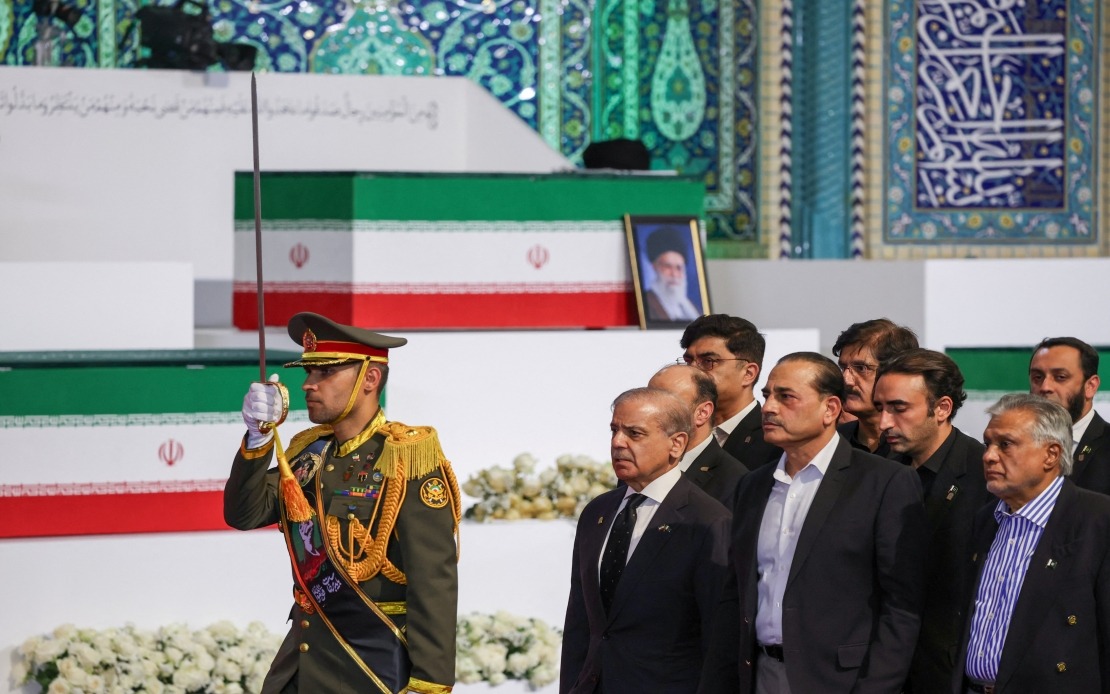
Pakistan's decision to send one of the world's most senior delegations to the funeral of Iran's Supreme Leader Ayatollah Ali Khamenei has earned fulsome commendation from Tehran, reinforcing the strategic partnership between the two Muslim-majority nations as they navigate competing regional interests and security challenges. Prime Minister Shehbaz Sharif headed the Pakistani contingent to the solemn ceremony in the Iranian capital on Friday, a symbolic gesture that reflected Islamabad's commitment to maintaining robust diplomatic relations with its western neighbour despite persistent border tensions and occasional military skirmishes.
The composition of Pakistan's delegation underscored the gravity with which Islamabad treated the occasion. Deputy Prime Minister and Foreign Minister Ishaq Dar, Chief of Army Staff Field Marshal Syed Asim Munir, and Pakistan People's Party chairman Bilawal Bhutto Zardari travelled alongside National Assembly Speaker Sardar Ayaz Sadiq, Interior Minister Mohsin Naqvi, and Information Minister Attaullah Tarar. This concentration of civilian and military leadership at a foreign state funeral was extraordinarily rare, signalling that Pakistan viewed the event as an opportunity to reaffirm its alignment with Iran's regional vision while preserving its own strategic autonomy.
Iranian Ambassador to Islamabad Reza Amiri Moghadam publicly acknowledged Pakistan's prominence among the mourners, declaring that the delegation was not only the largest from any single country but also represented the "highest possible level" of participation. In a statement posted on social media, he stressed that the visible turnout reflected the "enduring friendship, mutual respect, and fraternal bonds between our two brotherly nations." Such official recognition carried weight in Tehran's diplomatic circles, where ceremonial presence at state funerals often serves as a barometer of bilateral commitment and shared strategic vision.
Khamenei's death on 28 February, which Iran attributed to a United States-Israeli attack on his compound in Tehran, sent shockwaves through the region and triggered an immediate recalibration of diplomatic engagement across Asia and beyond. Approximately 100 countries dispatched representatives to the funeral proceedings, reflecting the geopolitical significance of Iran's Supreme Leader and the international dimensions of Middle Eastern power dynamics. Malaysia, Bangladesh, Saudi Arabia, Türkiye, Qatar, Oman, Egypt, Russia, Iraq, China, and India were among the nations represented, illustrating the broad coalition of state actors keen to maintain working relationships with post-Khamenei Iran.
For Pakistan specifically, the delegation's prominence served multiple strategic purposes. Islamabad has long sought to position itself as a bridge between competing regional powers, particularly given its historical relationships with both Iran and Saudi Arabia, as well as its alliance structures with the United States. By sending such a high-profile contingent to Khamenei's funeral, Pakistan signalled that it would not allow Great Power rivalries or Middle Eastern proxy conflicts to diminish its bilateral engagement with Iran. The presence of military leadership, notably Chief of Army Staff Field Marshal Syed Asim Munir, conveyed particular significance, as it demonstrated that Pakistan's institutional defence establishment viewed the funeral as an occasion worthy of senior military representation.
Prime Minister Shehbaz Sharif paid personal homage to the deceased leader, characterising Khamenei's tenure as Supreme Leader—a position he held from 1989 until his death at age 86—as having left an indelible mark on Iran's trajectory and regional influence. Sharif stated that Khamenei's "wisdom, leadership and profound influence on Iran and the wider region will be remembered for generations," language that avoided overt political endorsement whilst acknowledging the late leader's historical prominence. Such measured rhetoric allowed Pakistan to participate meaningfully in the funeral without appearing to champion Iran's ideological positions or align itself with Tehran in ways that might complicate its relations with other strategic partners.
The timing of Iran's public funeral ceremonies, which commenced on Saturday with burial scheduled for 9 July in Mashhad, Khamenei's birthplace, provided an extended window for international delegations to arrive and participate. This timeline allowed Pakistan to organise its high-level attendance without creating logistical complications, whilst also ensuring that the funeral proceedings received maximum global media coverage. The deliberate scheduling also reflected Iran's desire to make the funeral a statement of national continuity and international engagement, demonstrating that despite the trauma of the attack and Khamenei's loss, the Islamic Republic remained a functioning, respected member of the international community.
For Malaysian readers and Southeast Asian observers, Pakistan's diplomatic posture carries implications for how regional middle powers position themselves amid intensifying geopolitical competition. Pakistan's willingness to invest significant diplomatic capital in honouring Iran's leadership, whilst maintaining its other international relationships, demonstrates a model of strategic flexibility that balances multiple competing interests. Malaysia itself sent a delegation to the funeral, suggesting that countries across Asia, regardless of their varying relationships with Iran, recognised the importance of maintaining formal diplomatic engagement and acknowledging significant transitions in regional power structures.
The broader context involves Pakistan's long-standing challenge of managing its relationships with both Iran and the Gulf monarchies, particularly Saudi Arabia, which maintains a complex and often adversarial relationship with Iran across multiple domains including regional proxy conflicts and sectarian tensions. Pakistan's decision to send such a prominent delegation could be interpreted in Riyadh and other Gulf capitals as a rebalancing of Pakistan's regional diplomacy, though Pakistani officials would likely frame it as consistent engagement with a neighbouring nation rather than a geopolitical realignment. This balancing act remains central to Pakistan's foreign policy and reflects the delicate equilibrium required of nations situated at the intersection of competing regional powers.
Ambassador Moghadam's repeated emphasis on Pakistan's "enduring friendship and brotherhood" with Iran, combined with references to "shared values" and "historic ties," suggested that Tehran views Pakistan as a stable, predictable partner in a volatile region. The official praise for Pakistan's delegation participation may also signal Iranian efforts to consolidate relationships with key neighbouring states during a period of internal transition and potential leadership uncertainty. Pakistan's pragmatic engagement, offering symbolic support without ideological commitments, aligned with Islamabad's broader strategic culture of maintaining relationships across ideological and sectarian divides whilst preserving maximum flexibility in pursuit of its own national interests.

