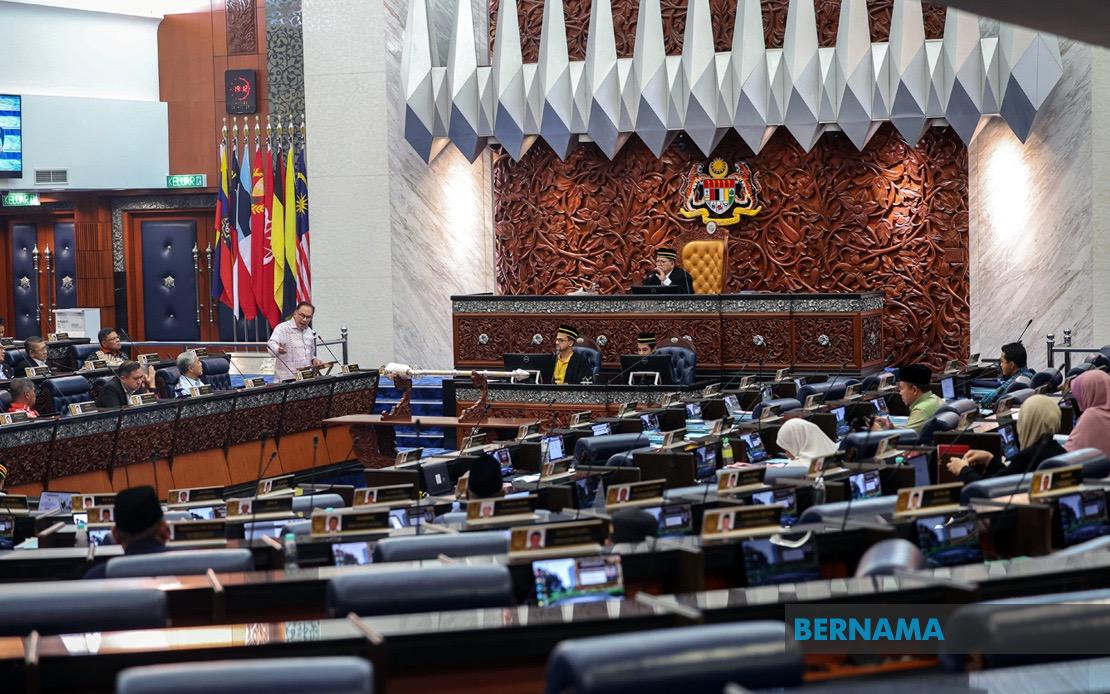
Malaysia's lower house of Parliament has given the go-ahead to redirect RM14.5 billion in remaining proceeds from Malaysian Government Investment Issues (MGII) into the Development Fund. The motion cleared both chambers following parliamentary debate, with Deputy Finance Minister Liew Chin Tong walking through the technical framework that underpins the government's debt management strategy during 2026.
The approval represents a measured step in how federal authorities allocate borrowed funds across competing priorities. Rather than allowing cash from bond sales to sit within government accounts, the legislature authorised channelling this capital into infrastructure and development projects—a practice grounded in Malaysia's constitutional prohibition on borrowing for day-to-day operations. Under the existing legal architecture, the government may only take loans to finance development expenditure; operating costs must come from tax revenue and other ordinary collections. This structural constraint shapes every major fiscal decision and distinguishes Malaysia's approach from nations with more flexible borrowing rules.
Liew elaborated that the Development Fund itself draws from multiple sources beyond the bond proceeds now approved. Regular transfers from the Consolidated Revenue Account, repayments of earlier development loans, and receipts tied to development activities all feed into this pool. The Fund essentially functions as Malaysia's principal investment vehicle for longer-term capital projects, whether roads, bridges, schools, or digital infrastructure. By consolidating these streams, policymakers can match funding sources with project timelines and ensure consistent delivery of public assets across economic cycles.
The broader MGII issuance programme for 2026 is projected to total RM95 billion, underscoring the scale of Malaysia's refinancing needs and development ambitions. Breaking down this figure reveals the competing demands on borrowed money: RM55 billion will refinance MGII bonds coming due, essentially rolling over existing debt rather than adding net new borrowing. A further RM2 billion addresses redemptions of Malaysian Islamic Treasury Bills, short-term shariah-compliant instruments that attract investors seeking ethical financial products. The remaining RM38 billion targets the 2026 fiscal deficit—the gap between what the government collects in revenue and what it spends on operations and development.
Between January and May 2026, MGII gross issuance reached RM40 billion. After setting aside RM25.5 billion to cover MGII refinancing within that period, the net new proceeds available for development work stood at RM14.5 billion. This arithmetic underscores a reality facing treasuries across Southeast Asia: much government borrowing goes simply to roll over old debt, with only a fraction representing genuinely fresh capital for economic growth. For Malaysia, this dynamic reflects both the legacy of past obligations and the fiscal pressures created by demographic shifts and competing spending demands.
Deputy Finance Minister Liew signalled that further parliamentary approval will likely be sought during the next sitting to channel additional MGII issuances from June through December 2026. This staged approach allows legislators to review and debate funding decisions at regular intervals rather than granting blanket approval for the entire year. Such procedural transparency builds confidence among investors that democratic scrutiny accompanies major borrowing, a factor that influences how international markets price Malaysian debt.
Parlimentary members raised a pointed concern about potential crowding-out effects in Malaysia's domestic financial market. The fear is that large government bond issuances might absorb savings that would otherwise flow to private business, starving companies of affordable credit. Specifically, questions centred on whether institutions like the Employees Provident Fund and the Retirement Fund Incorporated (KWAP) would feel compelled to purchase government paper at the expense of higher-returning private investments. Liew countered that the government has been progressively reducing net new borrowing year-on-year, suggesting the crowding-out risk remains manageable.
Moreover, Liew reframed government bond issuance as beneficial to institutional investors rather than merely a burden they must bear. MGII and Malaysian Government Securities provide the EPF, KWAP, and other funds with stable, government-backed instruments crucial for managing long-term liabilities to pensioners and members. Without such domestic investment opportunities, these institutions might redirect capital abroad—potentially weakening demand for Malaysian ringgit and creating currency instability. In this lens, government borrowing and bond issuance become tools for anchoring institutional investment within Malaysia's financial system, sustaining the ringgit's international value in the process.
The approval also reflects a broader Southeast Asian pattern in which governments navigate the tension between fiscal discipline and development needs. Regional peers including Thailand, Indonesia, and the Philippines face similar pressures to finance infrastructure while maintaining manageable debt ratios. Malaysia's legal framework—requiring borrowing only for development—puts it on the stricter end of the regional spectrum, yet even this framework requires regular parliamentary authorisation and public debate. For investors and analysts monitoring Southeast Asia, such institutional checks offer reassurance that borrowing decisions are not arbitrary but embedded in formal processes.
Looking forward, the scale of Malaysia's MGII programme signals confidence in the economy's fundamentals, at least from the perspective of policymakers. A RM95 billion issuance for a single year represents a significant mobilisation of capital, one that assumes investors remain willing to lend at acceptable rates and that development projects can be executed efficiently. Whether these assumptions hold depends partly on global financial conditions, partly on Malaysia's domestic economic resilience, and partly on perceived returns from the infrastructure financed by these bonds. The parliamentary approval, while procedurally routine, thus carries weight as a statement of governmental intent and institutional commitment to planned development.
For Malaysian households and businesses, the immediate implications are subtle but real. Government borrowing to finance infrastructure—roads, ports, electrical grids—shapes the productivity of the private sector and the quality of life in communities. Large MGII issuances now translate into better-connected regions and economic opportunities years hence. However, this dynamic also means that today's borrowing becomes tomorrow's repayment burden, affecting tax rates and government spending flexibility in future decades. The parliamentary debate, though technical in tone, thus touches on fundamental questions about intergenerational fairness and whether current borrowing genuinely serves long-term growth or merely defers adjustment.
The government has committed to incremental rather than radical expansion of the MGII programme, with Liew emphasising the downward trend in net new borrowing over recent years. This measured posture reflects awareness that Malaysia's debt-to-GDP ratio, while still manageable, is higher than some regional peers and requires careful stewardship. By channelling MGII proceeds explicitly toward development spending and submitting to parliamentary oversight at regular intervals, authorities aim to maintain investor confidence and preserve Malaysia's access to affordable financing. For Southeast Asian observers, this episode illustrates how even routine fiscal votes carry weight in signalling governmental discipline and institutional resilience.

