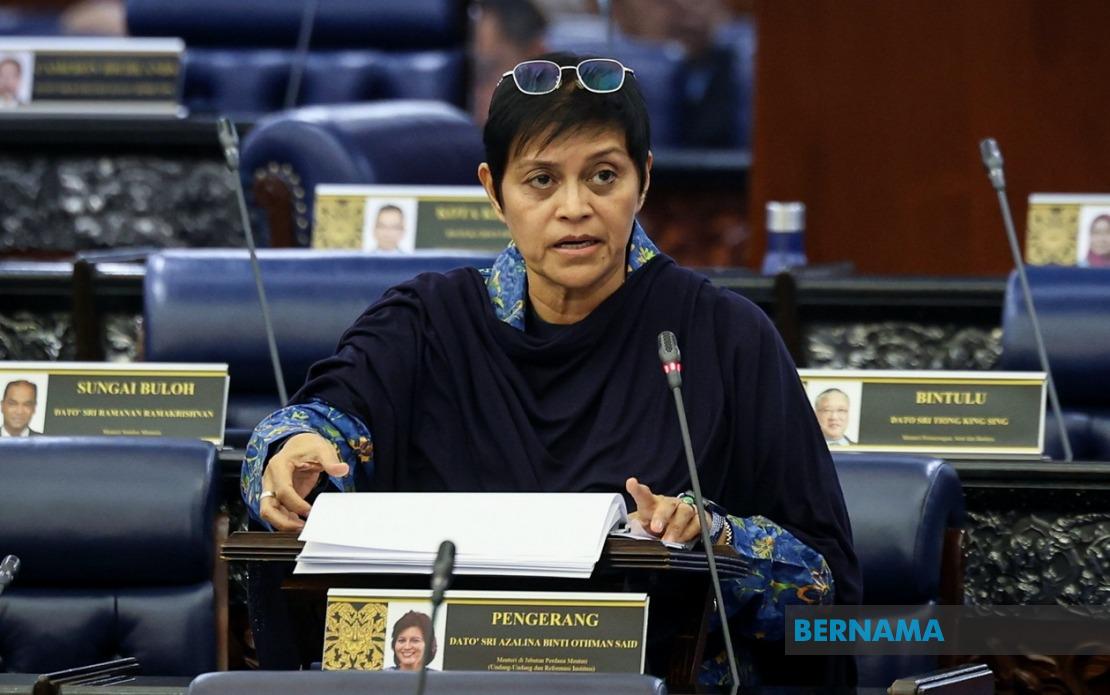
Parliament is poised to receive a transformative blueprint for restructuring Malaysia's prosecutorial framework, with lawmakers set to consider proposals that would fundamentally alter how the country's top legal officers are appointed and held accountable. The Special Select Committee's report on separating the Attorney General and Public Prosecutor roles represents a watershed moment in the government's broader institutional overhaul agenda, according to Datuk Seri Azalina Othman Said, the Minister in the Prime Minister's Department responsible for Law and Institutional Reform.
The initiative carries profound implications for Malaysia's justice system, striking at the heart of a longstanding institutional arrangement that has occasionally drawn international scrutiny. By divorcing these two powerful positions, the government seeks to establish clearer lines of accountability and independence within the prosecution service, addressing concerns about potential political influence in criminal cases. This separation would create a more insulated prosecutorial function, theoretically reducing the risk of selective prosecution or politically motivated legal actions.
The committee's extensive deliberations, spanning seven separate meetings, yielded seven substantive recommendations designed to fortify the Public Prosecutor's institutional standing. These proposals go beyond administrative reorganisation, instead seeking to embed safeguards directly into Malaysia's constitutional framework and statutory law. The recommendations reflect a deliberate effort to align Malaysia's prosecution architecture with international best practices observed in established democracies, where prosecutorial independence is treated as foundational to the rule of law.
Central to the proposed reforms is a reconfigured appointment mechanism that would significantly expand parliamentary involvement in selecting the Public Prosecutor. Under the current framework, the Prime Minister exercises considerable influence over this critical appointment. The new proposal would vest this authority instead with the Yang di-Pertuan Agong, acting on advice from the Judicial and Legal Service Commission, thereby removing executive interference from the equation. This modification would create institutional distance between the political leadership and prosecutorial decisions, theoretically insulating criminal investigations from partisan considerations.
The mechanism outlined in the proposed Constitutional amendment to Article 145A demonstrates sophisticated institutional design. Once the Commission identifies a suitable candidate, that individual's name would proceed to the Speaker of the Dewan Rakyat, where a dedicated parliamentary committee would subject the nomination to rigorous scrutiny and public examination. Only after this legislative vetting process would the Commission's recommendation return to the Judicial and Legal Service Commission for final formalisation to the monarch. This multi-layered approach creates sequential checkpoints throughout the appointment journey, ensuring no single institution or individual wields unchecked power.
The fixed seven-year non-renewable term represents another critical architectural element of the proposed framework. By establishing a predetermined tenure that cannot be extended, the reform removes incentives for the Public Prosecutor to court political favour to secure reappointment. This finite term contrasts with open-ended arrangements that might encourage caution regarding controversial but necessary prosecutions. The non-renewable nature is particularly significant, as it eliminates the perennial calculation of whether aggressive legal action might jeopardise future career prospects.
Introducing a dedicated Code of Ethics for Public Prosecutors would formalise behavioural expectations and provide a reference standard for evaluating prosecutorial conduct. Such a code typically addresses questions of impartiality, conflicts of interest, public accountability, and appropriate use of prosecutorial discretion. By establishing an explicit ethical framework, the reforms create measurable benchmarks against which professional conduct can be assessed and, if necessary, adjudicated. This transparency mechanism would strengthen public confidence by making prosecutorial standards explicit rather than implicit.
The proposed strengthening of Parliament's legislative capacity represents the reform package's broadest institutional effect. By empowering lawmakers to enact additional legislation governing the Public Prosecutor's office, the reforms acknowledge Parliament as the appropriate forum for defining prosecutorial limits and responsibilities. This shift distributes institutional power more widely, preventing any single actor from monopolising oversight of the prosecution service. For Malaysian readers accustomed to concerns about concentrated executive authority, this dispersal of power across multiple institutional nodes offers meaningful reassurance.
Azalina's characterisation of these reforms as foundational to the MADANI Government's broader institutional agenda reflects a strategic positioning of prosecutorial independence as interconnected with democratic consolidation generally. The government frames this not as a technical administrative adjustment but as a commitment to building enduring institutions capable of commanding public confidence across political transitions. This framing acknowledges an uncomfortable reality: justice systems survive political changeovers only when institutional safeguards transcend personalities and patronage networks.
The separation of Attorney General and Public Prosecutor functions addresses a persistent tension in Malaysia's legal architecture. The Attorney General operates as chief legal advisor to government, inevitably embedded within executive politics. The Public Prosecutor, by contrast, functions as an impartial administrator of criminal justice, a role conceptually incompatible with executive partisanship. By formally divorcing these functions, the reforms acknowledge that one institution cannot simultaneously serve as political counsellor and impartial justice administrator without inherent contradictions.
For Southeast Asian observers, Malaysia's prosecutorial reforms offer both example and warning. The region contains numerous jurisdictions where prosecutorial independence remains aspirational rather than institutional fact, with political pressure frequently influencing high-profile cases. Malaysia's willingness to constrain executive discretion over the prosecution service, however incompletely, suggests a modest but genuine commitment to judicial pluralism over majoritarian executive power. Conversely, the fact that such elementary safeguards require constitutional amendment signals the work remaining across the region.
The practical implementation of these reforms will ultimately determine their efficacy. Well-designed institutions remain inert without supporting political culture, institutional capacity, and enforcement mechanisms. Parliament's forthcoming debate will reveal whether lawmakers across the political spectrum genuinely embrace prosecutorial independence or whether they view the reform package cynically as temporary constraint on political opponents. The report's tabling represents conclusion of the intellectual exercise; the authentic test begins with Parliament's reception and subsequent legislative action.

