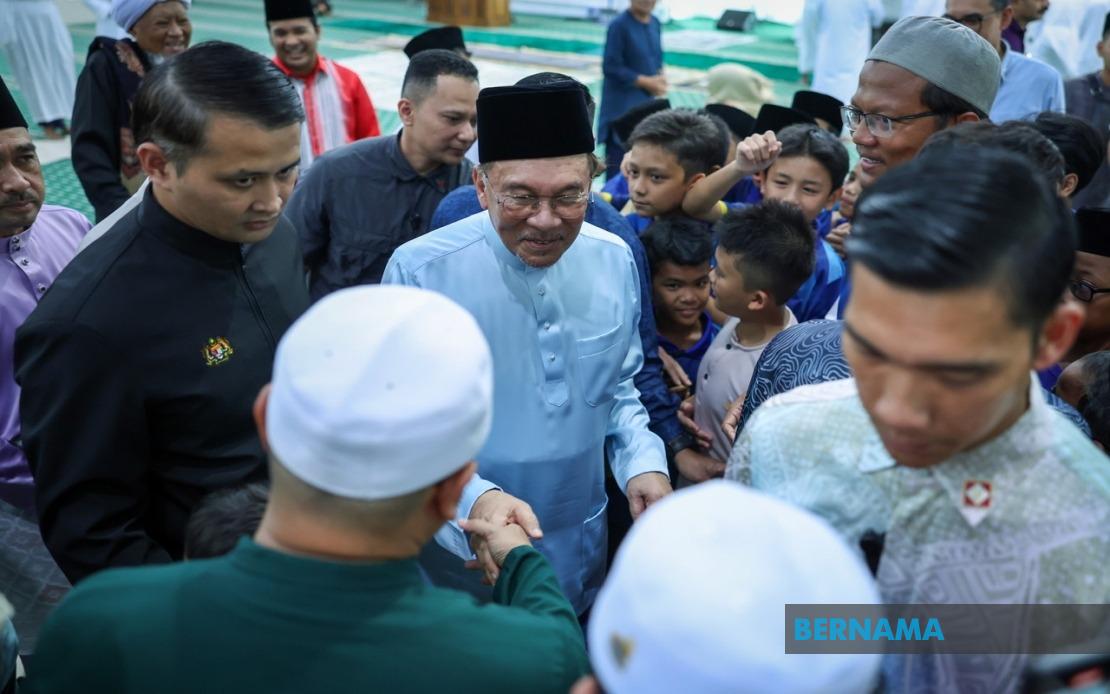
Prime Minister Datuk Seri Anwar Ibrahim has drawn a clear distinction between parliamentary constituency allocations and the personal prerogatives of elected representatives, stating definitively that such funds belong to the people rather than their Members of Parliament. Speaking to journalists in Alor Gajah following Friday prayers at Masjid Ar-Rasyidin on August 7, Anwar sought to address mounting complaints from opposition MPs who claim the government has suspended their access to constituency development budgets.
The Prime Minister explained that government funding directed to any parliamentary district carries a specific developmental mandate centred on tangible improvements to residents' quality of life. According to Anwar, these resources should flow toward essential infrastructure such as educational institutions, Islamic boarding schools, houses of worship, and drainage systems that address persistent flooding and sanitation issues. His remarks underscore an ongoing tension between the ruling coalition and opposition lawmakers regarding the distribution and control of constituency-level development resources, a particularly sensitive issue in Malaysia's competitive political landscape.
Anwar's position reflects longstanding parliamentary practice, though he acknowledged that the distinction between constituency funds and MP discretion has become blurred in recent years. He noted that this principle has existed for considerable time and should be familiar to MPs with prior government experience. The Prime Minister's comments appear designed to establish that withholding constituency allocations from opposition MPs does not constitute arbitrary punishment but rather follows established protocol whereby funds bypass intermediaries and reach residents directly through targeted community projects.
The government's approach diverges sharply from conventional practice in many legislatures where opposition MPs retain nominal control over constituency development budgets. In Malaysia's context, this policy creates a substantive distinction between ruling and opposition parliamentarians, granting the former greater discretion over how resources are deployed while potentially limiting the latter's ability to claim credit for local improvements. This structural difference carries significant political implications, as constituency service and visible development projects remain central to electoral competition at the grassroots level.
Anwar articulated the practical reality of fund deployment, using a concrete example to illustrate his point. If a constituency receives an allocation of RM2 million, he suggested, those funds should systematically address documented community needs—upgrading school facilities, maintaining religious infrastructure, repairing drainage systems, and tackling other pressing local concerns. This approach presumes that professional administrators and local authorities can identify and prioritise projects based on need rather than political preference, though questions remain about how such decisions are made and who participates in determining priorities.
The Prime Minister's remarks come as several opposition MPs have publicly contested the government's decision to redirect their constituency allocations elsewhere. These lawmakers have characterised the action as punitive and contrary to parliamentary convention, arguing that constituency development funds should be available to all elected representatives regardless of their party affiliation. The government's counter-argument, articulated through Anwar, treats such allocations as public resources held in trust for community benefit rather than as earned entitlements based on electoral success.
This interpretation raises broader questions about governance and the relationship between elected representatives and resource distribution. In democratic systems worldwide, opposition parties typically retain access to publicly funded constituency budgets as a means of ensuring that government doesn't monopolise local credit for development while simultaneously preventing opposition MPs from serving their residents effectively. Malaysia's approach, as outlined by Anwar, operates according to different principles—prioritising direct benefit delivery over representative authority over resource deployment.
The timing of Anwar's clarification suggests the issue has gained sufficient political salience to warrant the Prime Minister's personal intervention. Rather than allowing subordinates to defend the policy, Anwar chose to address the matter himself, indicating its importance within government communications strategy. His presence alongside Minister in the Prime Minister's Department (Religious Affairs) Senator Dr Zulkifli Hasan and Melaka Police chief Datuk Dzulkhairi Mukhtar may also signal broader coordination among federal agencies regarding local governance and constituency management.
Beyond constituency funding, Anwar touched on personnel matters within his own party, PKR. He explained that deputy president Nurul Izzah, who is also his daughter, had requested to step back temporarily from her formal position due to other commitments requiring her immediate attention. Anwar indicated he had approved this arrangement while emphasising that Izzah remains engaged with party activities. This brief comment addresses potential speculation about succession planning and internal party dynamics, suggesting that her departure from the deputy presidency reflects practical scheduling considerations rather than political tensions or organisational struggles within PKR's leadership.
The substance of Anwar's constituency funding remarks reflects broader governance tensions emerging in Malaysia following the political realignment of recent years. As government configurations have shifted and party coalitions have reformed, questions about the equitable distribution of public resources have become increasingly contentious. The Prime Minister's insistence that allocations serve people rather than politicians represents an attempt to reframe the debate in terms of public interest, yet observers note that determining which projects genuinely serve communities and which primarily benefit the parties directing their implementation often proves politically complex.

