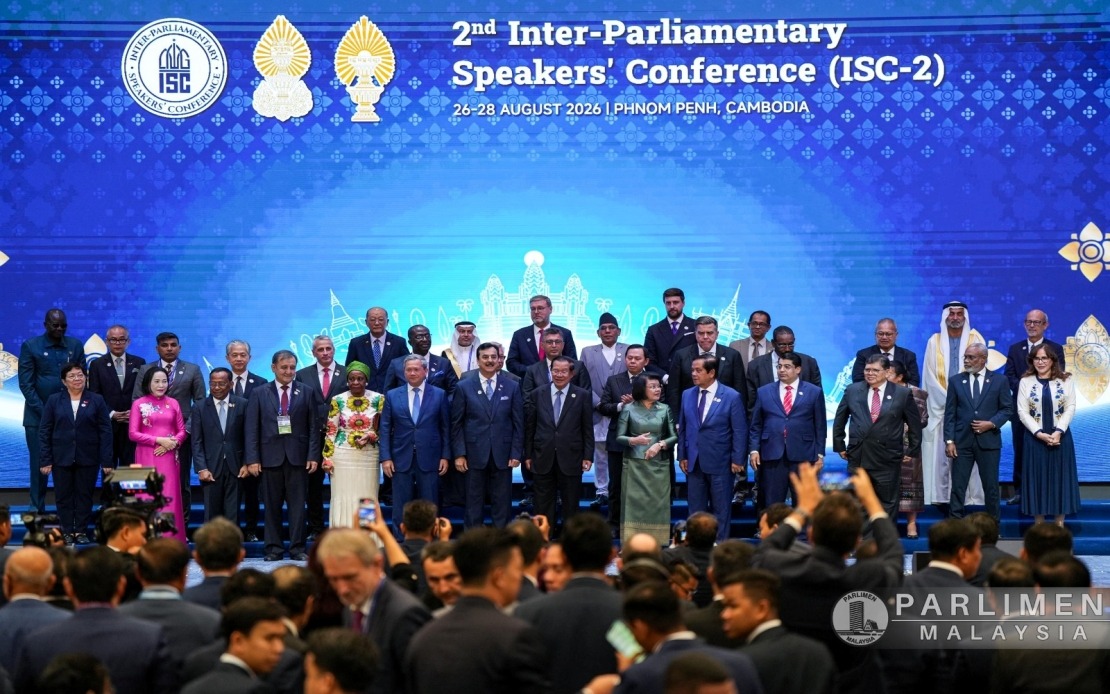
Tan Sri Dr Johari Abdul, Speaker of the Dewan Rakyat, has issued a call for national parliaments to expand their involvement in resolving international crises and managing geopolitical pressures that increasingly threaten global stability. Speaking at the Second Inter-Parliamentary Speakers' Conference (ISC-2) in Phnom Penh, he contended that legislatures should operate as equal partners to executive governments when confronting issues of war, peace and international justice—rather than remaining peripheral actors in such consequential matters.
The conference, held jointly by Cambodia's National Assembly and Senate between August 26 and 28, assembled parliamentary leaders under the banner of "Solidarity for Peace and Shared Prosperity: Strengthening International Law and Resolving Conflicts Peacefully." Dr Johari's intervention underscores growing recognition in the region that traditional diplomacy alone has proven insufficient to address the interconnected crises facing Southeast Asia and beyond, from armed conflicts that displace millions to climate-driven pressures that destabilise entire communities.
According to Dr Johari, the institutional separation between legislatures and executives creates an unnecessary gap in responding to contemporary challenges. He highlighted that elected representatives often possess insights into grassroots concerns that senior government officials may overlook, whilst executive branches sometimes approach problems through a narrow political lens that fails to capture the full human dimension of crisis. This complementary relationship—when properly leveraged—could produce more durable solutions grounded in both institutional expertise and public legitimacy.
The Malaysian Speaker emphasised that the human toll of modern conflicts transcends statistical measures. Across multiple theatres of conflict globally, families have been torn from their homes, children have lost access to education, and the social fabric binding communities together has been systematically destroyed. Parliamentary bodies, as representatives of ordinary citizens, bear a special responsibility to ensure these lived experiences inform policy rather than remaining abstract concerns relegated to humanitarian annexes of peace negotiations. By bringing legislative voices into dialogue forums, parliaments can centre civilian welfare in discussions where technical and geopolitical considerations often dominate.
Dr Johari articulated a particularly compelling argument regarding parliamentary diplomacy's unique value during periods of heightened tension. When diplomatic relations between governments become severely strained or severed entirely, legislative connections often remain open—preserved through established inter-parliamentary relationships, professional networks, and shared commitment to democratic institutions. These surviving channels enable dialogue to continue across otherwise hardened national boundaries, creating space for understanding when official government-to-government negotiations have frozen. Such persistence of communication may prove the difference between de-escalation and catastrophic misunderstanding.
For Southeast Asia specifically, Malaysia's parliamentary leader anchored his remarks in ASEAN's founding philosophy of dialogue, consultation and graduated consensus-building. He noted that the region's unusual success in maintaining peace despite profound diversity reflects these principles, yet warned that this achievement requires constant nurturing and reinvigoration. Parliamentary bodies across ASEAN nations could strengthen this regional achievement by independently fostering mutual understanding among their peoples, building constituencies for cooperation that transcend occasional high-level political shifts.
Dr Johari positioned respect for national sovereignty, territorial integrity, strict adherence to international law, and commitment to peaceful dispute settlement as the irreducible foundations for lasting peace. These principles carry particular resonance in Southeast Asia, where competing maritime claims, historical grievances, and power dynamics create persistent friction despite remarkable overall stability. Parliaments can reinforce these norms by consistently advocating for their observance in domestic debates and international forums, thereby creating a normative environment that constrains governments tempted toward unilateral action.
The Malaysian Speaker's intervention reflects deeper shifts in how middle powers like Malaysia approach global governance. Rather than accepting a hierarchical model where major powers and executive branches determine international outcomes, Dr Johari articulated a vision of more distributed leadership where legislatures actively shape regional and global responses to crises. This approach resonates particularly strongly in ASEAN, where collective decision-making and respect for individual member sovereignty already constitute governing principles.
The conference sequence itself reveals patterns of shifting parliamentary confidence. Pakistan hosted the inaugural Inter-Parliamentary Speakers' Conference in 2025, establishing the forum's foundational principles. Cambodia's hosting of the second iteration this month indicates expansion beyond South Asia toward inclusive regional representation. Indonesia's commitment to hosting the third conference next year signals that Southeast Asian parliaments intend to shape the emerging framework for legislative engagement on global issues—a significant assertion of regional agency.
For Malaysian stakeholders, Dr Johari's advocacy carries practical implications. It positions the Dewan Rakyat as a consequential actor in regional diplomacy and international relations architecture, not merely a domestic legislative body. Malaysian parliamentarians engaging with counterparts through the ISC framework gain platform to advocate positions on international law, regional stability, and peaceful conflict resolution. This elevation of parliamentary diplomacy could enhance Malaysia's voice in shaping how the region responds to crises from maritime disputes to humanitarian emergencies.
The broader argument for legislative empowerment also invites scrutiny regarding implementation. Parliaments vary dramatically in institutional capacity, democratic legitimacy, and independence from executive control. For the concept of parliamentary diplomacy to function meaningfully, legislatures must possess genuine autonomy and resources to engage substantively rather than serving as ceremonial endorsers of predetermined executive positions. The challenge lies in translating rhetorical commitment to parliamentary partnership into institutional reforms that enable genuine legislative influence.
Dr Johari's remarks also implicitly acknowledge that traditional state-to-state diplomacy, whilst essential, has become insufficient for addressing transnational challenges including conflict, climate disruption, and migration. Parliamentary engagement brings into focus the interests of affected populations whose voices often receive inadequate hearing in elite diplomatic circles. By insisting that peace processes and conflict prevention strategies must incorporate parliamentary perspectives, leaders like Dr Johari push for more inclusive decision-making frameworks that acknowledge governments do not represent societies uniformly.
As geopolitical tensions intensify globally and regional conflicts persist despite decades of international institution-building, the call for broader parliamentary participation in governance responds to evident need. The Inter-Parliamentary Speakers' Conference provides concrete mechanism for legislatures to develop coordinated responses, share expertise, and build coalitions around shared commitments to international law and peaceful settlement. For Malaysia and Southeast Asia, treating this forum as significant rather than peripheral represents both aspiration toward more representative global governance and practical investment in preventing conflicts that would inevitably demand far costlier responses than contemporary prevention efforts require.

