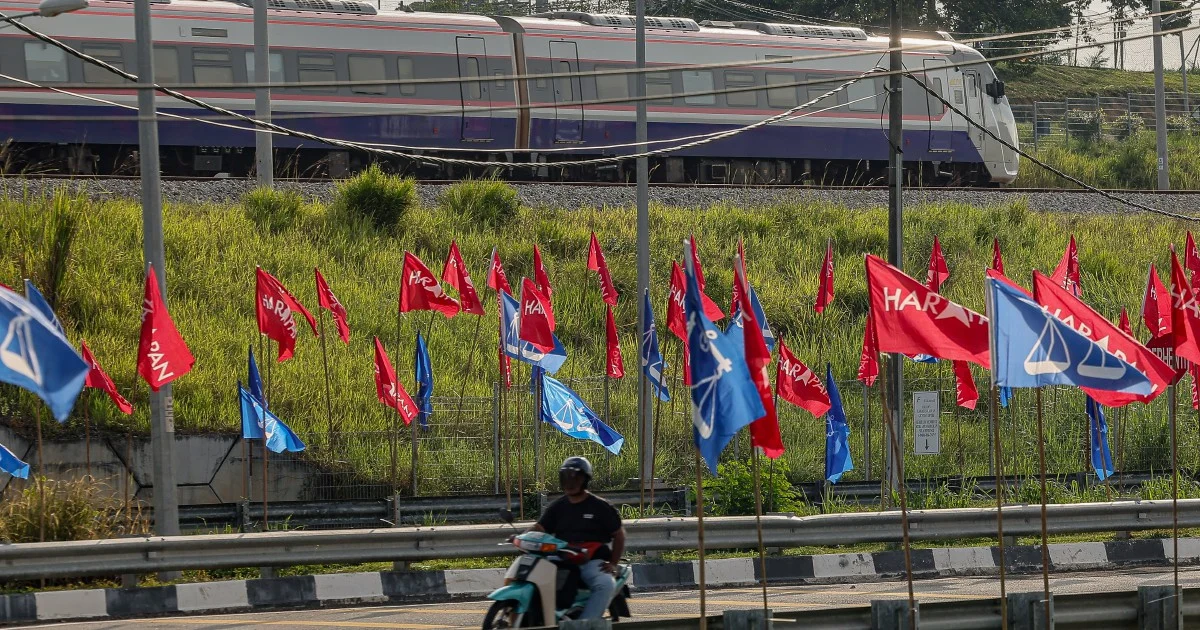
PAS Youth has moved to explain a significant tactical realignment within Malaysia's fractured opposition landscape, confirming that the party's willingness to throw support behind Barisan Nasional candidates in select constituencies represents a deliberate strategy to prevent Pakatan Harapan from gaining ground. The youth wing's clarification, made in Johor Baru, addresses growing speculation about informal electoral arrangements among the country's competing political blocs, revealing the complex calculations driving coalition politics at the grassroots level.
The decision reflects mounting tensions within the opposition space as PAS and Perikatan Nasional navigate a relationship increasingly complicated by overlapping electoral ambitions. By agreeing to stand aside in seats where PN is not contesting and directing support toward BN candidates instead, PAS Youth signals a pragmatic approach to vote management that prioritizes blocking one rival over advancing another. This represents a notable shift from traditional opposition solidarity, suggesting that the party's youth leadership views the containment of Pakatan Harapan as a more pressing concern than conventional anti-establishment politics.
The significance of this arrangement cannot be divorced from PAS's broader strategic position within Malaysian politics. As an Islamic-oriented party that has historically oscillated between opposition and government coalitions, PAS maintains distinct voter bases across different regions and demographic segments. The youth wing's endorsement of selective support for BN reflects calculations that allowing Pakatan Harapan dominance in certain areas poses greater risks to PAS's long-term political viability than permitting BN territorial consolidation in those same contests.
Johor Baru's selection as the venue for this clarification carries geographic weight. The state has emerged as a critical battleground in recent electoral contests, with multiple political factions competing for influence. Johor's large Malay-Muslim population and substantial urban constituencies create the precise conditions where PAS Youth's strategy might yield tangible results, particularly in constituencies where Perikatan Nasional lacks the infrastructure or local support to mount competitive challenges.
The arrangement underscores how Malaysia's three-bloc political system has generated unexpected alliances and counter-alliances that defy conventional ideological consistency. Rather than maintaining principled opposition to Barisan Nasional's federal governance record, PAS Youth's approach acknowledges the mathematical reality that splitting the anti-Pakatan vote across too many candidates in individual constituencies could inadvertently benefit the opposition coalition. This reflects a maturation of electoral strategy among younger party cadres who recognize that vote efficiency often trumps ideological purity in Malaysia's first-past-the-post system.
For Barisan Nasional, the arrangement offers tactical advantages in constituencies where party-fielded candidates might otherwise face three-way contests. By securing PAS Youth's implicit backing—or at minimum, minimizing opposition from that quarter—BN improves its prospects in marginal seats without necessarily formalizing controversial coalition arrangements that might alienate different voter segments. This informal cooperation allows both parties to maintain public distance while coordinating electoral efforts through youth wings and ground-level party structures.
The development has potential ramifications for Pakatan Harapan's electoral strategy across multiple states. The coalition has relied partly on opposition consolidation and anti-incumbency sentiment to penetrate areas of traditional BN strength. Any systematic arrangement where alternative opposition forces actively facilitate BN victories would substantially complicate Pakatan Harapan's path to expanding parliamentary representation, particularly in constituencies where it lacks overwhelming local dominance.
For Malaysian voters, particularly those in targeted constituencies, the arrangement highlights how electoral outcomes increasingly depend on complex behind-the-scenes calculations rather than straightforward party competition. Constituencies designated as priority targets for this voting arrangement may experience unusual political dynamics, where local party dynamics shift unpredictably as different factions navigate their respective strategic priorities. Younger voters especially deserve clarity about such arrangements, given that their electoral choices potentially serve as instruments for multi-level political negotiations that exceed individual constituency considerations.
PAS Youth's clarification also illuminates evolving fault lines within Perikatan Nasional itself. The fact that a senior party component feels empowered to unilaterally negotiate alternative support arrangements in non-PN constituencies suggests that the coalition's internal cohesion may be weaker than official pronouncements suggest. Whether such arrangements represent deliberate PN strategy or reflect independent PAS Youth initiative remains unclear, but either interpretation raises questions about Perikatan Nasional's stability as a unified political force.
Looking ahead, this pattern may establish precedent for future electoral contests. If PAS Youth's selective BN backing strategy proves electorally successful, other PN-affiliated components might pursue comparable arrangements. Conversely, should the strategy backfire through voter backlash or internal party recriminations, it could trigger a reassessment of informal coalition-building approaches. The 2024-2025 period will likely prove decisive in determining whether such tactical flexibility becomes normalized within Malaysian opposition politics or whether parties revert toward more rigid alliance structures.
For regional observers, Malaysia's evolving political dynamics offer instructive lessons about coalition management in systems with multiple competing blocs and weak party institutionalization. The willingness of opposition components to cooperate selectively with a governing coalition, framed as a means of containing perceived greater threats, demonstrates how electoral mathematics can override ideological consistency in competitive democracies lacking dominant party systems.

