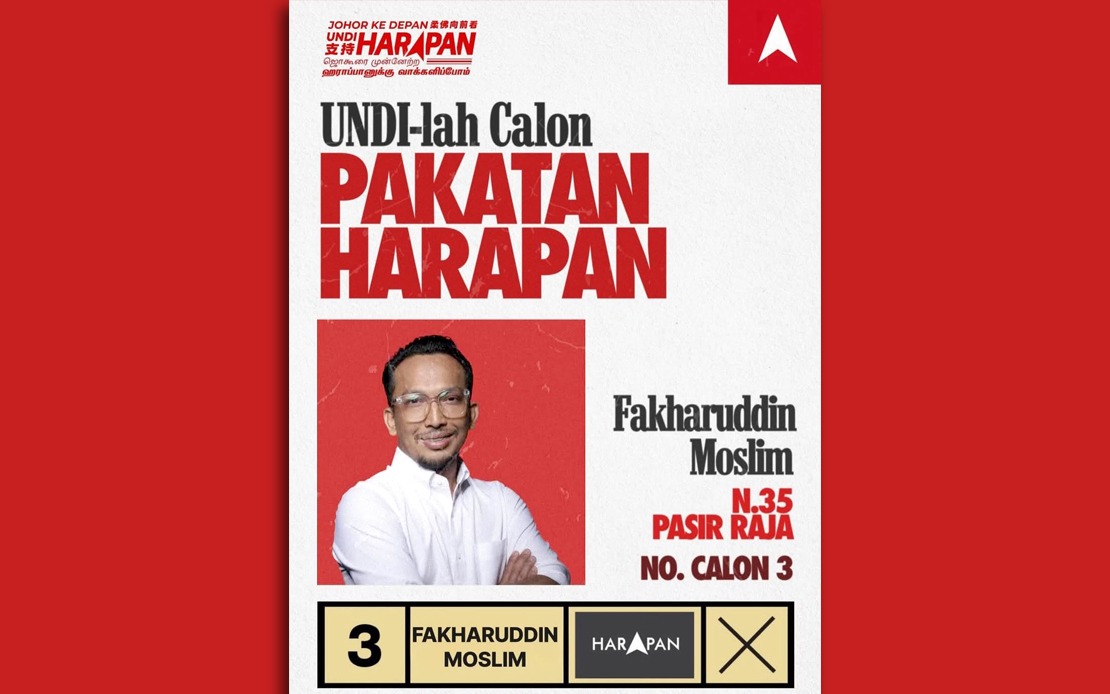
With four days remaining before voters head to the polls in the 2023 Johor state election, Mohd Fakharuddin Moslim, the Pakatan Harapan candidate for Pasir Raja, has rolled out what his campaign characterises as a hybrid strategy designed to maximise reach across disparate voter demographics. The approach merges traditional grassroots canvassing with strategically coordinated digital media campaigns—a combination his team credits with achieving comprehensive geographical coverage of the 29,818-strong electorate in the constituency.
The dual-track methodology reflects evolving campaign dynamics across Southeast Asian electoral contests, where candidates increasingly recognise that relying solely on either traditional retail politics or digital platforms leaves significant voter cohorts unengaged. Mohd Fakharuddin's framework attempts to bridge this divide by deploying campaign machinery for exhaustive physical visitation of all localities, including geographically isolated areas such as Sungai Redan, whilst simultaneously maintaining constant narrative presence on social media channels where younger voters and those residing outside the constituency congregate.
A defining feature of the campaign's approach centres on the distinction between awareness-building and voter mobilisation. Having completed what campaign officials describe as 100 per cent coverage of the constituency through direct ground contact, Mohd Fakharuddin indicated that the remaining campaign period would focus on reinforcement rather than initial outreach. The second-phase strategy involves revisiting areas already canvassed to consolidate voter confidence and remind supporters of the campaign's core messaging immediately before polling day.
The candidate has identified outstation voters—particularly youth who have migrated to urban centres for employment or education—as critical to electoral success. Digital platforms represent the optimal mechanism for reaching this dispersed group, who might otherwise remain unreached by conventional door-to-door canvassing. By concentrating messaging on social media, the campaign aims to convince non-resident voters that their participation remains consequential to the constituency's future development, thereby incentivising their return home to vote.
Mohd Fakharuddin's personal biography has been positioned as a campaign asset, particularly when engaging with Felda settler communities that constitute a significant portion of the electorate. As a Felda settler's son and second-generation resident, he possesses intimate knowledge of community concerns and family networks within these constituencies. Campaign accounts suggest this background has facilitated organic connections with voters, generating what campaign representatives describe as spontaneous chemistry that has manifested in informal social interactions during canvassing.
The receptiveness of Felda residents, encompassing both first-generation settlers and their descendants, appears to have surprised the campaign positively. Voters reportedly extended invitations to the candidate to participate in casual social settings—sharing refreshments and conversation at local stalls—rather than confining interactions to formal campaign appearances. These informal encounters potentially carry greater persuasive weight than structured political events, as they permit candidates to operate outside the controlled environment of prepared remarks and official messaging.
The Pasir Raja contest itself represents a three-way competition featuring established political forces. Opposing Mohd Fakharuddin are Datuk Seri Dr Adham Baba, the Barisan Nasional nominee, and Yuhanita Yunan, contesting on behalf of Perikatan Nasional. This tripartite arrangement complicates vote distribution and suggests that victory margins may prove tighter than in constituencies where clear two-candidate races dominate. Each faction's ability to consolidate support within its core voter base becomes correspondingly more critical in such configurations.
For Malaysian observers monitoring political evolution in Johor specifically and the peninsula more broadly, the Pasir Raja campaign illustrates broader strategic adjustments underway across major political coalitions. The integration of digital infrastructure into traditional campaign machinery suggests that parties recognise generational shifts in political engagement. Younger voters' diminished participation in conventional political events creates pressure to develop alternative contact mechanisms that align with their preferred information consumption patterns.
The emphasis placed on mobilising outstation voters also reflects demographic realities affecting rural and semi-rural constituencies throughout Malaysia. Rural-origin populations increasingly disperse to urban areas in search of economic opportunity, yet maintain emotional and familial connections to home constituencies. Political campaigns that successfully leverage these transnational networks—combining personal appeals transmitted through digital channels with the credibility of local candidates who embody community identity—appear positioned to capture otherwise difficult-to-reach voter segments.
The hybrid campaign model described in Pasir Raja's contest should not be understood as revolutionary, but rather as refinement of strategies that have evolved incrementally across several electoral cycles. Nonetheless, the deliberate articulation and systematic execution of such approaches suggests they have moved from experimental status to established campaign practice. As the 2023 Johor election progresses, the effectiveness of Mohd Fakharuddin's hybrid strategy will provide data points regarding whether this integrated approach delivers tangible electoral returns or whether its theoretical advantages fail to materialise in practice.

