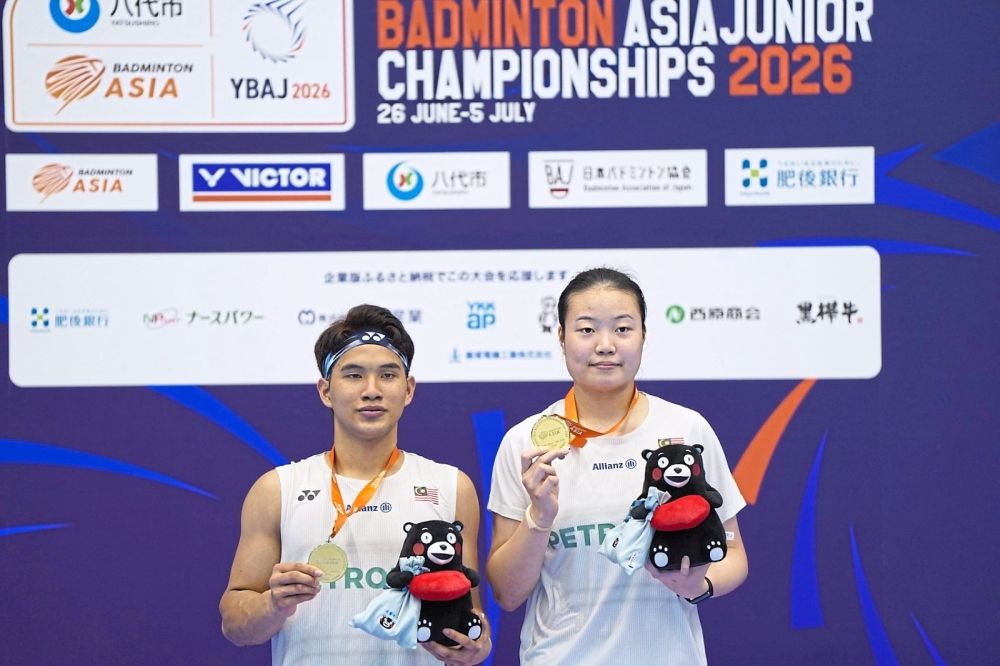
In a momentous upset at the Asian Junior Badminton Championships in Yatsushiro, Japan, Ahmad Redzuan Zulwaqqarizal and Low Zi Yu have brought an end to Malaysia's extended championship drought by capturing the mixed doubles title, their victory arriving nearly two decades after the nation last tasted success in this category. The Malaysian combination proved their mettle in a hard-fought contest against China's Zheng Weigang and Li Menghan, ultimately prevailing 21-15, 22-20 in a match that demanded every ounce of tactical acumen and mental resilience.
The path to victory, however, tested the pair's nerve considerably, most acutely during a second game that mirrored the unpredictability characteristic of elite badminton competition. Redzuan and Zi Yu found themselves tantalizingly close to the championship at 20 points, seemingly within touching distance of clinching the crown, only to watch their Chinese opponents mount a determined comeback that forced the match into a decisive third game. Rather than succumbing to the mounting pressure, the Malaysians demonstrated the composure required at the sport's highest levels, maintaining their focus when it mattered most to secure victory in 43 minutes of intense rallying.
Low Zi Yu, reflecting on the final moments that proved decisive, attributed much of the partnership's success to a deliberate approach centred on patience and composure rather than aggressive shot-making. The 15-year-old explained that at the critical juncture of 20-20 in the second game, the Malaysian pair managed to sustain greater concentration than their rivals, a marginal advantage that separated champions from runners-up. Beyond the tactical elements, Zi Yu emphasized the intangible benefits that team support provided, noting that encouragement from Malaysian teammates who had already been eliminated from their own events proved psychologically invaluable during the decisive moments, creating an environment that fostered motivation rather than isolation.
The significance of this triumph extends well beyond the immediate context of a single championship. The last Malaysians to inscribe their names on the Asian Junior mixed doubles honour roll were Tan Wee Kiong and Woon Khe Wei, who accomplished the feat in Kuala Lumpur during 2007. The 19-year interval represents not merely a gap in medal acquisition but underscores the difficulty of achieving sustained excellence in junior badminton, where the competitive landscape shifts annually as players mature and new talent emerges from badminton-obsessed neighbours. For Malaysia, a nation with a proud badminton heritage, the reclamation of this title signals a potential resurgence in the mixed doubles format among its younger generation.
For Redzuan himself, this championship carries additional poignancy rooted in professional adversity. The Terengganu-born shuttler's journey to this moment was marked by three consecutive disappointing campaigns at previous editions of the Asian Junior Championships. He initially made his debut in 2023 in Yogyakarta, where he competed in both boys' doubles and mixed doubles categories but encountered early eliminations in both events. Rather than gaining momentum, Redzuan faced similar early exits in subsequent years—at the 2024 edition in Yogyakarta and again at the 2025 tournament in Surakarta—creating a narrative of persistent underperformance at this level of competition. The breakthrough victory thus represents not merely a single successful tournament outcome but vindication of his perseverance through multiple seasons of setbacks.
Redzuan's own assessment of his performance revealed a player focused on the fundamentals and professional development rather than celebrating momentarily. He acknowledged satisfaction with his execution on court, particularly in translating the technical work developed during training sessions into match situations—a skill that distinguishes athletes capable of handling pressure from those overwhelmed by it. Simultaneously, he recognized the limitations of his current ability, identifying areas requiring refinement as he prepares for the elevated demands of senior competition. This balanced perspective, neither overconfident nor self-flagellating, characterizes athletes with the potential for sustained excellence beyond the junior ranks.
Zi Yu's participation in this championship extended beyond the mixed doubles final, as she pursued simultaneous success in the girls' doubles competition alongside partner Genevie Lim. The dual-event commitment netted a bronze medal in the girls' category after the Malaysian pair surrendered a close semi-final contest to Japan's second seeds Aoi Banno and Yuzu Ueno, falling 21-16, 17-21, 17-21 in a match that showcased the depth of Japanese talent at the junior level. While this represented a secondary medal in terms of prestige compared to the mixed doubles championship, it nevertheless demonstrated the breadth of Zi Yu's abilities across different partnership formats.
Zi Yu attributed her capacity to manage both events without diminishing her performance to the quality of her partners in each format. She emphasized that neither Redzuan nor Lim required extensive hand-holding or tactical guidance, noting that both players possessed the foundational skills and court awareness necessary to function effectively as independent operators. This distinction is important: successful doubles players at the elite level require partners capable of autonomous decision-making and execution, rather than relying upon a single dominant figure to orchestrate proceedings. Zi Yu's role was thereby simplified to managing her own game while offering tactical adjustments and encouragement when required, a philosophy that likely explains her capacity to maintain performance across two demanding categories.
The broader results from the championship indicated comprehensive dominance by players from China, Taiwan, and Japan, reflecting the structural advantages these nations possess in junior badminton development. China's Zheng Weigang-Li Menghan aside, competitors from these three countries captured the remaining titles in men's singles, men's doubles, women's singles, and women's doubles. Hong Tianyue's victory over Indonesia's Fardhan Joe by 21-18, 21-19 in men's singles provided China with an additional gold medal, whilst Taiwan's Huang Tzu-yuan and Lin Sheng-ming secured men's doubles honours by dominating compatriots Chen Ping-hsuan and Lee Wei-ting 21-10, 21-13. Women's singles witnessed an all-Chinese final contested between Yin Yiqing and Zhang Yixin, with Yin ultimately prevailing 21-17, 21-15, and Japan's Aoi Banno and Yuzu Ueno completed the medal sweep by capturing women's doubles in a competitive encounter against domestic rivals Ria Haga and Rio Yamakita.
Malaysia's singular championship victory at this year's Asian Junior Championships, whilst significant in breaking the two-decade drought, also reflects the competitive challenges facing the nation's badminton federation. The dominance of China, Taiwan, and Japan across five of the six medal events suggests that sustainable improvement in Malaysian junior performance will require continued investment in talent identification, coaching infrastructure, and international exposure. Yet the breakthrough achieved by Redzuan and Zi Yu provides a template: patience, mental fortitude, and the ability to execute under pressure can overcome marginal technical differences when facing high-quality opposition. Their success may inspire renewed commitment to junior development programmes that have occasionally been overshadowed by the achievements of Malaysia's elite senior players.

