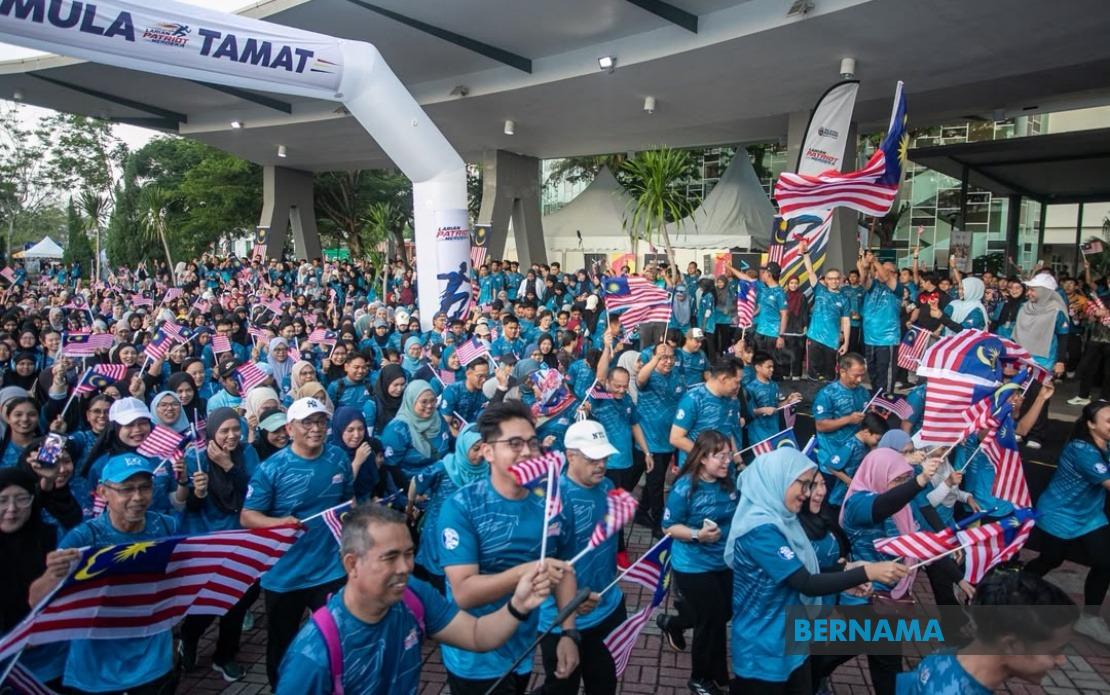
The early morning streets of Ipoh witnessed an outpouring of patriotic fervour as approximately 2,000 participants converged on the Sultan Azlan Shah Ministry of Health Training Institute for the Patriot Merdeka Run. The gathering, held before dawn broke fully over the city, represented a cross-section of Malaysian society, with families bringing children, seniors joining younger adults, and community groups marching together under the symbol of national unity. The event served as the inaugural public celebration marking the 2026 National Month and the Fly the Jalur Gemilang Campaign, positioning this year's independence commemorations as a moment for collective reflection on Malaysian identity and cohesion.
The organisers had strategically timed the event to harness the energy of early morning participation, an approach that appeared to resonate strongly with the local community. By 7 am, the training institute grounds were already animated with activity, suggesting that interest in organised patriotic activities remains strong among ordinary Malaysians. This turnout indicates that such initiatives can successfully mobilise diverse demographics around shared national symbols and values, a consideration relevant for policymakers designing civic engagement programmes across Southeast Asia.
Before the competitive element began, participants engaged in a mass aerobics session that set a collaborative, inclusive tone for the morning. This structured warm-up activity created a sense of collective participation before the run itself, transforming what might have been merely an individual athletic pursuit into a communal experience. The subsequent ritual of waving the Jalur Gemilang across the assembled crowd reinforced visual imagery of national solidarity, demonstrating how symbolic gestures can unite people who might otherwise have little connection to one another.
Communications Ministry secretary-general Datuk Abdul Halim Hamzah formally initiated the 2.5-kilometre fun run at 7.30 am, giving the event official sanction and public visibility. The decision to route the course with the national flag prominently displayed along its entire length meant that participants moved through a landscape saturated with national imagery. This deliberate staging created an environment where patriotic expression became inseparable from physical activity, potentially making the experience more emotionally resonant for participants than either element would have been in isolation.
The visible dynamics of the event—parents shepherding young children through the route, runners adorned in clothing reflecting the colours of the Jalur Gemilang, and the spontaneous expressions of encouragement passing between participants—painted a picture of grassroots national celebration. These informal interactions, difficult to mandate or orchestrate from above, often prove most effective in building genuine social cohesion. The intergenerational aspect, with elderly participants alongside toddlers, demonstrated that national identity can transcend age divisions and that monuments to nationhood need not exclude younger generations.
Organisers explicitly framed the run as serving dual purposes: promoting healthier lifestyles while simultaneously nurturing patriotic consciousness. This dual mandate reflects broader policy thinking in Malaysia around wellness and social cohesion, recognising that civic participation and physical wellbeing need not be separate concerns. For Southeast Asia more broadly, where several nations face challenges balancing modernisation pressures with traditional values, such integrated approaches offer templates for maintaining cultural continuity while addressing contemporary health concerns.
The Patriot Merdeka Run functioned as the opening salvo in what promises to be an extended period of commemoration surrounding the 2026 National Day and Malaysia Day celebrations. Event organisers evidently hope that this flagship run will establish momentum for subsequent activities, with the implicit theory that repeated, well-executed civic rituals gradually deepen public appreciation for national independence and its ongoing significance. Whether such hope proves justified will become clearer as additional events materialise throughout the year.
The timing of this inaugural event carries additional significance in that Prime Minister Datuk Seri Anwar Ibrahim was scheduled to officiate the broader launch of the 2026 celebrations later that morning at 10 am. This sequence—beginning with grassroots community participation and culminating in high-level government endorsement—creates a symbolic arc suggesting that national commemoration flows upward from popular engagement rather than downward from ministerial decree. Such framing can enhance public perception of authenticity, making celebrations appear to reflect genuine collective sentiment rather than merely governmental administration.
The Patriot Merdeka Run ultimately reflected how modern Malaysia approaches national identity in an increasingly pluralistic context. Rather than emphasising divisive aspects of independence or positioning patriotism as requiring uniformity of thought, the event instead emphasised inclusivity, family participation, and the idea that love of nation could comfortably coexist with diverse personal backgrounds and political viewpoints. For Malaysian policymakers and their counterparts across Southeast Asia navigating questions of national cohesion amid growing social diversity, such inclusive models of patriotic expression offer compelling alternatives to more exclusionary approaches.
Participation levels and the evident enthusiasm of attendees suggest appetite for well-organised patriotic activities that emphasise participation and accessibility over hierarchical ceremony. The fact that children, families, and ordinary citizens comprised the bulk of participants rather than political elites or government officials indicated that the event successfully transcended its status as a government-initiated programme to become something participants embraced on their own terms. This distinction—between celebrations that feel imposed and those that feel genuinely owned by communities—likely determines their long-term impact on national consciousness and social cohesion.

