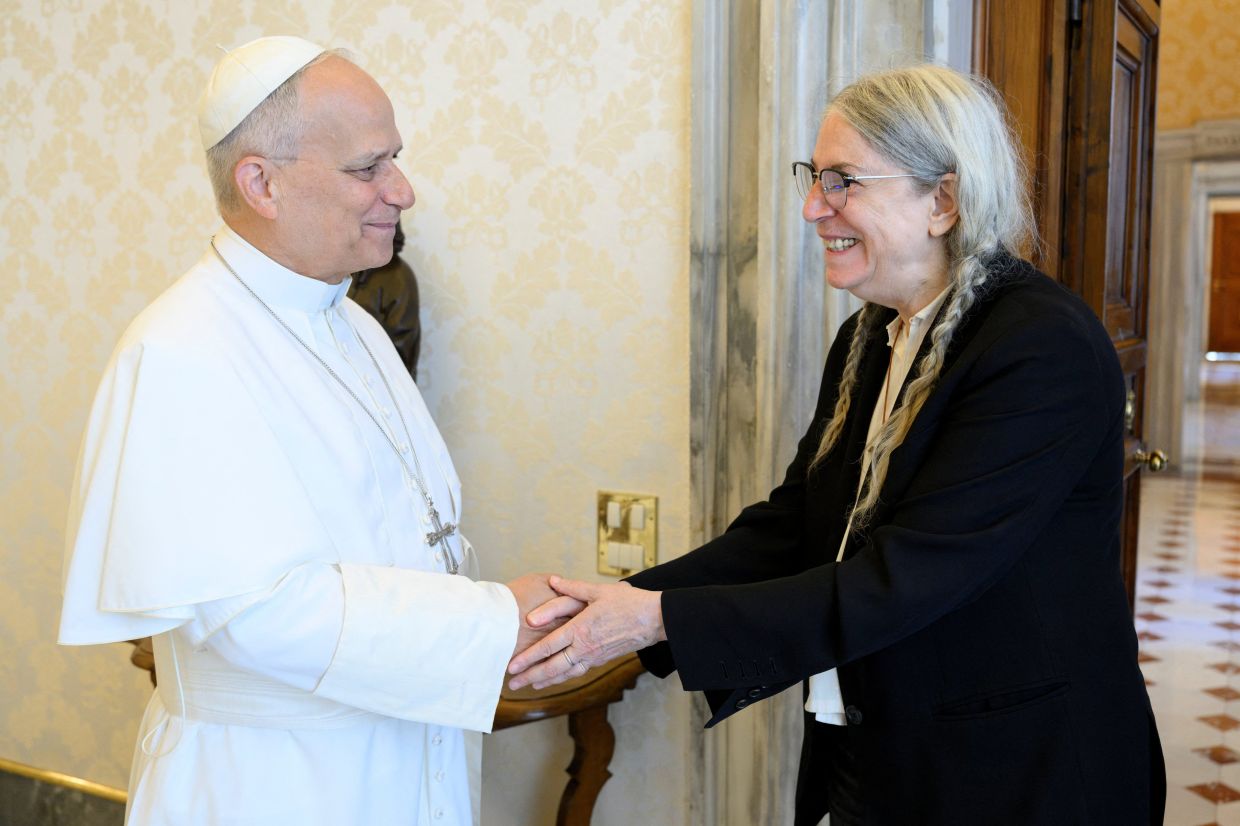
Rock musician Patti Smith sat across from Pope Leo XIV in the Apostolic Palace on Friday, greeting the pontiff with a simple but heartfelt "Hi" as she settled into the moment. The encounter marked another chapter in the Chicago-born artist's increasingly significant relationship with the Vatican, a connection forged through her long-standing friendship with Rev Antonio Spadaro, who serves as undersecretary in the Vatican's culture ministry. Though Smith has never converted to Catholicism, her spiritual affinity with the Church's recent leadership has drawn her into the ecclesiastical orbit with remarkable regularity and visible warmth.
Smith's appearance at the Vatican reflected her distinctive personal style: a crucifix pendant hung around her neck, and her hair was arranged in the braids that have become her signature look across decades of artistic reinvention. Her presence at the papal residence underscores how the Church under recent pontiffs has actively cultivated relationships with cultural figures and artists, viewing such connections as essential to bridging institutional religion with contemporary society. The meeting itself lasted approximately forty minutes, according to Spadaro, who accompanied Smith to the audience and provided an account of the exchange that emphasised its intimate, unhurried character.
Spadaro's description of the encounter painted a picture far removed from the formality typically associated with papal audiences. He characterised the forty-minute conversation as resembling "a meeting between two people discovering they were old friends, sharing memories woven from words and music, dreams, visions, and hopes—both from yesterday and for today." This framing suggests that Pope Leo XIV and Smith found genuine common ground, transcending the ceremonial boundaries that ordinarily define such encounters. The undersecretary's careful articulation hints at a mutual recognition of shared values centred on artistic expression, humanitarian concern, and spiritual reflection.
Smith's Vatican engagement has intensified markedly in recent months. In May, she performed during the ceremonial opening of the Holy See's pavilion at the Venice Biennale, the world's premier contemporary art exhibition. That performance occurred on May 8, which coincided with the anniversary of Pope Leo XIV's election—a meaningful synchronicity that underscores the Vatican's deliberate integration of Smith into its cultural programming. This kind of high-profile artistic presence at international venues like Venice signals the Church's desire to remain visible and relevant within global cultural conversations.
The musician's spiritual journey with the Catholic Church began well before Leo's papacy. Smith first encountered Pope Francis in 2013, subsequently performing for him in 2014. Their connection outlasted Francis's papacy: when the pontiff died on April 21, 2025, Smith memorialised him through poetry shared on social media, comparing Francis to a dandelion—"humble yet strong." In that same tribute, she wrote that "Nature and poetry and the suffering shall miss their champion," articulating Francis's significance not merely as a religious figure but as a voice for the vulnerable and marginalised. This poetic assessment reveals Smith's reading of the papacy as fundamentally intertwined with advocacy for human dignity and ecological consciousness.
Smith's articulated reasons for her Vatican connections centre on Pope Francis's distinctive approach to leadership and spirituality. She has stated publicly that while doctrine does not bind her to Catholicism, she was profoundly drawn to Francis's "gentle, open, and steadfast sense of humanity." This formulation identifies the appeal not as theological but as characterological—Francis's manner of being in the world rather than his institutional authority. For an artist whose career has been marked by countercultural sensibility and resistance to establishment conventions, this distinction matters considerably. The Church in Smith's estimation becomes valuable insofar as it channels compassion and welcomes the outsider.
During Friday's encounter, Pope Leo XIV demonstrated familiarity with Smith's artistic catalogue, responding positively when she apparently referenced or discussed one of her compositions. "That was marvelous," the pope remarked, indicating both knowledge of her work and appreciation for its significance. This reciprocal recognition—between a rock musician and a religious leader—represents a kind of cultural validation that carries symbolic weight. It suggests that artistic achievement and spiritual leadership need not occupy separate spheres, that a pontiff can honour creativity as a legitimate form of human expression and meaning-making.
Smith's continued presence at the Vatican under Pope Leo XIV's papacy suggests that the new pontiff shares his predecessor's openness to cultural figures and artistic voices. Leo XIV's schedule this week reflected his own engagement with music and the arts: on Wednesday, July 29, he attended a concert honouring his papacy, where world-renowned tenor Andrea Bocelli performed. The coordination of Smith's visit and Bocelli's concert within the same week indicates a deliberate curatorial approach to papal activity, one that privileges artistic and musical expression as essential to the Church's public witness. For the Vatican, such events serve multiple functions simultaneously—they demonstrate contemporary relevance, they attract international media attention, and they create opportunities for dialogue between the institution and influential cultural figures.
For Malaysian and Southeast Asian observers, Smith's engagement with the Vatican carries particular relevance. The region is home to growing Catholic communities, especially in the Philippines, and the Church's ability to maintain cultural credibility through figures like Smith influences its standing among younger, culturally engaged populations. Smith represents a mode of spirituality that is sincere yet unorthodox, artistic yet morally serious—precisely the combination that appeals to contemporary audiences sceptical of institutional religion but not necessarily hostile to spiritual inquiry. Her comfort in the papal presence, and Leo XIV's evident comfort with her, models a form of religious openness that transcends doctrinal boundaries.
As Smith departed the Apostolic Palace, she offered another simple farewell: "Bye. Bye." The words carry the same unadorned sincerity as her greeting, suggesting that for Smith, encounters with religious authority require no elaborate verbal performance. Her repeated Vatican visits and the Church's evident delight in her company reflect an unusual convergence: a legendary rock musician and a contemporary papacy discovering unexpected kinship through shared commitments to art, humanity, and transcendence. Whether this relationship endures under subsequent papacies remains an open question, but its current vitality speaks to the Church's ongoing effort to remain engaged with contemporary culture and to the enduring power of artistic witness.

