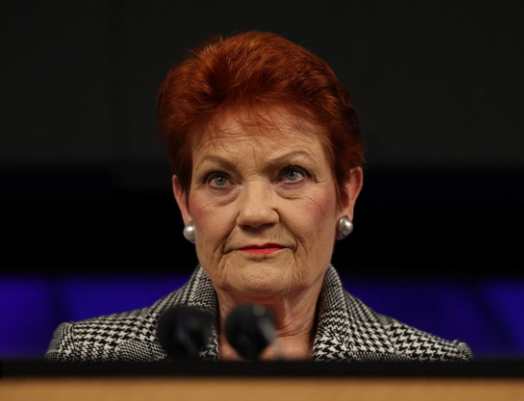
Pauline Hanson's legal battle to challenge a racial vilification finding has come to an end, with Australia's Federal Court dismissing her appeal on Monday. The ruling represents a significant moment in Australian law regarding the boundaries between free speech and vilifying conduct, particularly as Hanson's One Nation party gains ground in national politics. The senator's attempt to overturn the 2024 decision hinged on constitutional arguments around freedom of expression, but the court found no merit in her challenge, reinforcing that certain speech crosses the line into unlawful territory regardless of the speaker's political intent.
The dispute originated in 2022 when Hanson took to social media to attack Mehreen Faruqi, a Greens senator of Pakistani descent, over comments the latter had made regarding Queen Elizabeth II's death. Faruqi, a left-leaning parliamentarian, had characterised the late British monarch as the leader of an empire that had accumulated wealth and territory through colonialism and exploitation. Rather than engaging with the substance of Faruqi's political critique, Hanson responded by questioning the senator's place in Australia itself, suggesting she should "pack your bags and piss off back to Pakistan" given her apparent dissatisfaction with the country. The language employed made explicit reference to Faruqi's immigrant background and national origin, framing her criticism of the monarchy as evidence of disloyalty to Australia.
When the Federal Court examined the exchange in 2024 following Faruqi's complaint, judges concluded that Hanson's words constituted a "strong form of racism" under Australian racial vilification laws. The finding reflected the court's assessment that the remarks were designed to demean an individual based on her ethnicity and country of origin, moving beyond political disagreement into territory that targets a person's identity. This distinction proved crucial to the appeal decision, as courts distinguish between criticism of ideas or policies and attacks that weaponise someone's race or national background to suggest they are unworthy of participation in civic life.
Hanson's response to the appeal dismissal emphasised her view that she was defending the monarchy's honour rather than engaging in discriminatory conduct. She stated she felt "incensed" by what she perceived as disrespect shown to Queen Elizabeth II and merely wanted to "call that out" against Faruqi. This framing attempts to reposition her remarks as a defence of national symbols and values rather than as an attack on a person's inherent right to belong in Australia. However, the court's rejection of her appeal suggests that whatever the underlying motivation, the practical effect and language of her statement crossed established legal boundaries.
The timing of this court defeat carries particular weight given Hanson's recent surge in political popularity. One Nation has climbed significantly in opinion polls throughout 2024, positioning itself as one of Australia's most electorally competitive parties. This rise reflects broader global patterns where far-right and populist movements have gained traction, often by capitalising on anxieties around immigration, national identity, and rapid social change. In Hanson's case, her platform combines hard-line stances on immigration control, including calls for mass deportations of undocumented migrants, with broader critiques of what she frames as excessive government spending and misguided international engagement.
Hanson's political messaging resonates with voters who feel economically squeezed or culturally alienated, and her willingness to articulate grievances in provocative language has become a signature aspect of her political brand. She has positioned One Nation as unafraid to challenge what she characterises as political correctness and restrictions on speech. The party's current policy platform includes sweeping cuts to government expenditure that Hanson herself has likened to Elon Musk's DOGE (Department of Government Efficiency) proposal in the United States. Such positioning appeals to voters sceptical of government institutions and attracted to outsider candidates offering radical alternatives to mainstream politics.
For Malaysian and Southeast Asian observers, the case illustrates how immigration politics and questions around multicultural integration occupy similar terrain across democratic societies. Like Australia, Malaysia hosts diverse populations with distinct ethnic and religious backgrounds, and political discourse frequently intersects questions of national identity with immigration and integration policy. While Malaysia's constitutional framework enshrines different protections and prohibitions than Australia's racial vilification laws, the underlying tensions between freedom of expression, protection from discrimination, and questions about belonging remain universally resonant in diverse societies.
The court's decision also highlights how institutional constraints on speech function differently across democracies. Australia's Racial Discrimination Act provides legal remedies for vilification in ways that create enforceable boundaries around public speech, particularly from politicians. Hanson's failed appeal demonstrates that even politicians with significant electoral support cannot operate wholly outside these legal frameworks, suggesting that institutional checks retain some force even as populist movements challenge their legitimacy. This dynamic will likely continue shaping Australian politics as One Nation consolidates its base and tests the limits of acceptable political speech in various contexts.
Looking forward, Hanson faces a political landscape where her legal loss may energise her supporters by confirming their narrative that establishment institutions constrain outsider voices, while simultaneously constraining her personal freedom to make certain public statements. The case exemplifies the persistent tension in liberal democracies between protecting minority groups from discriminatory harm and preserving robust political debate, a tension that courts must navigate without solving entirely.

