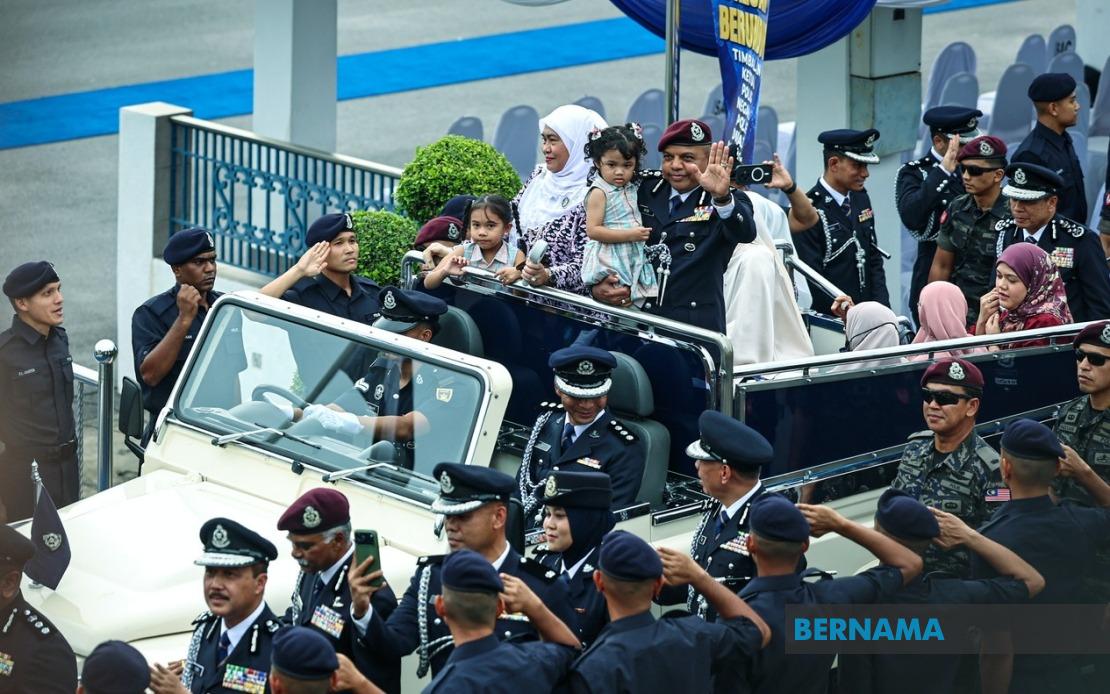
The Royal Malaysian Police must be granted independence to enforce the law without fear or favour if Malaysia aspires to build a police force capable of meeting international standards. This view came from Tan Sri Ayob Khan Mydin Pitchay, the outgoing Deputy Inspector-General of Police, who underscored that treating all citizens equally before the law—irrespective of their political connections or background—remains the cornerstone of institutional credibility. Speaking at the Kuala Lumpur Police Training Centre on the occasion of his handover, Ayob Khan made clear that consistent, unbiased application of the law is not merely a procedural matter but essential to maintaining public respect for the force.
Ayob Khan's emphasis on impartial policing comes at a moment when questions about political interference within law enforcement persist across Southeast Asia. The incoming Acting Deputy Inspector-General, Datuk Seri Ibrahim Darus, formerly the Bukit Aman Special Branch director, now assumes the role as Ayob Khan approaches compulsory retirement after nearly 35 years of service. This leadership transition offers an opportunity to reinforce institutional values and operational independence, particularly given ongoing concerns about how political pressures can shape policing priorities and enforcement decisions. The timing of these remarks suggests a deliberate attempt to establish clear expectations for the incoming administration regarding the boundaries between lawful governance and political influence.
To illustrate his commitment to non-partisan enforcement, Ayob Khan referenced his tenure leading the Counter-Terrorism Division in 2019, when his division apprehended between 14 and 15 individuals suspected of links to the Liberation Tigers of Tamil Eelam. Notably, this operation included the arrests of two State Assemblymen who belonged to the then-ruling political coalition. Rather than viewing this as evidence of bias or selective prosecution, Ayob Khan presented it as proof that his division applied the law consistently, crossing no political red lines and showing no allegiance to any party. This example carries particular weight in the Malaysian context, where questions about whether law enforcement treats opposition figures differently from government loyalists have occasionally clouded public confidence in the police.
The distinction Ayob Khan drew between a politician and a statesman encapsulates a broader argument about institutional governance. While politicians, he suggested, focus narrowly on the next electoral cycle, statesmen adopt longer time horizons and think in terms of generational impact. This framing implicitly positions professional law enforcement as belonging to the latter category—institutions whose legitimacy depends on transcending partisan cycles and serving the nation's broader interests. For Malaysian readers, this resonates with ongoing debates about whether public institutions, from the judiciary to civil service, can genuinely operate above politics, or whether structural factors inevitably inject partisan considerations into supposedly neutral organisations.
Ayob Khan was also explicit about his own disinterest in political involvement after retirement, stating that he has no intention of joining any political party or movement. Such declarations, while routine in retirement speeches, carry significance in Malaysian politics, where retired senior security officials have occasionally transitioned into political roles or advisory positions with elected governments. His firm rejection of political participation underscores a professional identity centred on law enforcement rather than power-seeking, though observers might note that maintaining this boundary becomes easier once retirement has been secured. Nevertheless, the statement reinforces a model of police leadership rooted in institutional rather than personal political interests.
The broader implications of Ayob Khan's message extend beyond Malaysia's borders to the wider Southeast Asian region, where questions about police independence and professional integrity affect public trust across multiple nations. Thailand, the Philippines, Indonesia, and Vietnam have all grappled with allegations that police forces operate as instruments of particular political factions rather than impartial enforcers of law. Malaysia's police leadership articulating a clear commitment to non-partisan enforcement potentially sets a regional benchmark, though the extent to which such principles translate into practice remains an open question requiring consistent institutional reinforcement and transparent oversight mechanisms.
During his extensive career, Ayob Khan navigated numerous sensitive postings that tested the principles he now advocates. His roles included leadership of the Narcotics Criminal Investigation Department, the Criminal Investigation Department at Bukit Aman, and a stint as Johor police chief—positions requiring navigation between crime control imperatives and political sensitivities. His progression through these positions without public scandal or allegations of gross misconduct suggests either genuine adherence to professional standards or considerable skill in managing institutional relationships. Either way, his appointment as Deputy Inspector-General and his statements upon departure carry weight because they come from someone who has operated within Malaysia's security establishment and presumably understands its political economy intimately.
The question of police independence intersects with Malaysia's evolving constitutional and political landscape. Recent years have witnessed discussions about reforming governance structures, enhancing transparency, and strengthening institutional checks on executive power. A truly world-class police force, as Ayob Khan frames it, would necessarily embrace these reforms as enhancing rather than threatening professional legitimacy. This perspective aligns with international standards advocated by organisations like Transparency International and Human Rights Watch, which emphasise that professional, accountable policing ultimately serves state interests more effectively than politically-captured enforcement.
For Malaysian citizens and readers across the region, the practical challenge lies in translating such institutional commitments into observable outcomes. Public perception of police fairness depends not merely on leadership rhetoric but on measurable patterns in arrests, prosecutions, and enforcement actions across different demographic and political groups. Building truly world-class policing will require sustained attention to recruitment and training standards, investment in technology and operational capacity, and perhaps most importantly, transparent mechanisms for accountability when individual officers or units deviate from professional standards. Ayob Khan's parting message establishes a benchmark against which his successors' actions will inevitably be measured.

