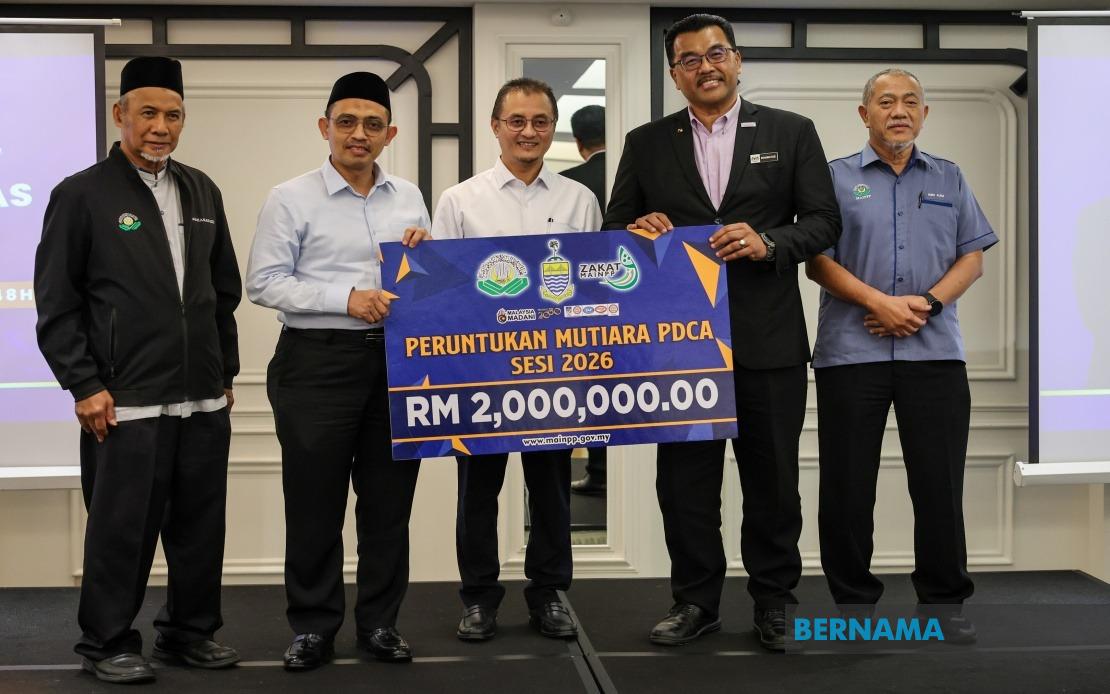
The Penang State Islamic Religious Council (MAINPP) has invested RM2 million into its marquee educational initiative, the Mutiara Didik Cemerlang Akademik (MPDCA) Programme, reaching 7,403 Bumiputera pupils and students throughout the state. Announced by Penang Deputy Chief Minister I Datuk Dr Mohamad Abdul Hamid at a coordinating teachers' briefing in Kepala Batas, the funding represents a sustained commitment to narrowing educational inequalities among disadvantaged communities in Malaysia's northern region.
The programme operates as a collaborative framework involving MAINPP, the Penang State Education Department (JPNPP), the Penang Bumiputera Participation Coordination Division under the Prime Minister's Department Implementation Coordination Unit, and the Penang Regional Development Authority (PERDA). This institutional partnership underscores the multi-level governance approach required to implement educational subsidies at scale. The coordinated structure allows participating agencies to pool resources, align curriculum delivery, and monitor outcomes across 71 primary schools and 38 secondary schools—a network encompassing 698 teacher coordinators tasked with delivering quality instruction to eligible beneficiaries.
For primary-level participants, the 2026 iteration concentrates on four foundational subjects: Bahasa Melayu, English, Mathematics and Science. Secondary students preparing for the Sijil Pelajaran Malaysia (SPM) examination access instruction in thirteen subjects, expanding the curriculum to include History, Arabic, Additional Mathematics, Physics, Chemistry, and Biology. Students enrolled in government-aided religious schools benefit from three specialised curriculum areas covering contemporary Arabic language studies, Islamic jurisprudence, and Islamic foundational theology—reflecting the religious dimension embedded within MAINPP's educational mission.
The programme's pedagogical approach emphasises structured learning modules, examination technique workshops, and academic seminars rather than conventional classroom repetition. Materials are systematically developed to strengthen foundational competencies in literacy and numeracy while preparing students for classroom-based assessments (PBD) and formal examinations. This deliberate design mirrors international best practices in remedial education, where targeted intervention using evidence-based materials produces measurable gains in student performance.
Testimony from educators implementing the programme highlights its particular value for economically marginalised households. Teachers at participating schools report that families unable to afford private tuition—a significant expense for lower-income Malaysian households—gain access to professional instruction at no cost. One educator observed that interactive, quiz-based learning activities have demonstrably increased student engagement and classroom participation, translating into improved academic outcomes. The programme thus functions as an equity mechanism, providing resources that wealthier families secure privately to students whose families lack such financial capacity.
Beyond the primary MPDCA initiative, MAINPP's broader educational investment portfolio reveals institutional depth. The council has allocated RM22.36 million for higher education bursaries, RM6.3 million for post-secondary institution commencement assistance, RM3 million for early schooling aid, and RM3 million for school uniform support. Collectively, these allocations exceed RM36 million, constituting substantial financial commitment toward human capital development. This integrated approach—spanning early childhood through tertiary education—reflects understanding that educational equity requires intervention across the entire learning trajectory.
The MPDCA programme itself carries a two-decade track record. Introduced in 2006, it has operated continuously through various economic cycles and educational policy shifts, suggesting institutional stability and genuine commitment to sustainability. Data from JPNPP demonstrates positive academic trajectories among programme participants compared to similar students outside the initiative, validating the investment. The longevity and demonstrable effectiveness of this mechanism distinguish it from ad-hoc interventions that frequently lack rigorous evaluation or longitudinal assessment.
For Malaysia's broader policy context, the Penang model offers instructive lessons. As the nation pursues its ambitions to enhance educational outcomes and reduce socioeconomic achievement gaps, state-level religious councils have emerged as significant educational actors. MAINPP's expanded role reflects broader recognition that conventional government education budgets, whilst substantial, require supplementation through targeted programmes. Religious and community institutions, often possessing trust networks within Bumiputera communities, demonstrate particular effectiveness in reaching populations that might otherwise face barriers accessing academic support.
The programme's emphasis on Bumiputera targeting aligns with Malaysia's constitutional framework and social contract commitments. By concentrating resources on this demographic, MAINPP operationalises constitutional provisions through practical educational delivery. This targeting simultaneously raises equity questions regarding access for disadvantaged non-Bumiputera students in similar economic circumstances, though Malaysian policymaking has consistently maintained categorical entitlements based on constitutional enumeration.
Looking forward, the RM2 million annual commitment, whilst substantial in isolation, remains modest relative to overall education system budgets. Scaling this model across peninsular Malaysia would require significantly expanded funding and institutional capacity. The relative success in Penang partly reflects particular demographic composition, strong institutional coherence between religious councils and education authorities, and the state's particular socioeconomic profile. Replication elsewhere would necessitate contextualised adaptation rather than wholesale duplication.
The programme ultimately demonstrates how state institutions can utilise available fiscal space to address educational inequality without requiring major budgetary restructuring at federal levels. For Malaysian policymakers evaluating how to improve Bumiputera educational outcomes, the Penang experience suggests that institutional partnership, structured pedagogical interventions, and sustained resource commitment—even at modest annual levels—can produce measurable improvements in student achievement and opportunity access.

