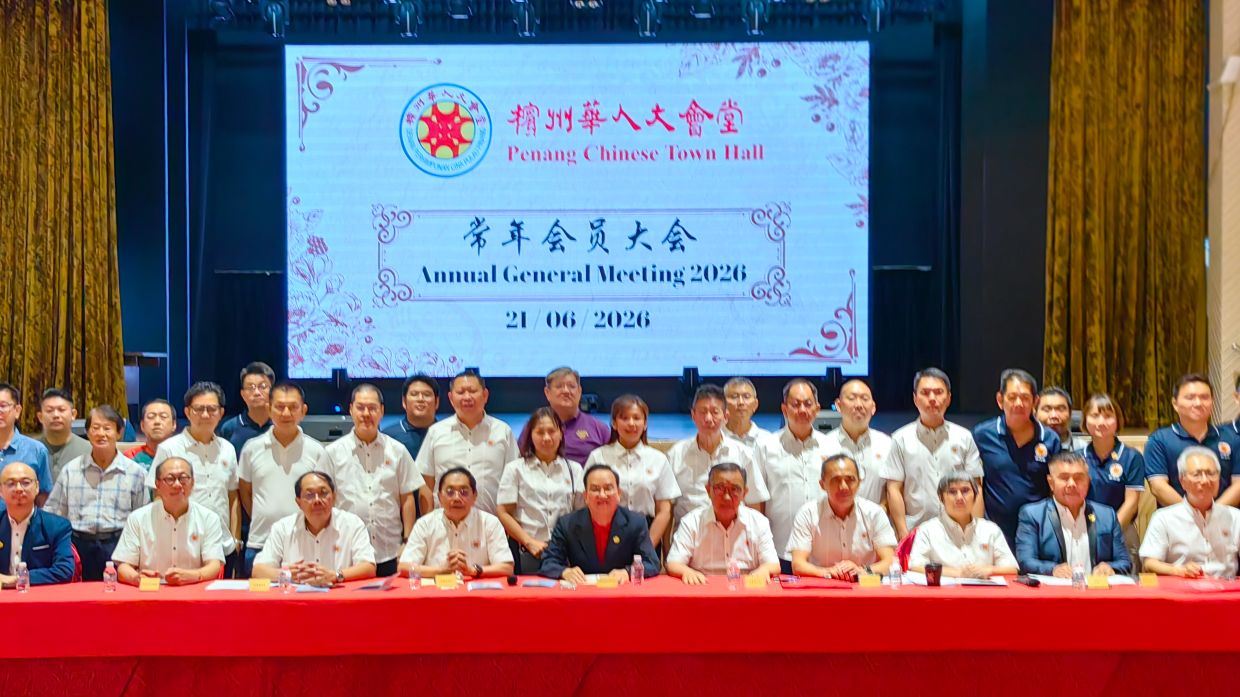
Penang Chinese Town Hall has completed its financial year 2025 with total income reaching RM12.61mil against expenditure of RM12.55mil, yielding a surplus of RM59,191 according to the organization's latest annual report filed through December 31. The slender margin between income and outgoings underscores the organization's commitment to reinvesting most of its resources directly into community activities and charitable work rather than building reserves.
Donations formed the backbone of PCTH's revenue stream, contributing RM11.24mil or roughly 89 percent of total income. This reliance on philanthropic contributions reflects the organization's role as a community institution dependent on the generosity of members and supporters who value its heritage and social functions. Beyond donations, the organization generated RM439,671 from rental and maintenance fees, RM361,245 from auditorium rental services, and RM222,498 from anniversary-related receipts, demonstrating diversified revenue channels that supplement its core funding base.
Expenditures mirrored the donation-heavy income profile, with charitable disbursements consuming RM11.12mil or approximately 88.6 percent of total spending during the year. This proportion actually improved from the previous year when donations reached RM12.35mil in 2024, indicating PCTH successfully moderated its charitable commitments while maintaining operational effectiveness. Operating costs included salaries and allowances which climbed to RM502,625 from RM452,761 in 2024, reflecting modest wage growth across the organization's staff complement.
Chairman Tan Sri Prof Tan Khoon Hai used the organization's annual general meeting on June 21, attended by approximately 200 members, as a platform to emphasize civic engagement and democratic participation. With Johor and Negri Sembilan scheduled to conduct state elections during 2025, his remarks about informed voting carried immediate relevance for the Malaysian political calendar. Tan advocated that voters evaluate competing parties' track records and election promises with careful deliberation, prioritizing candidates whose platforms centered on national unity, sustainable economic expansion, and preservation of social cohesion.
The chairman framed elections beyond their conventional interpretation as mechanisms for securing local infrastructure improvements and community projects. Instead, he positioned electoral choices as pivotal moments for setting the nation's long-term direction and determining the character of governance that would shape Malaysia's development trajectory. His address reflected concerns within community institutions about voter engagement and the quality of political decision-making in the contemporary Malaysian context.
Tan unveiled significant capital improvements at PCTH with the completion of Ping Zhang Hall's comprehensive renovation and modernization initiative. The upgraded facility now features expanded floor space designed for comfort, complemented by professional-grade sound systems, advanced lighting infrastructure, and contemporary LED display technology. These enhancements position the hall as a versatile venue suitable for corporate functions, association gatherings, anniversary celebrations, charitable fundraisers, and community assemblies, broadening PCTH's capacity to serve diverse organizational needs beyond its traditional membership base.
Looking forward, PCTH is positioning itself at the intersection of regional technology cooperation by jointly organizing the 2026 China-Asean Artificial Intelligence Cooperation Forum scheduled for November in Penang. The initiative brings together business enterprises and technology organizations from China and across the Asean bloc, reflecting Penang's established credentials as a regional technology hub and electronics manufacturing center. This strategic involvement signals PCTH's evolution beyond its historical role as a purely cultural institution toward engagement with contemporary economic development priorities.
Penang's recognition as the Silicon Valley of the East and its dominant position in Malaysia's electrical and electronics sector provide substantial foundation for artificial intelligence industry expansion, Tan explained. The forum will convene technological experts, corporate leadership, and sector specialists from throughout the region to examine emerging AI technologies, their industrial deployment pathways, and mechanisms for practical cross-border collaboration. By hosting this high-level gathering, Penang positions itself as a serious contender for AI development within the broader Southeast Asian economy.
Tan actively encouraged PCTH members possessing relevant technological expertise and industry connections to participate in the forum's organization and programming. His appeal reflected recognition that community institutions can meaningfully contribute to regional economic initiatives when they leverage member networks and institutional credibility. The forum represents an opportunity for Penang-based professionals and entrepreneurs to strengthen the city's standing within Asian technological cooperation frameworks and demonstrate local capacity for advanced industry development.
The financial results, facility upgrades, and strategic technology initiatives collectively illustrate PCTH's transition toward a more diversified organizational model. While maintaining its foundational role as a community gathering space and charitable contributor, the institution increasingly engages with contemporary policy issues and regional economic partnerships. This evolution allows traditional community organizations to remain relevant within rapidly changing economic and social contexts while preserving their core identity and values.
For Malaysian business observers and stakeholders in the technology sector, PCTH's expanded role demonstrates how established community institutions can facilitate regional cooperation and knowledge exchange. The organization's involvement in the AI forum underscores Penang's enduring importance in Malaysia's technology ecosystem and signals growing interconnections between established cultural institutions and emerging economic initiatives. These dynamics suggest that community organizations will play increasingly important roles in regional development beyond their traditional charitable and social functions.
%22%2F%3E%3C%2Fpattern%3E%3C%2Fdefs%3E%3Crect%20width%3D%22100%25%22%20height%3D%22100%25%22%20fill%3D%22url(%23ph1f6pzg)%22%2F%3E%3Crect%20width%3D%22100%25%22%20height%3D%22100%25%22%20fill%3D%22url(%23ph1f6pzp)%22%2F%3E%3Ctext%20x%3D%2250%25%22%20y%3D%2250%25%22%20text-anchor%3D%22middle%22%20dominant-baseline%3D%22central%22%20fill%3D%22rgba(255%2C255%2C255%2C0.95)%22%20font-family%3D%22Georgia%2C%20'Times%20New%20Roman'%2C%20serif%22%20font-weight%3D%22700%22%20font-size%3D%22151%22%20letter-spacing%3D%22-0.02em%22%3EPerikatan%3C%2Ftext%3E%3C%2Fsvg%3E)
%22%2F%3E%3C%2Fpattern%3E%3C%2Fdefs%3E%3Crect%20width%3D%22100%25%22%20height%3D%22100%25%22%20fill%3D%22url(%23ph5mwpng)%22%2F%3E%3Crect%20width%3D%22100%25%22%20height%3D%22100%25%22%20fill%3D%22url(%23ph5mwpnp)%22%2F%3E%3Ctext%20x%3D%2250%25%22%20y%3D%2250%25%22%20text-anchor%3D%22middle%22%20dominant-baseline%3D%22central%22%20fill%3D%22rgba(255%2C255%2C255%2C0.95)%22%20font-family%3D%22Georgia%2C%20'Times%20New%20Roman'%2C%20serif%22%20font-weight%3D%22700%22%20font-size%3D%22272%22%20letter-spacing%3D%22-0.02em%22%3EWorld%3C%2Ftext%3E%3C%2Fsvg%3E)
%22%2F%3E%3C%2Fpattern%3E%3C%2Fdefs%3E%3Crect%20width%3D%22100%25%22%20height%3D%22100%25%22%20fill%3D%22url(%23ph7ryqg)%22%2F%3E%3Crect%20width%3D%22100%25%22%20height%3D%22100%25%22%20fill%3D%22url(%23ph7ryqp)%22%2F%3E%3Ctext%20x%3D%2250%25%22%20y%3D%2250%25%22%20text-anchor%3D%22middle%22%20dominant-baseline%3D%22central%22%20fill%3D%22rgba(255%2C255%2C255%2C0.95)%22%20font-family%3D%22Georgia%2C%20'Times%20New%20Roman'%2C%20serif%22%20font-weight%3D%22700%22%20font-size%3D%22320%22%20letter-spacing%3D%22-0.02em%22%3EIAEA%3C%2Ftext%3E%3C%2Fsvg%3E)