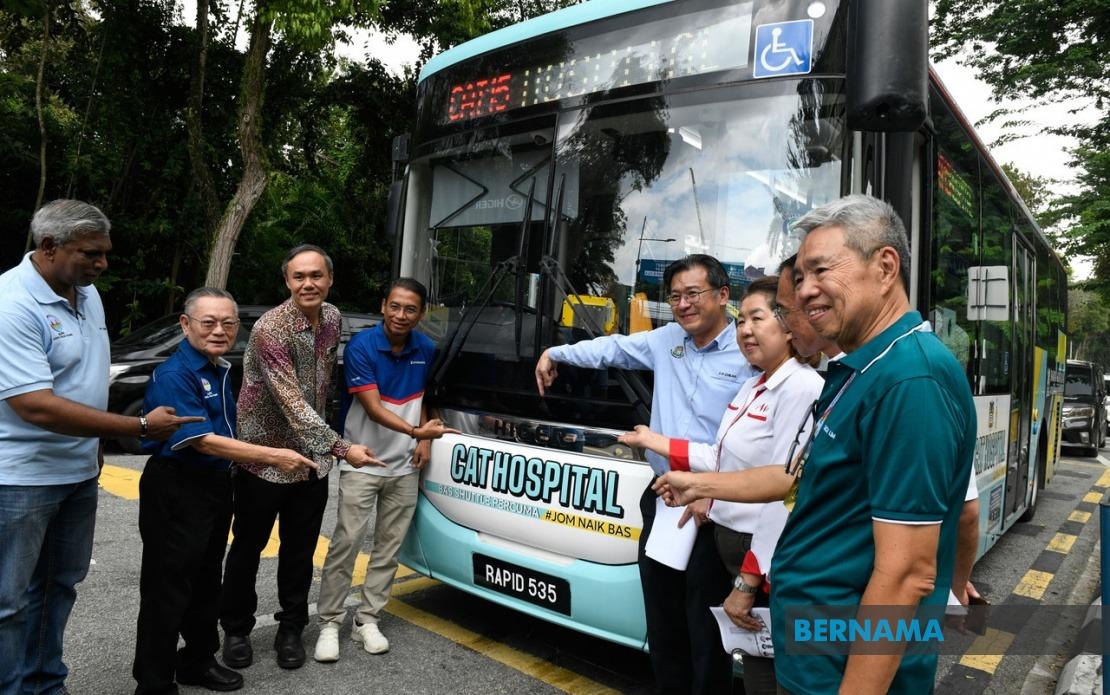
The Penang Island City Council (MBPP) is investing RM900,000 annually to maintain a free shuttle bus service that links the city's central business district with Penang Hospital and adjacent healthcare facilities, representing a significant commitment to public health accessibility and urban mobility. The Central Area Transit (CAT) shuttle service, which launched on January 1, operates along an eight-kilometre route connecting Komtar with Penang Hospital, three private hospitals, and several medical centres in the George Town area. This initiative reflects growing efforts across Malaysian cities to integrate health infrastructure with sustainable public transport options.
According to MBPP Engineering Director Cheah Chin Kooi, the service was conceived as a multifaceted solution to urban transport challenges that emerged following Penang Hospital's expansion project. The hospital's growth had intensified parking constraints in the surrounding area, creating logistical difficulties for patients, healthcare workers, and visitors. Rather than simply expanding car parks—a costly and space-intensive approach common in many Malaysian urban areas—the council opted to address the underlying transport problem by providing a convenient, cost-free alternative that would shift some demand away from private vehicles.
The operational framework demonstrates practical coordination between public sector entities and transport operators. Three Rapid Penang buses service the route daily, running from 6 am to 8 pm with departures every 20 minutes, yielding 36 trips per day. This frequency ensures that users face minimal waiting times, a critical factor in encouraging adoption of public transport among older patients and caregivers who may otherwise default to private vehicles or expensive taxi services. The regularity of service also supports hospital operations by providing predictable patient arrival patterns.
Early adoption metrics suggest the initiative has gained substantial traction. Since launching, daily ridership has grown from approximately 300 passengers to around 600 currently—a doubling of demand that indicates the service addresses genuine transport needs. This trajectory suggests that as awareness spreads through word-of-mouth and hospital promotion, usage could increase further. For a city struggling with congestion, such transport solutions offer measurable benefits beyond the immediate catchment of hospitals and healthcare facilities.
The strategic rationale underlying the investment aligns with broader urban planning objectives articulated by Cheah and his counterparts. By reducing reliance on private vehicles, the shuttle service directly contributes to alleviating traffic congestion in one of George Town's most congested areas during peak hospital visitor hours. Simultaneously, it addresses parking scarcity—a chronic problem that forces many patients and visitors into informal parking arrangements that further clog local streets. In a city where property values are high and available land limited, investing in transport infrastructure rather than parking facilities represents fiscally prudent governance.
The hospital administration has reciprocated the council's investment with complementary infrastructure improvements. Penang Hospital director Dr Goh Hin Kwang indicated that the institution upgraded pedestrian walkways along Jalan Residensi and is undertaking work to improve the main entrance on Jalan Utama. These modifications facilitate seamless transfers from the shuttle bus to hospital facilities, eliminating the disconnects that often plague last-mile transport links. Such attention to passenger experience is crucial; even excellent bus services fail if users encounter confusing or inconvenient transitions to their final destinations.
The initiative carries particular significance for vulnerable populations who depend on healthcare access. Senior citizens, who constitute a growing proportion of Penang's population, often face challenges using private transport or affording taxi services. Free shuttle access reduces financial barriers while accommodating mobility limitations that make independent driving difficult or unsafe. Similarly, caregivers accompanying patients benefit from predictable, cost-free transport that allows them to dedicate time to supporting family members rather than managing vehicle logistics. This equity dimension extends the service's value beyond simple traffic management.
From a regional perspective, this Penang model offers lessons for other Malaysian cities facing similar urban transport and healthcare access challenges. Many hospitals in Kuala Lumpur, Johor Bahru, and other urban centres struggle with parking and traffic pressures, yet few have implemented systematic solutions combining free public transport with destination infrastructure improvements. The relatively modest annual outlay of RM900,000—equivalent to perhaps 20-30 passenger car parking spaces in a comparable area—suggests that cost need not be a prohibitive barrier to such schemes.
The involvement of multiple stakeholders—Rapid Bus Sdn Bhd Northern Region head Mohd Amir Abd Halim, hospital leadership, and city council representatives—demonstrates that effective transport solutions require coordination across traditionally siloed organisations. This collaborative approach, though common in developed urban systems, remains inconsistently implemented across Southeast Asia. Sustaining such partnerships through regular communication, performance monitoring, and shared accountability will determine whether the initiative remains viable as usage patterns evolve.
Looking forward, the service's performance will bear close monitoring. Ridership growth, user satisfaction surveys, and measured reductions in hospital-area traffic could justify expansion to additional routes or extended operating hours. Conversely, if growth plateaus, analysis of barriers would inform design improvements. The current trajectory, however, suggests that when public authorities strategically invest in transport solutions addressing genuine urban needs, uptake follows. For Malaysia's densifying cities, such evidence carries weight as planners consider how to balance growth, mobility, and livability.

