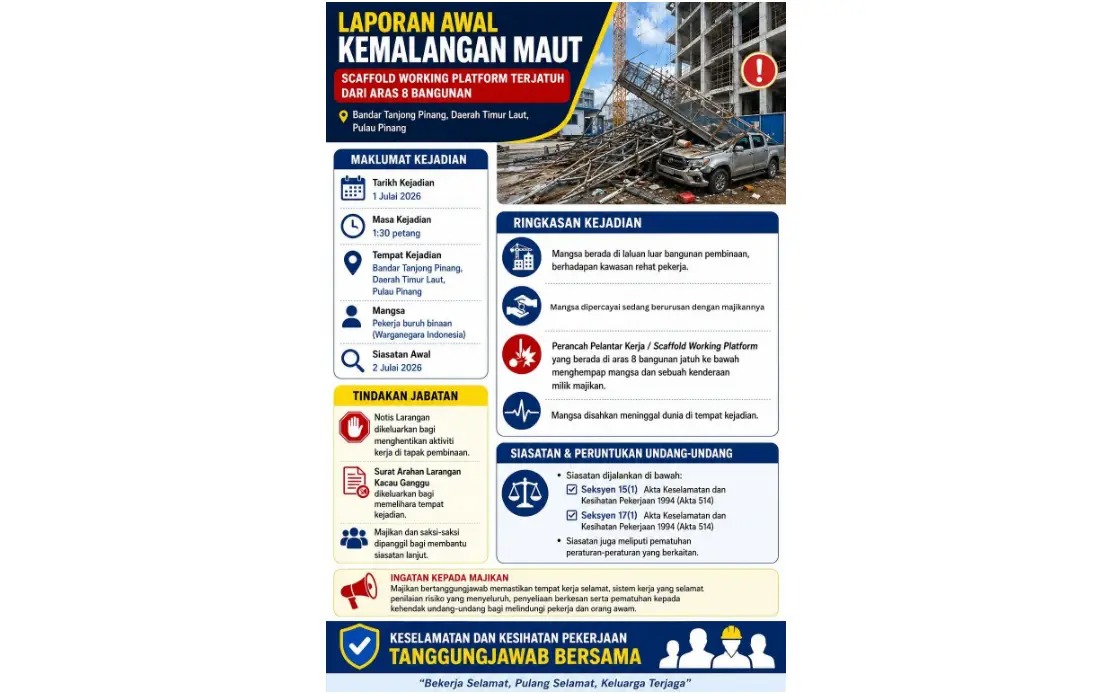
The Department of Occupational Safety and Health (DOSH) in Penang has moved swiftly to shut down operations at a Bandar Tanjong Pinang construction site in the aftermath of a fatal accident that claimed the life of an Indonesian worker. The tragic incident, which occurred on July 1 at 1.30 pm, has prompted urgent regulatory action designed to prevent further casualties while investigators work to establish the circumstances surrounding the collapse.
According to DOSH's statement, a worker on the site was fatally struck by a working platform attached to scaffolding that detached from the eighth floor of a building under construction. The victim, whose identity has not been disclosed, was positioned on a lower level of the structure, standing on an external walkway in front of a workers' rest area when the scaffolding suddenly fell. The force of the impact was severe enough to damage a vehicle belonging to the employer who was present at the time of the incident.
In response to the tragedy, DOSH has issued a prohibition notice requiring the immediate cessation of all work activities at the site. This enforcement measure is accompanied by a non-disturbance order that preserves the accident scene in its current state, safeguarding evidence for investigators. These actions reflect the regulator's commitment to conducting a thorough examination of the circumstances that led to the collapse, and to determining whether workplace safety standards were properly maintained.
The investigation now underway will examine whether the site's management complied with mandatory provisions under the Occupational Safety and Health Act 1994. Specifically, DOSH will focus on Sections 15(1) and 17(1) of the legislation, which establish the fundamental duties employers must discharge to protect worker safety. These provisions require employers to take all reasonably practicable steps to ensure the health and safety of employees and other persons who may be affected by workplace operations. The investigation will also scrutinise relevant regulations that govern the safe installation, maintenance, and use of temporary structures such as scaffolding on construction sites.
DOSH has called on employers, witnesses, and other individuals connected to the work site to cooperate fully with investigators. Their testimonies and accounts will prove crucial in reconstructing the sequence of events leading up to the collapse, and in identifying any failures in planning, supervision, or maintenance that may have contributed to the accident. The scope of the inquiry extends beyond a simple examination of the scaffolding itself to encompass the entire safety management system in place at the site.
Penang DOSH has warned that enforcement action will be pursued if the investigation reveals any breaches of occupational safety legislation. This could result in substantial penalties, including fines and prosecution of individuals and organisations found responsible. The regulatory authority has used the incident as an opportunity to remind all stakeholders in the construction industry—developers, main contractors, and subcontractors—of their legal and moral obligations to operate safely.
The incident highlights persistent challenges within Malaysia's construction sector, where safety lapses continue to result in preventable deaths and injuries. Worker fatalities involving temporary structures such as scaffolding occur with disturbing frequency across the region, often stemming from inadequate training, poor maintenance, or insufficient supervision. This particular accident, involving a foreign worker, underscores the vulnerability of migrant labourers who may lack familiarity with local safety standards or the language necessary to report hazards.
For Malaysian employers and contractors operating construction sites, this case serves as a stark reminder of the consequences of cutting corners on safety procedures. DOSH's decisive action in issuing a stop-work order demonstrates that regulators are prepared to take swift enforcement action when workers' lives are at stake. The investigation's findings will likely generate significant scrutiny of how scaffolding is engineered, inspected, and maintained across similar sites throughout Penang and beyond.
The broader implications for Malaysia's construction industry are substantial. As the nation continues to expand infrastructure projects and urban development across multiple states, maintaining rigorous safety standards becomes increasingly important. The construction sector employs hundreds of thousands of workers, many of them migrant labourers from neighbouring countries, who are entitled to the same level of protection afforded to Malaysian workers. Regulatory bodies must ensure that safety requirements are enforced consistently and that companies understand that negligence carries serious consequences.
Beyond the legal and regulatory dimensions, this tragedy raises questions about corporate accountability in the construction industry. Site managers and safety officers bear responsibility for implementing systems that prevent such incidents. The investigation will likely reveal whether adequate toolbox talks, hazard assessments, and competent supervision were in place. It will examine whether workers were provided with appropriate personal protective equipment and whether they understood the specific risks associated with working near temporary structures.
For the deceased worker's family and colleagues, the stop-work order and investigation provide some assurance that the incident will receive serious scrutiny and that accountability will be pursued if negligence is found. DOSH's commitment to taking such cases seriously sends a message to the industry that worker safety is not negotiable and that breaches will result in consequences.
The Bandar Tanjong Pinang incident will likely lead to increased scrutiny of other active construction sites in Penang and across Malaysia. DOSH may intensify routine inspections to ensure compliance with scaffolding standards and general occupational safety requirements. Contractors and developers who have grown complacent about safety procedures should expect heightened regulatory attention in the coming months. The investigation's conclusions will inform guidance for the industry and may prompt revisions to existing standards or the implementation of additional safeguards.

