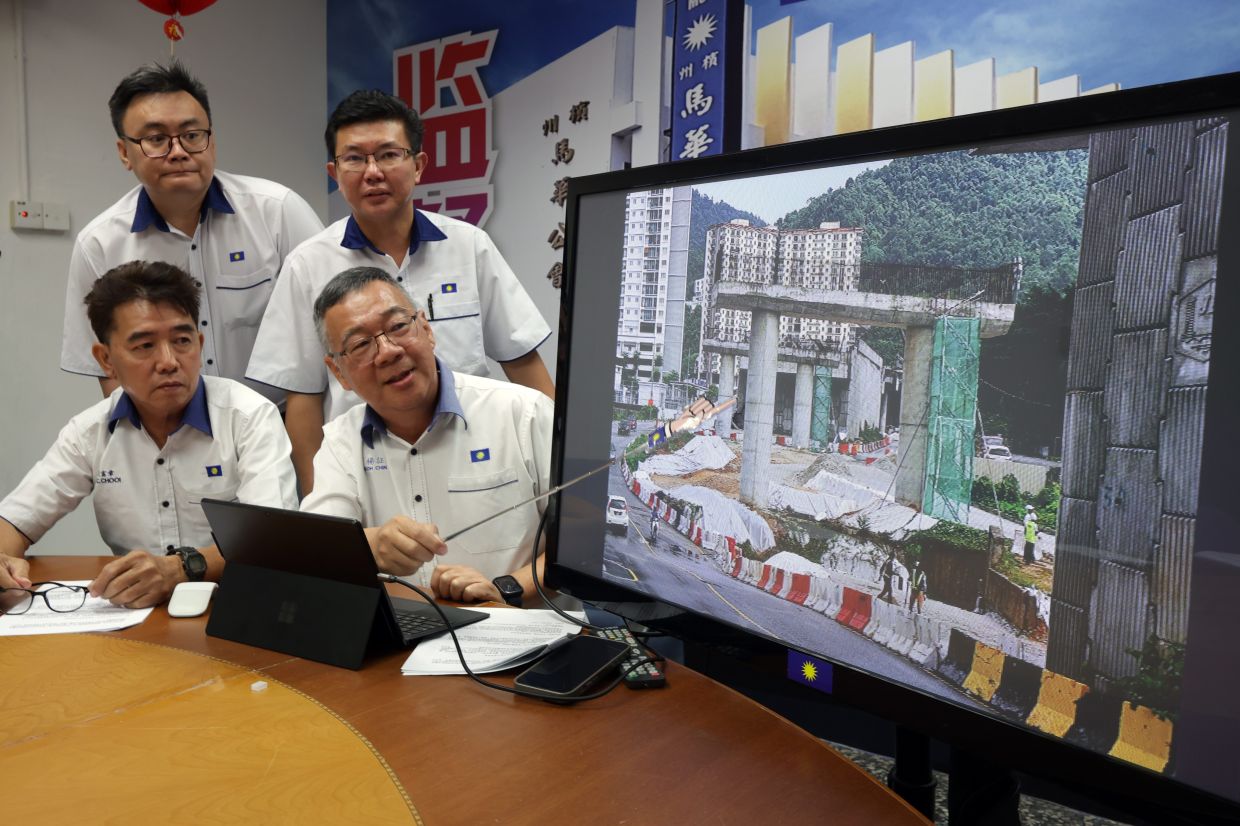
The Penang MCA has escalated pressure on the state government to account for delays affecting the Air Itam-Tun Dr Lim Chong Eu Expressway bypass project, moving beyond simple explanations of postponements to demand comprehensive documentation of expenditures, consultant certifications and independent assessments. Party secretary Yeoh Chin Kah framed the dispute as fundamentally a matter of public confidence rather than mere project management, signalling that political stakes have risen considerably around infrastructure accountability in the state.
Yeoh's intervention reflects growing scepticism about official completion figures that have shifted from 80% in May to 89% in December despite acknowledged setbacks. The discrepancy between reported progress metrics and observable construction conditions on the ground has become the focal point of challenge. During an inspection conducted by party members on July 1, MCA representatives documented that Valley Road, Changkat Tembaga and Jalan Thean Teik sections remain substantially incomplete, with structural elements far from finished.
Visual evidence gathered during the site visit contradicts the reported advancement rate. Concrete bridge supports exist at several locations, but critical components including bridge beams, deck structures and surface layers have not been installed across multiple sections. Crucially, secondary installations such as guardrails, sound barriers, and electrical and mechanical systems remain absent from many areas, presenting a comprehensive picture of incomplete work that cannot reasonably align with claims of near-90% progress. This gap between reported metrics and visible reality has triggered MCA's formal challenge to state authorities.
The Air Itam-Tun Dr Lim Chong Eu Expressway project represents the second package of Penang's broader undersea tunnel and paired roads initiative, comprising a 6-kilometre toll-free corridor connecting Lebuhraya Thean Teik in Bandar Baru Air Itam to the Tun Dr Lim Chong Eu Expressway via a combination of elevated viaducts, subterranean passages and conventional surface roadways. Originally envisioned for 2024 completion, the project has undergone two formal extensions, with authorities now targeting April 12, 2027 for handover. The infrastructure's eventual opening stands to benefit approximately 300,000 residents across Air Itam, Bandar Baru Air Itam and Paya Terubong through reduced travel times and improved traffic distribution.
Yeoh has issued the state government a seven-day ultimatum to produce requested documentation including payment records to contractors, consultant certification reports validating work quality, and formal project assessment documents. Should authorities fail to comply, Penang MCA has committed to filing formal complaints with both the National Audit Department and the Malaysian Anti-Corruption Commission, escalating the matter beyond state-level discussion to federal oversight bodies. Additionally, the party intends to establish a dedicated monitoring committee to track reported completion percentages and verify payment transactions against actual construction progress.
Paya Terubong state assemblyman Wong Hon Wai has countered the MCA accusations, asserting that current progress stands at 91% and trajectory remains consistent with the April 12, 2027 deadline. Wong indicated he attended a construction team meeting on June 30 where updated figures were presented, and that the contractor has provided assurances regarding timely completion. He noted that 12 bridge beams on the Gelugor side are scheduled for installation between the current month and August, with the remaining six beams targeted for the final quarter of the year.
Wong's statement confirmed that bridge beams on the Bandar Baru Air Itam side have already been launched, though he clarified that road opening will not occur immediately upon construction completion. Ongoing work includes deck slab installation and parapet construction, activities that must conclude before evaluation begins. Following completion of these works, Wong indicated that the Road Safety Audit process will be conducted by relevant government agencies, with the Public Works Department subsequently recommending an opening date based on audit outcomes. This multi-stage verification process suggests potential additional delays beyond the stated April 2027 target.
The disagreement between Penang MCA and state administration reflects broader patterns of infrastructure delivery accountability across Malaysia, where announced completion dates frequently slip while official progress percentages suggest near-readiness. The specificity of MCA's photographic documentation from July 1—identifying incomplete bridge structures, unfinished surface works, and absent safety installations—presents empirical foundation for questioning reported metrics. Such discrepancies between numerical progress claims and ground-level evidence have undermined public trust in similar projects nationwide.
For Malaysian readers and regional observers, this episode illustrates the governance challenges that accompany large infrastructure projects in developing economies. Completion rate percentages, while useful for internal project management, may not accurately reflect construction reality when measured against observable physical progress. The importance of independent verification and transparent documentation becomes evident when official narratives diverge sharply from what site inspections reveal, particularly for projects intended to serve hundreds of thousands of residents. The MCA's escalation strategy—combining photographic evidence, formal documentation demands, and threats of federal complaint—represents a template that opposition parties and civil society groups increasingly employ when challenging infrastructure narratives.
The broader implications extend to Penang's status as a high-profile infrastructure laboratory within Southeast Asia. The state has positioned itself as a development showcase through ambitious transport projects, including the undersea tunnel concept that encompasses this expressway. Credibility regarding delivery timelines and cost management carries particular weight for attracting future investment and maintaining public support for government spending. Should authorities be unable to satisfactorily explain discrepancies between reported progress and observable conditions, or produce transparent payment and certification documentation, political ramifications could extend beyond this single project to affect broader confidence in state administration.
The situation also highlights tensions between contractor timelines, government announcements and independent verification in Malaysian infrastructure delivery. Contractors have inherent incentives to report positive progress to avoid penalty clauses and maintain good standing for future projects, while government officials may face political pressure to present optimistic completion forecasts. Independent monitoring through legislative oversight, audit bodies and opposition party scrutiny serves as an essential counterbalance to these institutional biases. Penang MCA's confrontational approach, while politically motivated, performs a necessary accountability function that formal project management structures sometimes fail to deliver.

