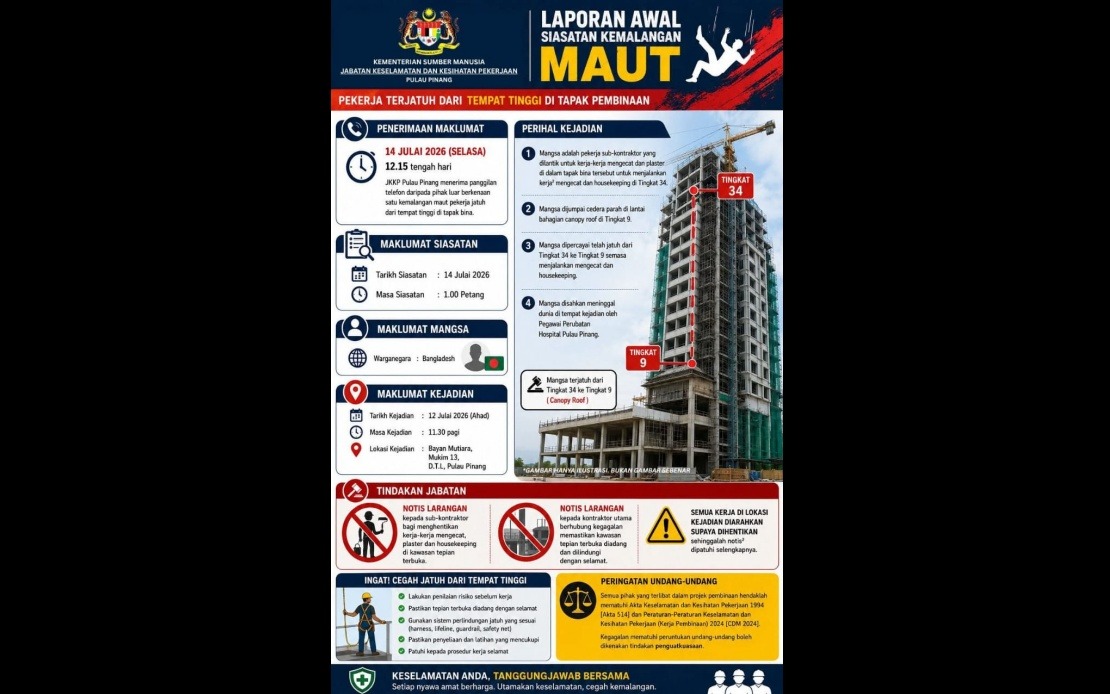
The Penang Department of Occupational Safety and Health has launched a formal investigation into the fatal fall of a Bangladeshi construction worker at a residential high-rise project in Bayan Mutiara, marking another serious incident in the state's building sector. The worker, employed by a subcontracting firm, died after falling from the upper reaches of the building, prompting immediate intervention from safety regulators and raising fresh concerns about hazard management on Malaysian construction sites.
Penang DOSH director Hairozie Asri disclosed that the department received initial notification of the incident at 12.15 pm on July 14, with investigating officers dispatched promptly to examine the scene. The victim had been engaged by a subcontractor responsible for painting, plastering, and housekeeping operations across the construction site. Preliminary findings indicate he was performing work on the 34th floor when the accident occurred, though he was subsequently discovered with severe injuries on the canopy roof structure at Level 9, suggesting a dramatic fall spanning multiple storeys.
Medical personnel from Penang Hospital arrived at the site and determined that the worker had already succumbed to his injuries by the time they arrived. The fatality underscores the inherent risks associated with high-altitude construction work, where even momentary lapses in safety protocols or equipment failures can prove catastrophic. For migrant workers particularly, many of whom have limited familiarity with Malaysia's occupational standards or language capabilities to voice safety concerns, such incidents highlight systemic vulnerabilities in site management and worker protection.
In response to the fatality, DOSH moved swiftly to impose operational restrictions. The regulator issued a prohibition notice to the subcontractor, explicitly forbidding continuation of painting, plastering, and housekeeping activities in areas with unprotected edges—a direct measure addressing the apparent circumstances of this tragedy. Additionally, a separate prohibition notice was served on the main contractor overseeing the overall construction project, establishing clear accountability across the contractual chain.
All work activity at the accident site has been ordered to cease immediately until the subcontractor and main contractor can demonstrate full compliance with the prohibition notices and related safety requirements. This suspension represents a significant operational disruption for the project, but reflects DOSH's prioritisation of worker safety over construction schedules. The enforcement action signals that Malaysian occupational authorities are prepared to use their statutory powers to halt projects when safety breaches are identified.
The incident occurs within a broader context of construction safety challenges across Malaysia and the broader Southeast Asian region. High-rise development in urban centres like Penang has accelerated substantially in recent years, often driven by competitive pressures that can inadvertently compromise safety standards. Subcontracting chains, which fragment responsibility across multiple entities, can create accountability gaps where safety accountability becomes diffused and preventative measures are neglected in favour of cost minimisation.
For Malaysia's substantial migrant worker population—estimated at over two million individuals, with Bangladeshi nationals forming a significant cohort in the construction sector—fatal workplace incidents carry particular weight. These workers frequently accept positions with limited clarity regarding safety provisions, often work without adequate personal protective equipment, and may lack recourse mechanisms when hazards manifest. This worker's fall from the 34th floor likely involved preventable factors including potentially inadequate guardrails, fall-arrest systems, or training protocols.
The Penang case reflects patterns observed across Malaysian construction that warrant systemic attention. Main contractors and subcontractors must establish robust hierarchies of control, beginning with engineering measures such as guardrails and netting, proceeding through administrative protocols and training, and only relying on personal protective equipment as a final safeguard. The apparent absence of such measures at the Level 9 canopy area suggests these fundamentals were not properly implemented.
DOSH's investigation will scrutinise multiple dimensions of the incident. Officers will examine whether the subcontractor possessed necessary licensing and qualifications, whether the worker received adequate induction and safety training specific to high-altitude work, whether appropriate fall protection systems were specified in project documentation and actually installed, and whether supervision and monitoring processes could have identified and corrected unsafe practices before tragedy struck. The findings will likely inform enforcement actions beyond the immediate prohibition notices.
For the construction industry and workers across Malaysia, this incident serves as a sobering reminder that occupational safety must remain paramount rather than subordinate to project timelines and budgets. Contractor firms that view safety compliance as an impediment to profitability rather than an essential operational requirement expose themselves to both humanitarian failure and regulatory sanction. DOSH's decisive response—including work cessation—demonstrates that regulators will enforce consequences when standards are violated and lives are lost.
The broader implications extend to how Malaysia positions itself as a construction destination and employer of migrant labour. As regional development accelerates and competition for skilled workers intensifies, maintaining credible occupational safety standards protects both workers and Malaysia's international reputation. The tragedy in Bayan Mutiara, though devastating for the deceased worker's family and colleagues, creates an opportunity to reinforce safety culture across the sector.

