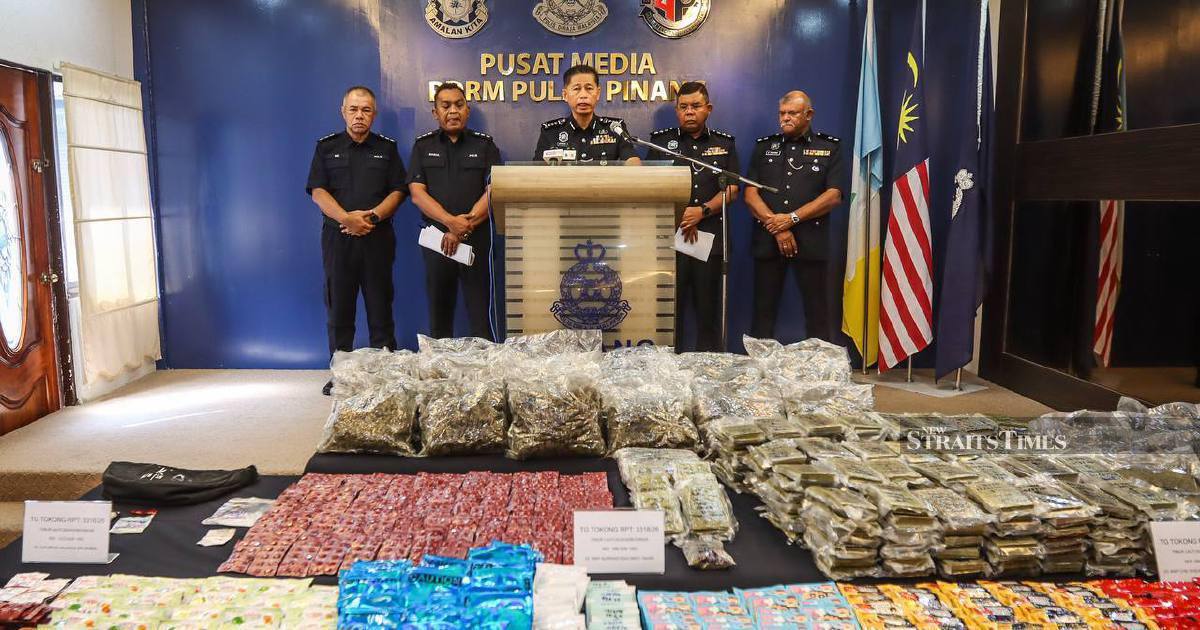
Penang police have successfully shut down three distinct drug-trafficking organisations in a significant crackdown, leading to the arrest of seven individuals and the seizure of controlled substances estimated at RM3.2 million. The operation, conducted through a series of carefully coordinated raids across the state, represents a substantial blow to the region's illicit drug supply network and demonstrates the ongoing enforcement efforts by local authorities against organised narcotics operations.
The investigation, which culminated in multiple simultaneous operations, resulted in the apprehension of a married couple among the seven arrested suspects. This development suggests that family-based networks continue to play a substantial role in drug distribution operations across Malaysia, a pattern law enforcement agencies have increasingly observed over recent years. The involvement of couples in drug trafficking reflects wider concerning trends where criminal enterprises leverage familial relationships to establish trust and operational security within their networks.
The RM3.2 million valuation of confiscated narcotics underscores the scale of commerce flowing through Penang's underground drug economy. The state, with its strategic geographic position along the northern corridor and its status as a major transport hub, remains vulnerable to transit trafficking and local distribution networks. Penang's proximity to Thailand and its well-developed port infrastructure create conditions that continue to attract drug syndicates seeking to move contraband through Southeast Asia.
The dismantling of three separate organisations simultaneously indicates that Penang police employed comprehensive intelligence gathering and strategic coordination across multiple investigation units. Such operations require meticulous surveillance, financial tracking, and often cooperation with other enforcement agencies to penetrate the compartmentalised structures that sophisticated trafficking networks typically employ. The successful execution of parallel operations suggests the authorities had developed robust evidence against each target group before moving forward with arrests.
For Malaysian readers, these enforcement actions represent part of the broader national struggle against substance abuse and trafficking. The quantities and monetary values seized in Penang are consistent with patterns observed in Kuala Lumpur and other major metropolitan areas, where individual operations can generate millions in narcotics revenue. The existence of multiple syndicates operating simultaneously highlights the persistent challenge facing law enforcement despite ongoing crackdowns and international cooperation efforts.
The strategic location of Penang makes it particularly significant in the regional context. As a gateway for international trafficking networks, disruptions to local operations in the state can have ripple effects throughout Southeast Asia's drug supply chains. Criminal organisations operating across Thailand, Malaysia, and Singapore often utilise Penang as a nodal point for redistribution, making police successes here particularly consequential for regional security.
Drug trafficking networks in Malaysia typically operate with hierarchical structures involving importers, wholesale distributors, mid-level dealers, and street-level operatives. The arrest of seven individuals across three distinct syndicates suggests these networks maintained some separation, though coordination between groups occasionally occurs for large shipments or during periods of supply disruption. Understanding these structural patterns helps authorities identify remaining members and dismantle supporting infrastructure.
The seizure of RM3.2 million in narcotics represents not merely confiscated product but reflects the substantial financial flows underlying Malaysia's drug problem. Industry analysts estimate the value of drugs seized represents only a fraction of total trafficking volumes, suggesting that despite successful operations, significant quantities continue reaching users. The economic incentives driving trafficking remain formidable, explaining why elimination of one network frequently leads to emergence of replacement operations.
Penang's enforcement agencies face distinctive challenges related to the state's demographics and geography. The substantial tourist industry, while economically vital, can create opportunities for traffickers to disguise movements of contraband. Additionally, cross-border dynamics with Thailand introduce complications requiring coordination between Malaysian authorities and international partners. Recent years have seen increasing cooperation through regional frameworks, though challenges remain in addressing sophisticated criminal organisations with resources to adapt to enforcement pressures.
The successful prosecutions of traffickers arrested in operations such as this one contribute to Malaysia's international standing on drug enforcement, relevant particularly for relations with neighbouring countries and the broader ASEAN community. Malaysia's National Drug Agency continues emphasising supply-side enforcement alongside demand-reduction initiatives, though critics argue the balance requires further reorientation toward treatment and rehabilitation of users.
For Penang residents and businesses, operations targeting major traffickers can produce short-term disruptions in local drug markets, potentially affecting street-level pricing and availability. Historical patterns suggest that while major busts temporarily constrict supply, market forces typically reassert themselves within weeks as competing organisations move to fill vacuum, unless sustained enforcement pressure continues. Authorities acknowledge this dynamic and indicate ongoing investigation into remaining network members and supporting infrastructure associated with the dismantled organisations.
The effectiveness of this operation will ultimately be measured not merely by arrests and seizures, but by sustained pressure on trafficking networks attempting to rebuild operations. Penang police and federal agencies recognise that comprehensive approach combining intelligence work, international cooperation, and disruption of financial flows provides the most promising pathway toward reducing drug availability and associated harms to communities throughout the state.

