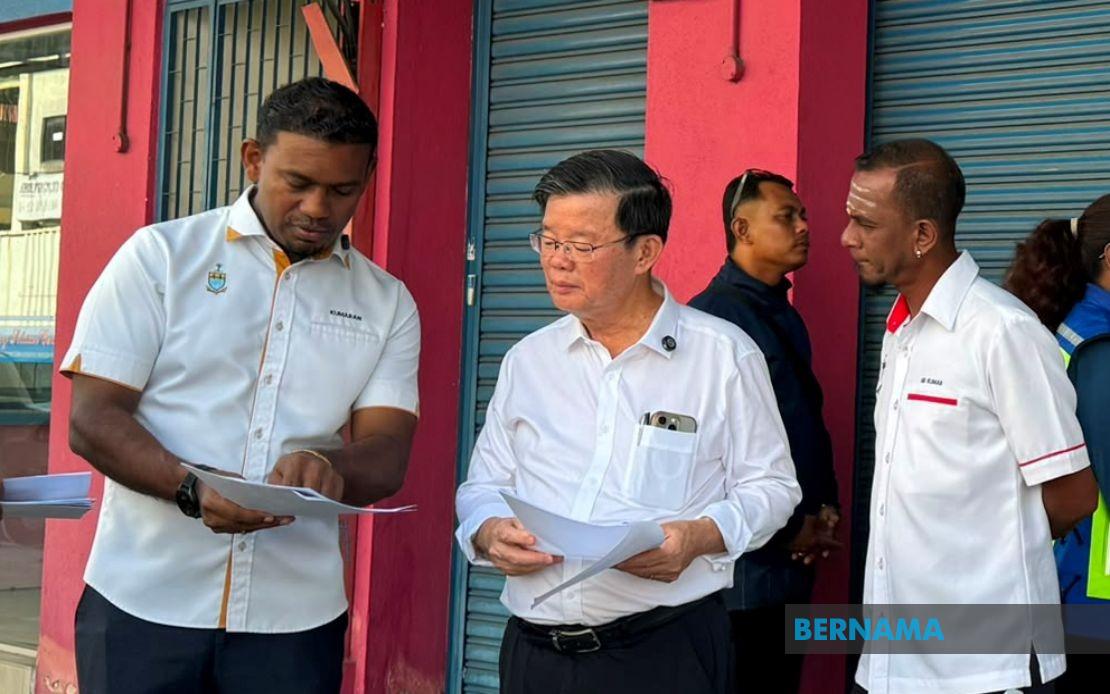
Penang will not reverse course on its newly implemented water tariff despite mounting pressure to suspend the increase, Chief Minister Chow Kon Yeow declared on Wednesday, defending the decision as unavoidable for the state's water security. The tariff, which came into effect on July 1, represents the culmination of a deliberation process that saw the state government already defer implementation by nearly a year from the original timeline set by the National Water Services Commission (SPAN), the federal regulator that oversees water pricing across the nation.
The state's position underscores a tension facing Penang as it balances consumer affordability with urgent infrastructure demands. Chow explained that while the state had previously delayed the tariff beyond the federal deadline of July 30, 2025, further postponement would compromise the financial viability of the Penang Water Supply Corporation (PBAPP) and imperil long-term water supply security. The decision reflects a calculation that the short-term cost to consumers is justified by the long-term benefit of reliable water availability, a concern that has taken on heightened importance across Southeast Asia amid climate volatility.
The additional revenue generated by the tariff increase is projected to yield approximately RM20 million annually, funds that PBAPP intends to channel towards an ambitious capital expenditure programme. The corporation faces capital requirements approaching RM2 billion simply to execute water supply security projects within the state, a figure that does not account for complementary infrastructure being developed in partnership with neighbouring Perak. These interconnected projects represent a significant multi-state initiative to enhance water availability across the northern corridor of Peninsular Malaysia.
The tariff mechanism itself operates under a standardised framework administered by SPAN, which applies uniformly across all state water operators. Under this system, water companies may petition for tariff adjustments once every three years, with applications evaluated against operating expenditures and infrastructure development requirements. The approach aims to ensure cost-reflective pricing while enabling equitable comparison across jurisdictions, though it leaves limited discretion for individual states to absorb cost increases.
A key element of Penang's tariff structure involves cross-subsidisation between consumer classes. Chow highlighted that domestic users continue to pay rates substantially below the actual cost of water supply, which has surpassed RM1 per cubic metre. Under the revised tariff, residential consumers pay approximately 65 sen per cubic metre, effectively receiving a implicit subsidy funded by industrial and commercial operators, who face significantly higher charges. This arrangement reflects a policy priority to shield household budgets from price volatility while ensuring operators can sustain service delivery.
The immediate impact on ordinary households appears modest in absolute terms. According to PBAPP chief executive Datuk K. Pathmanathan, approximately 82 per cent of Penang's residential customers consuming up to 35 cubic metres monthly will experience an additional daily cost of RM0.08, translating to roughly RM2.55 extra per month. By contrast, business consumers utilising 500 cubic metres monthly face an incremental daily charge of RM2.59, or RM77.70 monthly, reflecting the cross-subsidy structure and commercial users' capacity to absorb higher tariffs.
The tariff increase has not gone unchallenged. Lim Guan Eng, Member of Parliament for Bagan, recently appealed through social media for the state government to consider deferring the 20 sen per cubic metre increase for an additional year, articulating public concern about the timing and magnitude of the adjustment. His intervention illustrates the political sensitivities surrounding utility pricing, particularly in a state with a competitive political landscape where utility costs can influence household perceptions of government performance.
Pathmanathan emphasised that revenue raised through the tariff increase must be mobilised without further delay to fund the Water Contingency Plan 2030 (WCP 2030), the state's blueprint for ensuring adequate water availability over the coming decade. Delays in implementing the tariff would directly constrain funding for critical components of this plan, jeopardising timelines for construction of new treatment facilities at Mengkuang Dam and Sungai Perai. The programme also encompasses capacity enhancements at existing plants, including upgrades to the Sungai Dua facility and land acquisition for the proposed Sungai Muda treatment plant, alongside pipeline infrastructure improvements connecting the Macallum and Bukit Dumbar areas.
For Malaysian observers, the Penang case reflects broader challenges facing water utilities across the region. As water demand intensifies due to population growth and industrial expansion, operators require sustained capital investment to maintain service standards and build resilience against supply disruptions. The tension between affordability and fiscal sustainability that Penang confronts mirrors dilemmas in other states and neighbouring countries, where ageing infrastructure and climate uncertainties demand modernisation investments even as consumers resist price increases.
The regulatory framework overseen by SPAN attempts to create consistent standards across the country, yet allows limited flexibility for individual states to manage rate increases according to local economic conditions or political circumstances. This tension between uniformity and contextual sensitivity will likely persist as water demand continues growing throughout Malaysia. Penang's decision to proceed without further deferment signals that at least one major state is prioritising long-term infrastructure security over short-term affordability relief, a calculation that other jurisdictions facing similar choices may watch closely.
Looking forward, the success of the WCP 2030 and its underlying tariff mechanisms will depend not only on capital mobilisation but also on effective execution of planned projects and maintenance of consumer confidence in the utility operator's stewardship of revenue. For Malaysian water consumers and policymakers, the Penang situation illustrates the enduring challenge of financing reliable water services in an era of tightening resources and competing development priorities.

