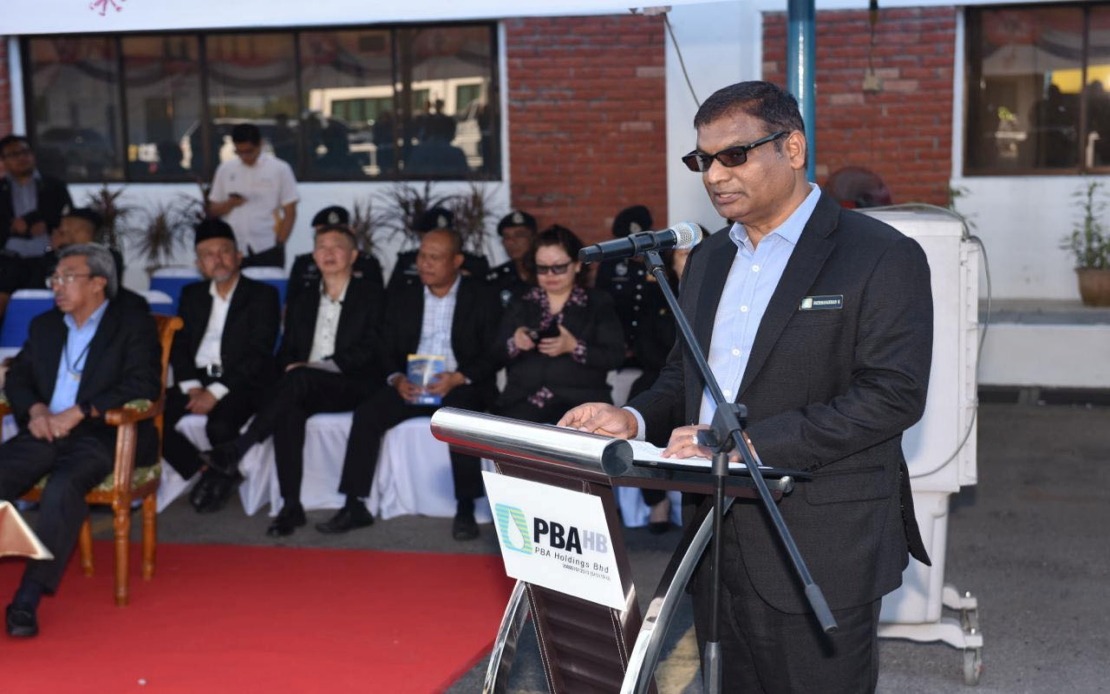
Penang Water Supply Corporation (PBAPP) is moving to significantly expand treated water capacity in Seberang Perai Selatan, announcing plans for a new 80 million litres-per-day (MLD) treatment facility expected to commence operations in 2027. The development represents a critical investment to address mounting pressure on water infrastructure as the southern district experiences accelerating industrial and residential expansion. According to Chief Executive Officer Datuk K. Pathmanathan, the facility will be developed under a Build-Operate-Transfer model and will draw raw water from Sungai Kerian, with further specifications to be disclosed at a later stage.
This plant forms the centrepiece of a medium-term strategy designed to insulate Seberang Perai Selatan from water supply constraints that could otherwise hamper its development trajectory. The corporation's planning framework reflects growing recognition that insufficient water infrastructure could become a limiting factor for economic growth in one of Penang's most dynamic regions. The district currently supports 87,611 registered water users with average daily consumption of 116.8 MLD in 2025, accounting for approximately 13.5 percent of the state's total water demand.
Looking further ahead, Penang's water authorities are implementing a cascading supply strategy that extends beyond the 2027 facility. By 2030, the Sungai Kerian LRA with capacity of 114 MLD is projected to begin service under the state's Water Contingency Plan 2030, providing an additional buffer against supply volatility. This phased approach acknowledges that demand will continue climbing throughout the decade as industrial development materialises and residential expansion accelerates across the district.
The most ambitious element of this strategy involves the Perak-Penang Water Project, expected to deliver between 300 and 500 MLD of treated water transferred from Perak beginning in 2031. This inter-state arrangement, if realised, would fundamentally transform Penang's water security profile and would also support the adjacent Seberang Perai Tengah region. Such cross-border cooperation underscores the scale of anticipated demand growth and suggests that local water sources alone cannot sustain planned development in the next decade.
Understanding the immediate pressures facing Seberang Perai Selatan requires examining the major projects driving demand upward. The RM2.2 billion Batu Kawan Industrial Park 3 represents a flagship development spanning approximately 165 hectares with projected water consumption reaching around 220 MLD during the 2030s. This single project would account for more water than the entire district currently consumes, illustrating the magnitude of infrastructure requirements. Beyond BKIP3, developments including the SkyWorld Cassia residential and commercial complex, combined with the proposed Siliconware Precision semiconductor manufacturing facility, will generate additional competing claims on limited water supplies.
PBAP's infrastructure planning demonstrates proactive management of the supply-demand equation, though success depends on timely implementation across multiple interdependent projects. The corporation has already commissioned a temporary compact treatment facility in Seberang Perai Selatan at a cost of RM8.1 million, which began operations in March 2024 and currently produces up to 6.4 MLD of treated water. This facility already serves approximately 4,000 users and exemplifies the incremental approach being deployed to manage supply gaps while larger permanent installations move through planning and construction phases.
Chief Minister Chow Kon Yeow's administration has adopted a philosophy prioritising sustainable and resilient water infrastructure as a prerequisite for state development. The framing of water security as integral to Penang's socio-economic advancement reflects acknowledgment that industrial parks and residential projects cannot proceed without guaranteed water availability. This principle—that development cannot be constrained by supply limitations—essentially commits the state to investing heavily in water infrastructure alongside promotion of economic expansion.
For Malaysian observers of infrastructure policy, Penang's approach offers a contrasting model to more reactive management strategies seen elsewhere in the region. Rather than permitting bottlenecks to emerge and then scrambling to address them, the state's authorities are attempting to anticipate demand and construct supply capacity in advance. The multi-decade planning horizon spanning from 2027 to 2031 and beyond reflects realistic acknowledgment that major infrastructure projects require extended development and construction timeframes.
The reliance on multiple supply sources—local Sungai Kerian resources supplemented by inter-state transfers from Perak—hedges against the risks of depending on any single source. This portfolio approach to water security mirrors international best practice and recognises that southern Penang's industrial ambitions cannot be satisfied through localised solutions alone. The strategic significance extends beyond state borders, as successful execution would position Penang as an anchor for regional manufacturing and technology sectors requiring reliable industrial water supplies.
Challenges remain in translating these plans into operational reality. The Perak-Penang Water Project in particular requires coordination across state lines and substantial capital investment in inter-state pipeline infrastructure. Cost overruns and scheduling delays could compress the window available for Seberang Perai Selatan's industrial parks to commence operations. Additionally, the agricultural and environmental implications of extracting such quantities from Perak's water sources require careful management to avoid creating scarcity elsewhere in the Klang Valley.
For water-stressed regions across Southeast Asia, Penang's experience offers lessons regarding the necessity of treating water infrastructure investment with the same priority as other economic fundamentals. As climate patterns shift and populations concentrate in urban and industrial corridors, competition for limited water resources will intensify. The corporation's commitment to completing the 80 MLD facility by 2027, while simultaneously pursuing longer-term solutions through 2031, demonstrates determination to avoid becoming a cautionary tale of infrastructure deficit limiting economic potential.

