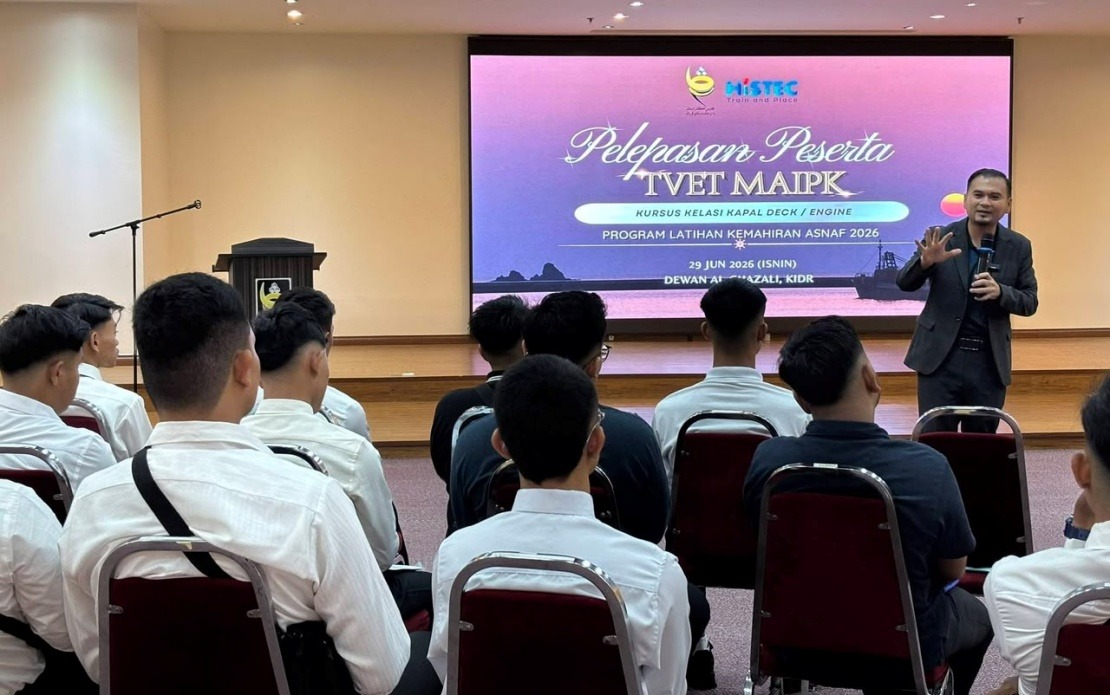
The Perak Islamic Religious and Malay Customs Council (MAIPk) has committed RM470,000 to enable 25 underprivileged youth to pursue professional maritime qualifications, marking a significant intervention in Malaysia's technical vocational education landscape. The three-month training programme, delivered through the Ranaco Education and Training Institute in Chukai, Terengganu, represents an investment of RM18,800 per participant and signals the council's recognition that skills development is fundamental to breaking cycles of economic disadvantage among vulnerable communities.
The initiative addresses a critical gap in Malaysia's workforce development strategy. Maritime industries across Southeast Asia face persistent shortages of qualified personnel for deck and engine crew positions, yet training barriers—particularly financial constraints—prevent many capable individuals from accessing these pathways. By removing the cost burden, MAIPk creates a direct pipeline linking disadvantaged youth to stable, internationally recognised employment opportunities. Participants will receive both theoretical instruction and hands-on practical training, culminating in professional certification and a seaman's licence, credentials essential for immediate entry into the maritime workforce.
What distinguishes this programme from conventional vocational support is its explicit framing as a tool for broader socio-economic transformation. Rather than treating skills training as a transactional outcome, MAIPk positions TVET as a catalyst for sustainable social mobility among the asnaf—Islamic terminology denoting those eligible for Zakat assistance. This philosophical grounding reflects how religious charitable frameworks in Malaysia can mobilise institutional resources toward systemic poverty reduction rather than temporary relief.
For Perak specifically, the scheme carries particular significance. The state's coastal geography and existing maritime infrastructure in areas like Chukai create genuine employment opportunities for graduates, reducing the risk of credentials without corresponding job prospects. The post-completion employment placement commitment ensures that training translates directly into income-generating work, addressing a common dropout point where young people complete courses but struggle to navigate job markets independently.
The employment guarantee component deserves emphasis. Many TVET initiatives in the region produce graduates without securing their transition into actual positions; MAIPk's commitment to immediate maritime sector placement suggests partnerships with shipping operators and logistics firms, creating accountability beyond training completion. This approach aligns with industry needs while providing participants with the income security necessary to sustain themselves and support families, a critical consideration for asnaf communities often managing multiple household obligations simultaneously.
The financial architecture of the programme also merits scrutiny for broader policy implications. At RM470,000 for 25 participants, the per-person investment remains accessible for other Malaysian religious and community organisations contemplating similar initiatives. This cost structure demonstrates that targeted skills funding need not require enormous capital outlays, potentially encouraging replication across other states and sectors where persistent skill deficits constrain economic development.
Malaysia's maritime sector faces compound challenges: aging workforces in developed maritime nations create opportunities for Southeast Asian crew recruitment, yet language barriers, certification standards, and training accessibility limit Malaysian participation in these international supply chains. By producing crew members with professional documentation and international competency standards, MAIPk positions its participants for employment not merely domestically but across regional and global maritime networks, substantially broadening their economic prospects.
The programme's location in Terengganu, a state with significant industrial maritime activity, facilitates knowledge transfer between training institutions and industry practitioners. Students benefit from proximity to active shipping operations, ports, and logistical hubs, enabling exposure to real-world maritime conditions and contemporary industry practices. Such geographic alignment between training delivery and employment clusters significantly improves graduate retention and job satisfaction.
From a development policy perspective, the MAIPk initiative illustrates how religious institutions can function as strategic actors in inclusive economic growth. Rather than confining Islamic charitable frameworks to welfare distribution, this programme leverages zakat-eligible populations' productive potential through skills certification and labour market access. The model potentially offers lessons for other communities seeking to channel institutional resources toward capabilities-building rather than dependency-creating support.
The send-off ceremony, formalising participant commitment and institutional backing, carries psychological and social dimensions often overlooked in skills training discourse. Public acknowledgment of programme participants' selection and potential elevates their social status within communities, countering stigma associated with asnaf classifications and reinforcing that skills development represents merit-based advancement rather than charitable consumption.
For Malaysian policymakers monitoring TVET expansion, the MAIPk initiative demonstrates how non-state actors can address skills deficits efficiently within niche labour markets. As Malaysia navigates post-pandemic economic repositioning and regional competition for manufacturing and logistics investments, developing sufficient technically qualified workforces remains essential. Private sector and civil society contributions, particularly when targeted toward previously excluded populations, complement government TVET initiatives and distribute financing burden across multiple institutional actors.
The three-month timeline suggests an intensive, focused curriculum prioritising core competencies essential for immediate employment. This compressed delivery model contrasts with longer vocational programmes, enabling rapid labour market entry while maintaining instructional quality—a pragmatic design choice for participants under financial pressure. Completion rates and subsequent employment durability will indicate whether intensity successfully balances with retention and performance quality.
Ultimately, the RM470,000 allocation represents more than financial support for maritime training; it constitutes an institutional commitment to demonstrating that systematic pathways from disadvantage to skilled employment remain feasible within Malaysia's economic framework. As these 25 participants transition into maritime careers, their trajectories will likely influence similar initiatives across Perak and potentially other states, shaping how Malaysia's religious and community institutions engage with workforce development challenges.

