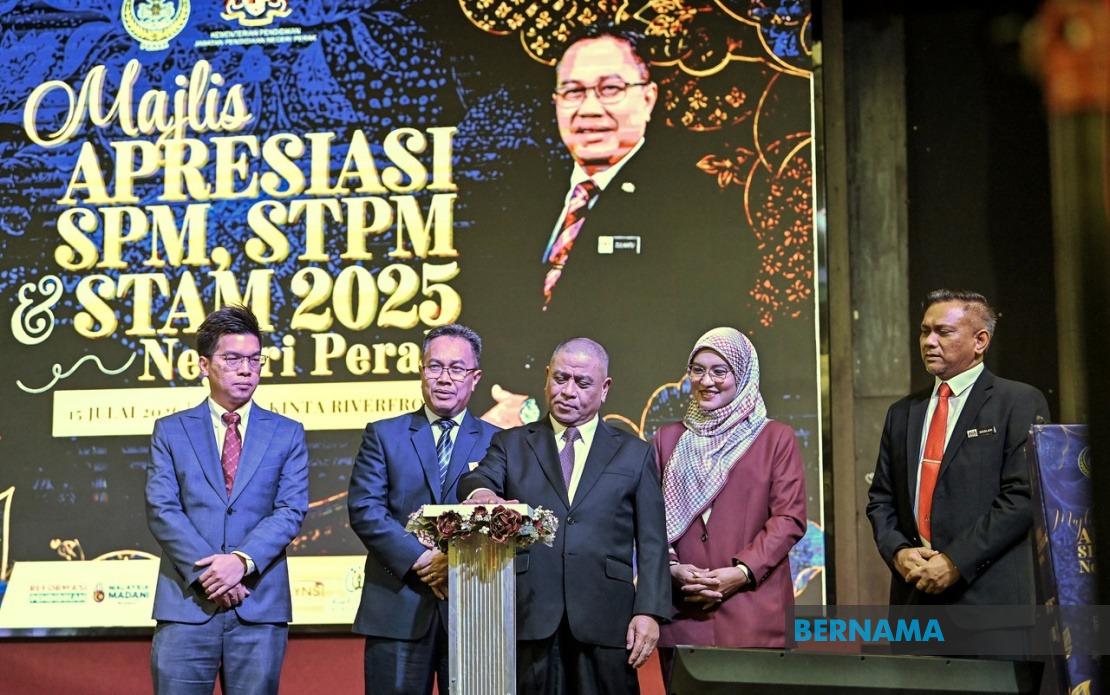
The Perak state government's Menteri Besar Scholarship programme is demonstrating measurable success in tackling educational inequity, with recipients reporting that the financial assistance directly enables them to afford tuition, study materials, and examination fees that would otherwise stretch household budgets. At a state-level recognition ceremony for 2025 examination cohorts held in Ipoh, scholarship beneficiaries highlighted how the assistance—ranging from RM1,000 to RM1,200 per semester—has become instrumental in permitting them to pursue academic excellence without adding strain to their families' finances, particularly among households where parents work in self-employment or operate on modest incomes.
Yoong Lam, a 20-year-old scholar from Sekolah Menengah Kebangsaan Sultan Yussuff who achieved a perfect 4.00 overall grade point average in the Sijil Tinggi Persekolahan Malaysia examination, described how her RM1,200 allocation covers examination fees, reference book purchases, and supplementary tuition sessions. As the eldest of two children in a family reliant on her father's self-employment income, she articulated that the scholarship materially reduces pressure on her parents and enables her to concentrate on academic work rather than part-time employment. Her perspective underscores a critical reality for middle-income and lower-income families throughout Malaysia: examination excellence often requires investment in additional resources that stretch household finances.
The programme's impact extends across different educational streams and family demographics. Muhammad Haziq Hafit, aged 19 from Al-Ulum Al-Syar'Iyyah Religious Secondary School in Bagan Datuk, received RM1,000 in assistance that he intends to deploy toward initial university expenses as he pursues education studies at the University of Malaya. Similarly, Muhammad Taufiq Ikwan Mohammad Asri, also 19 and from the same institution, views his scholarship allocation as essential preparation before commencing postgraduate studies in Egypt. Both recipients emphasised that while the scholarship amount may appear modest compared to larger tertiary education bursaries, its significance for families navigating middle-income circumstances cannot be overstated, particularly when households face multiple competing financial demands.
Peeling back to examine the state's broader educational trajectory reveals that Perak's strategic investments in student support are coinciding with exceptional academic outcomes. The state recorded an average grade point value of 4.49 across the 2025 SPM examination cohort, representing the strongest performance across a 13-year period and extending an upward trend now sustained over three consecutive years. What distinguishes this achievement from previous improvements is the narrowing disparity between urban and rural candidates: the performance gap has contracted to merely 0.04 points, signalling that geographical disadvantage is progressively ceasing to determine academic trajectory.
This equitable outcome did not materialise through scholarship distribution alone. The Tuisyen Cikgu Saarani programme, a collaborative initiative between Yayasan Perak and the Perak State Education Department, has distributed 63,567 additional reference books tailored specifically to SPM candidates throughout the state, with particular focus on students requiring supplementary guidance to master core subject material. The initiative represents a methodical response to identified student needs: teaching professionals analysed examination patterns and learning gaps, then produced condensed, concept-focused study materials authored by experienced educators familiar with Perak's student demographic. This targeted intervention reportedly benefited nearly 25,000 SPM candidates in 2025 and is projected to support approximately equivalent numbers in 2026.
Crucially, these support mechanisms are being extended to populations historically underserved by mainstream tutoring infrastructure. For the first time this year, the additional reference book programme has been rolled out to students attending Sekolah Menengah Tahfiz Darul Ridzuan and Sekolah Menengah Agama Rakyat institutions across Perak, operating under the supervision of the Perak Islamic Religious Department. This expansion acknowledges that religious and tahfiz school pupils—often from distinctive socioeconomic backgrounds and pursuing syllabus pathways different from standard government school frameworks—require customised study support to compete effectively in standardised examinations.
For Malaysian policymakers and regional education administrators, Perak's experience offers instructive lessons about the mechanics of equitable improvement. The state has avoided the common pitfall of adopting universal, one-size-fits-all interventions; instead, scholarship support, customised learning materials, and targeted programme expansion have been calibrated to address specific bottlenecks identified through systematic analysis. The closure of the urban-rural achievement gap particularly warrants attention, as this disparity has historically persisted across Southeast Asia despite numerous policy initiatives, suggesting that Perak's combination of financial support and pedagogical resource development may offer a replicable framework.
The scholarship recipients' own testimonies underscore an often-overlooked dimension of educational access: parents' financial capacity to support examination preparation shapes not merely whether students enter higher education, but the quality of preparation they receive beforehand. A student from a household where a parent is self-employed operates under different constraints than one with two professional incomes; scholarship assistance that proves marginal to affluent families can prove transformative to those navigating tighter budgets. By specifically targeting students from middle-income backgrounds, Perak has identified a cohort whose potential might otherwise remain unrealised simply because their households cannot afford simultaneous investment in examination fees, reference materials, and tuition without sacrificing other essentials.
Looking forward, Perak's trajectory suggests that sustainable educational improvement requires simultaneous attention to financial barriers, pedagogical quality, and programme differentiation. While the scholarship programme directly addresses affordability, the Tuisyen Cikgu Saarani initiative tackles the quality dimension—ensuring that available study materials genuinely reflect examined content and employ effective pedagogical approaches. The expansion into religious and tahfiz school sectors indicates recognition that improvement must span entire student populations, not merely those in conventional government schools. For Malaysian states and other Southeast Asian jurisdictions experiencing similar geographic and socioeconomic achievement disparities, this multi-pronged approach merits serious consideration, particularly the principle of designing interventions around identified needs rather than assuming that financial transfers alone will eliminate deep-rooted inequities in educational outcomes.

