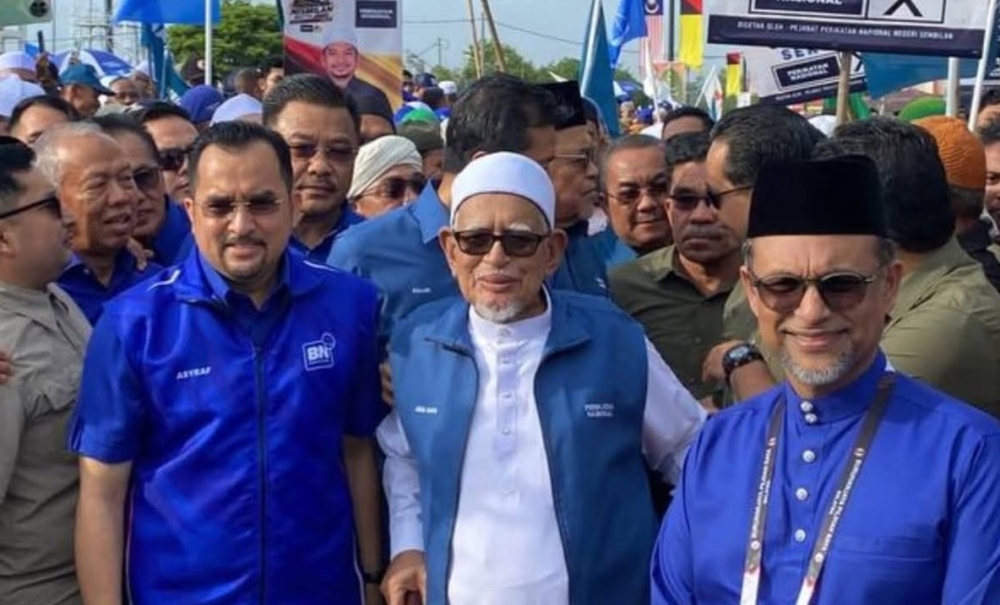
Perikatan Nasional and Barisan Nasional will throw their combined support behind each other's candidates in the forthcoming Negeri Sembilan state election, according to PAS president Tan Sri Abdul Hadi Awang. The announcement represents a continuation of the electoral cooperation that has characterised relations between the two coalitions in recent months, even as they maintain separate political identities and compete for influence within Malaysia's fractured political landscape.
The decision to campaign jointly signals pragmatic calculation on both sides. For Perikatan Nasional, which comprises PAS, Bersatu, and several smaller partners, the Negeri Sembilan contest offers an opportunity to strengthen its presence in a state where Barisan Nasional has traditionally held sway. By pooling resources and coordinating messaging, the two coalitions can theoretically maximise their combined vote share and prevent the opposition Pakatan Harapan from capitalising on any fractured support among mainstream parties.
Barisan Nasional, the governing coalition that includes UMNO, MCA, and MIC, faces its own strategic imperatives. The decision to accept PN campaign support suggests a calculus that benefits outweigh risks—specifically, that gains from PN's voter mobilisation capacity outweigh any political costs from appearing to collude with an ideologically distinct coalition. For UMNO and its partners, working with PAS-led Perikatan represents a pragmatic response to Malaysia's volatile political environment, where singular dominance by any one coalition has become increasingly difficult to achieve.
Negeri Sembilan holds particular significance in Malaysian politics as a traditional Barisan stronghold with a relatively balanced urban-rural demographic. The state has 36 state assembly seats spread across nine districts, making it a microcosm of Malaysia's political diversity. Recent polling patterns have shown tightening competition as Pakatan Harapan strengthens its appeal among urban voters, even as Barisan retains advantages in certain rural constituencies. The joint campaign arrangement suggests both PN and BN acknowledge that divided opposition support could prove fatal to their collective interests.
The cooperation framework raises important questions about coalition governance and electoral ethics. In Malaysia's multi-ethnic, multi-religious democracy, voters often look to how different political blocs manage cooperation and competition. The joint campaign approach, while legally permissible, represents a fairly explicit arrangement that transcends informal understandings. It demonstrates how Malaysia's fractionalised political system increasingly operates through temporary alliances rather than coherent, enduring coalitions built on shared ideological platforms.
PAS's central role in brokering this arrangement underscores the party's transformed political position. Once primarily a Kelantan-based party focused on Islamic issues, PAS now functions as a kingmaker capable of negotiating terms with multiple partners. By positioning itself as the intermediary between PN and BN, the party enhances its bargaining power for future discussions about ministerial portfolios, budget allocations, and policy direction. This strategic flexibility reflects PAS's broader political evolution and its ambitions to expand beyond its traditional heartland.
The implications for Malaysian voters extend beyond Negeri Sembilan's boundaries. The Perikatan-Barisan joint campaign arrangement sets a precedent for how these coalitions might behave in future federal or state contests. Should this approach yield electoral success, both coalitions will likely view it as validated and seek to replicate it elsewhere. Conversely, poor performance could precipitate recriminations and fragmentation, as each side blames the other for campaign failures or unpopular policy positions.
For Southeast Asia and regional observers, the Negeri Sembilan contest carries broader implications for Malaysian political stability. A successful joint campaign might suggest that Malaysia's political class is moving toward a more orderly, coalition-based system of governance. However, the cooperation remains tactical rather than strategic—both PN and BN continue to compete for supremacy and harbour significant policy differences, particularly regarding religious governance and economic direction.
The electoral mathematics remain uncertain despite cooperative arrangements. Pakatan Harapan retains considerable organisational capacity and continues to poll well among younger, urban voters—demographics that are increasingly important in Negeri Sembilan. The joint PN-BN approach, while potentially effective in consolidating centrist and conservative support, may struggle to overcome Pakatan's advantages in mobilising progressive constituencies. The actual impact of their coordinated campaign will become apparent only when votes are cast and counted.

