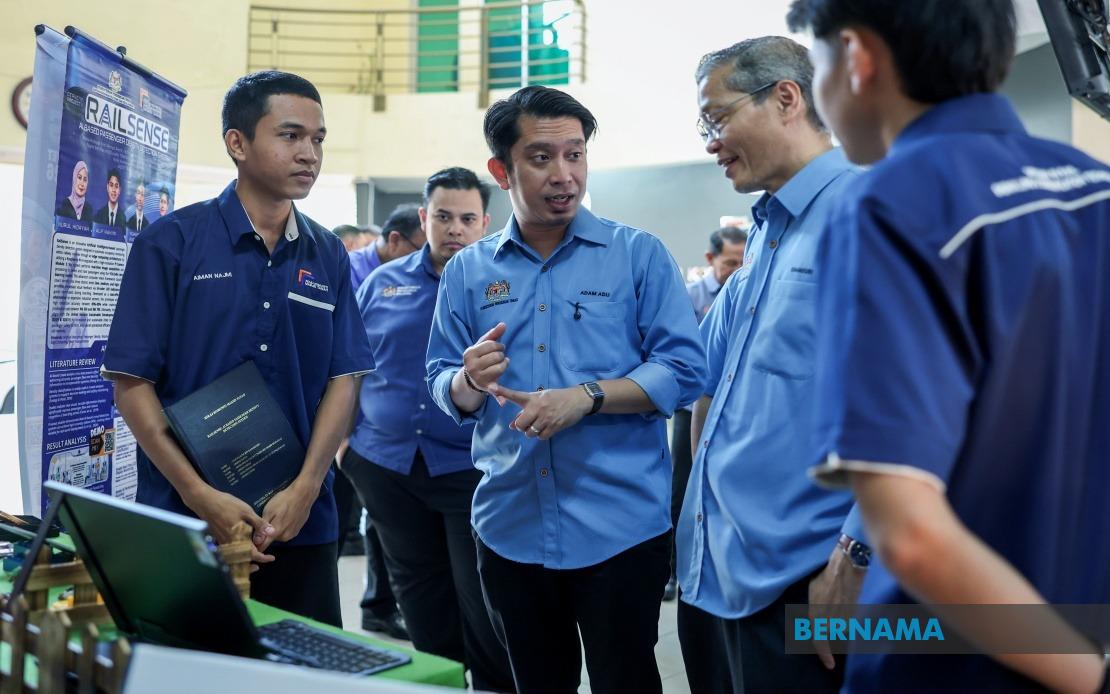
Malaysia's push to develop home-grown technological talent has reached a critical juncture as policymakers stress the importance of safeguarding innovations through formal intellectual property channels. At the closing of the National TVET Innovation Competition (PERISA '26) held at Masjid Tanah Community College in Alor Gajah, Deputy Higher Education Minister Adam Adli Abd Halim underscored that participants must move beyond creating solutions and take concrete steps to protect their work through copyright and patent registration. The message reflects growing recognition within Malaysia's education establishment that innovation alone, without proper legal protection, leaves promising ideas vulnerable to appropriation and limits their commercial potential.
Adam Adli emphasised that securing intellectual property rights represents a natural progression in the innovation cycle, one that transforms a standalone creation into a defensible asset capable of attracting industry interest and investment. He stressed that patenting does not constitute hoarding or restricting access to an idea; rather, it establishes ownership while preserving the competitive value that makes an innovation marketable and commercially viable. This nuance matters considerably for emerging innovators who may fear that registering patents somehow diminishes the social utility of their work. The minister's remarks suggest Malaysia's technical and vocational education system is maturing in its understanding of how innovations transition from classroom prototypes to real-world deployment, a critical gap that has historically limited the commercialisation of TVET graduate ideas.
The 2026 edition of PERISA, themed 'Agentic AI in Innovation', attracted 118 innovation projects spanning five categories including Engineering Technology, Information Technology, Social Sciences, Commerce and Hospitality, and the Student category. This year's focus on artificial intelligence applications reflects both national priorities and the growing sophistication of Malaysia's TVET ecosystem. Competition entries demonstrated considerable breadth, with one standout project addressing rail passenger density monitoring—a system with immediate practical applications that attracted industry attention. The presence of such solutions indicates that Malaysian polytechnics and community colleges are producing work aligned with contemporary economic needs, particularly in transport and urban logistics where AI deployment can drive efficiency.
Beyond competition mechanics, PERISA '26 functioned as a strategic platform for repositioning TVET education as a driver of innovation rather than merely a pathway to vocational skills. The three-day event brought together educators, students, and industry representatives, creating informal networks that often prove more valuable than formal outcomes. By situating TVET within an innovation narrative, policymakers signal that technical education produces not just skilled workers but potential entrepreneurs and solution-developers capable of addressing societal challenges. This reframing holds particular significance for Malaysia, where TVET has traditionally occupied a lower rung than university-based research in the national innovation hierarchy.
The institutional partnerships forged during PERISA '26 illustrate how competitions can catalyse deeper collaboration between education providers and industry. The Memorandum of Understanding between Masjid Tanah Community College and Prasarana Malaysia Berhad, Malaysia's public transport operator, creates a direct pipeline for student innovations to encounter real-world deployment constraints and commercial viability testing. Similarly, the Letter of Intent with ERL E-MAS, the airport rail link operator, signals recognition that TVET graduates can contribute to solving operational challenges in Malaysia's critical infrastructure sectors. These partnerships move beyond rhetorical commitment to creating structured channels through which student-developed innovations can be refined, tested, and potentially commercialised.
The emphasis on competency development and expertise-sharing within these partnerships addresses a fundamental weakness in Malaysia's innovation ecosystem: the disconnect between educational institutions and industry practitioners. TVET educators often work in isolation from the operational realities that determine whether a solution will gain market adoption. By embedding students and instructors within industry collaboration frameworks, PERISA '26's strategic partnerships create opportunities for real-time feedback and mentorship from practitioners who understand the technical specifications, regulatory constraints, and cost parameters that innovations must satisfy. This experiential learning component frequently proves more transformative than classroom instruction alone.
From a regional perspective, Malaysia's intensified focus on TVET innovation positions the country competitively within Southeast Asia's technology landscape. Thailand, Vietnam, and Indonesia are simultaneously investing in vocational education reform, creating a competitive dynamic that will determine which nations develop robust local innovation ecosystems versus remaining dependent on foreign technology transfer. Malaysian TVET institutions that successfully bridge the innovation-to-commercialisation gap will attract stronger students, retain talented instructors, and secure deeper industry partnerships. The IP protection messaging at PERISA '26 thus represents more than bureaucratic procedure; it signals that Malaysia is serious about creating conditions under which homegrown innovations can survive and thrive in competitive markets.
The intellectual property dimension merits particular attention given Malaysia's historical reliance on foreign investment and imported technology. Encouraging TVET graduates to patent their inventions, however modest, builds a domestic innovation culture where creators understand that their intellectual contributions possess economic value. This psychological shift—from viewing innovation as an academic exercise to recognising it as potential commercial property—can reshape how graduates approach problem-solving throughout their careers. Over time, widespread patent consciousness among TVET cohorts creates infrastructure supporting startup formation, licensing negotiations, and venture capital interest in early-stage technical innovations.
Adam Adli's statement that patenting preserves competitive value while enabling commercialisation addresses a common misconception among novice inventors who equate IP protection with restricting knowledge diffusion. In reality, the patent system enables controlled sharing through licensing arrangements that compensate inventors while allowing broader adoption. An innovator can patent a solution and subsequently license it to multiple manufacturers or service providers, generating revenue while accelerating market penetration. This licensing model proves particularly valuable for TVET graduates who lack capital for manufacturing or distribution but possess genuine technical solutions. By understanding this distinction, participants gain realistic pathways to commercialisation beyond equity stakes or direct business ownership.
The competition's emphasis on addressing real-world issues through AI applications reflects pragmatic alignment with where global technology development is concentrated. Rail density monitoring, supply chain optimisation, healthcare diagnostics, and predictive maintenance represent domains where AI systems deliver measurable value relatively quickly. TVET innovations focused on these applications enjoy stronger commercial prospects than speculative technologies with uncertain utility. By channelling innovation efforts toward AI applications in concrete problem domains, PERISA '26 essentially teaches participants an investment discipline: solutions should solve identifiable problems for customers willing to pay for resolution. This commercial realism, embedded within a government-sponsored competition, suggests Malaysia's TVET sector is developing sophisticated innovation literacy rather than treating innovation as an abstract aspiration.
The three-day format and national-level structure of PERISA '26 indicate that Malaysia intends this competition as an annual institution rather than a one-off initiative. Recurring competitions establish expectations among TVET institutions, encouraging systemic integration of innovation projects within curricula rather than treating them as supplementary activities. Students approaching their final years understand they should develop commercially viable projects, mentors are incentivised to guide students toward patentable solutions, and institutional leadership recognises innovation metrics as key performance indicators. Over multiple years, such systemic reinforcement can meaningfully shift TVET culture from emphasising technical compliance toward encouraging creative problem-solving.

