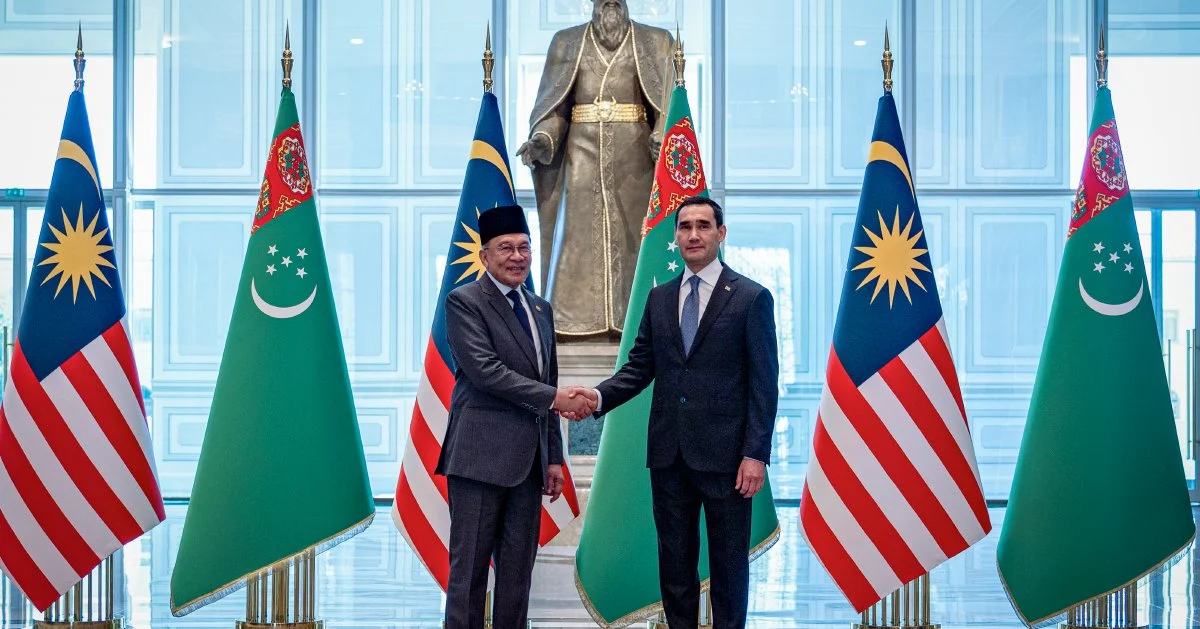
Petronas has emerged as a significant conduit for strengthening Malaysia-Turkmenistan relations, capitalizing on momentum generated by Prime Minister Datuk Seri Anwar Ibrahim's official visit to Turkmenistan. The national oil and gas company's deepening engagement in the Central Asian nation reflects a broader strategy to diversify Malaysia's international partnerships while positioning the country as a credible energy investor in emerging markets beyond Southeast Asia.
The timing of Petronas's expanded activities in Turkmenistan coincides with heightened diplomatic focus on the bilateral relationship. Anwar's visit signals Malaysia's commitment to broadening ties with Central Asian partners, and Petronas's operational footprint provides tangible substance to what might otherwise remain purely diplomatic gestures. This convergence of political interest and commercial activity creates a foundation for sustained, mutually beneficial engagement that extends well beyond traditional oil and gas transactions.
Turkmenistan, as one of the world's largest natural gas reserves holders, represents a strategically important market for Malaysian energy interests. The country's position along critical Asian energy corridors makes it particularly valuable during a period of global energy transition and supply chain reconfiguration. Petronas's long-established presence there has already yielded operational experience and relationships that newer investors would struggle to replicate, providing the company with competitive advantages in exploring further opportunities.
The expansion of Petronas's role addresses several Malaysian national interests simultaneously. Energy security remains a fundamental concern for Malaysia's economic development, and diversifying supply sources and partnership models reduces dependency on any single region or supplier. Turkmenistan's vast hydrocarbon resources offer potential long-term supply partnerships that could support Malaysia's industrial base and electricity generation needs for decades to come.
Beyond hydrocarbons, the strengthening relationship opens pathways for knowledge transfer and technology cooperation. Malaysian expertise in downstream operations, refining, petrochemicals, and energy infrastructure development represents valuable intellectual capital that Turkmenistan requires as it modernizes its energy sector. Conversely, Turkmenistan's upstream capabilities and resource management experience provide learning opportunities for Petronas to refine its global operations.
The commercial relationship also facilitates Malaysian participation in Turkmenistan's broader infrastructure development agenda. Energy projects typically extend far beyond extraction and processing, encompassing transportation networks, port facilities, telecommunications, and urban development around operational hubs. Malaysian construction companies, engineering firms, and technology providers benefit indirectly from Petronas's expanded presence, as the national oil company becomes an anchor tenant attracting complementary foreign investment.
For Southeast Asia's energy landscape, Malaysia's proactive engagement in Central Asia carries wider implications. The region has historically been dominated by Russian, Chinese, and European interests, with limited Southeast Asian involvement. Malaysia's presence through Petronas demonstrates that regional energy companies can successfully operate across continents, competing effectively against larger international majors and establishing long-term strategic partnerships that benefit home countries.
Turkmenistan itself stands to gain substantially from Petronas's commitment. The company brings proven technical competency, financial stability, and operational transparency—factors critical for resource-rich nations seeking to maximize returns from finite hydrocarbon reserves. Malaysian investors bring different perspectives and operational philosophies compared to traditional partners, potentially spurring competitive improvements and more efficient resource management throughout Turkmenistan's energy sector.
The diplomatic dimension should not be underestimated. Petronas operates not merely as a commercial entity but as a quasi-representative of Malaysian interests abroad. The company's success in Turkmenistan enhances Malaysia's reputation as a reliable, sophisticated partner capable of managing complex, long-term energy projects. This reputation capital extends far beyond petroleum—strengthening Malaysia's broader positioning as a credible interlocutor in regional and international affairs.
Anwar Ibrahim's official visit validates Petronas's operational presence while signaling governmental commitment to supporting the company's strategic objectives in Central Asia. Such high-level political endorsement facilitates negotiations with Turkmenistani authorities, smooths regulatory processes, and demonstrates consistency in Malaysia's foreign policy approach toward Central Asian engagement. The synchronization of political visits and commercial expansion represents textbook strategic coordination.
Looking forward, the Malaysia-Turkmenistan energy partnership could serve as a template for Malaysian companies seeking greater international exposure. Petronas's success demonstrates that regional enterprises can achieve significant scale and influence in markets far removed from home bases, provided they combine technical capability with patient capital and genuine commitment to long-term relationships. This model has applications for Malaysian firms across multiple sectors.
The relationship also positions Malaysia favorably within broader Central Asian geopolitical dynamics. As major powers compete for influence in this resource-rich region, Malaysia's non-aligned status and commercial rather than political approach to engagement offer Turkmenistan an attractive partnership option. Petronas provides the mechanism through which this preferred positioning translates into concrete economic benefits.
Ultimately, Petronas's expansion in Turkmenistan exemplifies how energy cooperation can serve multiple strategic objectives simultaneously—advancing national energy security, supporting domestic companies' international ambitions, enhancing diplomatic relationships, and contributing to regional economic development. As Malaysia navigates an increasingly complex international environment, such multi-layered approaches to bilateral engagement that combine high-level diplomacy with credible commercial substance will prove increasingly valuable.

