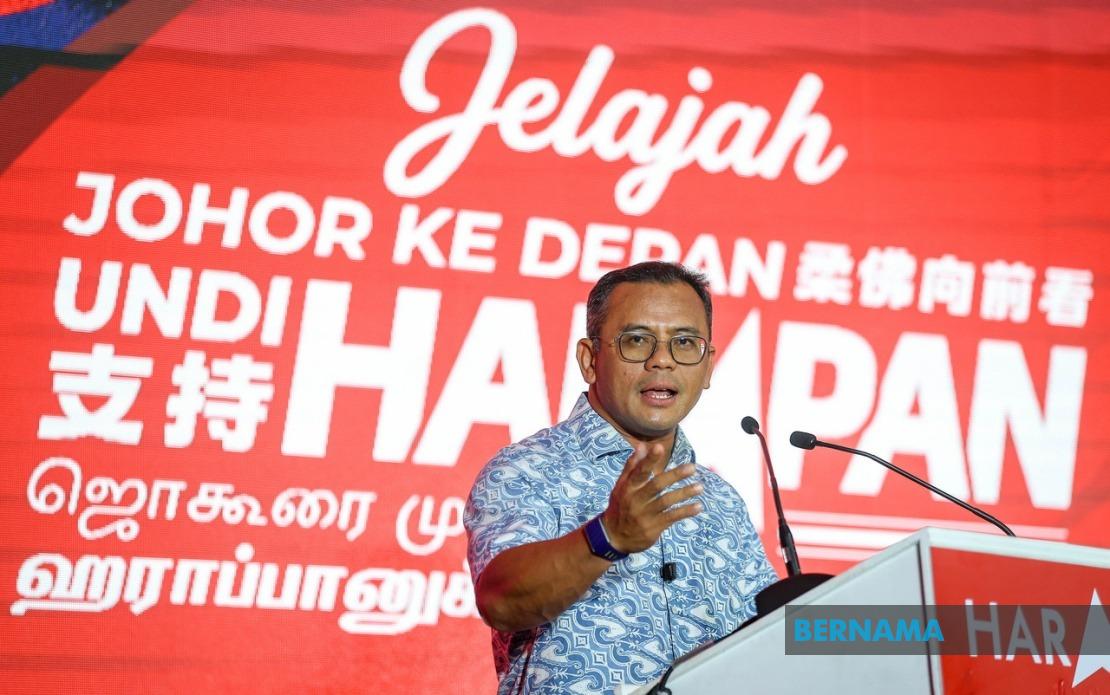
Pakatan Harapan is framing its contest in the upcoming Johor state election as a campaign to unlock the state's untapped economic potential through more balanced development rather than as a challenge to existing stability. Speaking in Batu Pahat ahead of the July 11 polling day, PKR vice-president Datuk Seri Amirudin Shari articulated a vision of spreading prosperity across all corners of Johor, moving beyond the concentration of economic activity that has long characterised the state's growth pattern.
The coalition's central argument rests on a diagnosis of lopsided development within Johor. While the state possesses substantial economic assets and has attracted significant investment, these gains have clustered heavily around Johor Bahru district, leaving peripheral regions struggling to participate in the state's overall progress. Amirudin, who doubles as Selangor Menteri Besar and PKR's election director, framed this disparity as a critical governance challenge requiring systemic intervention. The income differential between Johor Bahru and inland districts like Segamat exemplifies a structural problem that PH believes demands fresh policy approaches rather than incremental adjustments to the existing model.
The statistics Amirudin cited underscore his argument about investment efficiency and job creation. Johor attracted RM101 billion in investments in the year preceding his remarks, yet the employment gains from this capital inflow appear modest relative to what comparable investment figures have generated elsewhere. He contrasted this with Selangor's performance, where RM83 billion in investments during the same period yielded approximately 60,000 new jobs. By his account, Johor's job creation from substantially larger investment inflows fell short of 40,000 positions, suggesting either capital intensity issues or missed opportunities in translating foreign direct investment into broadly distributed employment opportunities.
This productivity gap between investment and employment creation carries particular weight for Malaysian policymakers and voters. High-value investments should theoretically generate proportional employment benefits, especially in skilled and semi-skilled categories. If Johor is experiencing a divergence between capital inflow and job generation, it points to either a mismatch between investment sectoral composition and local workforce capabilities, or a failure to embed local economic participation within foreign investment frameworks. PH's diagnosis implies that current state administration has not sufficiently aligned investment attraction strategies with human capital development and job distribution objectives.
The coalition has identified the Johor-Singapore Special Economic Zone as a cornerstone of its alternative approach. This initiative represents precisely the kind of integrated investment and employment strategy that Amirudin suggests has been lacking. By coupling federal government support with state-level coordination, PH argues that the JS-SEZ can generate high-wage employment opportunities that retain talent within Johor rather than pushing young workers across the border into Singapore for daily employment. The cross-border commute phenomenon Amirudin highlighted carries social and economic costs that extend beyond individual family budgets—it represents a loss of human capital and economic dynamism within the state itself.
The framing of Johor as encompassing far more than its capital city represents a deliberate pivot toward inclusive governance messaging. Acknowledging the northern, eastern, and western regions as integral to Johor's identity, rather than peripheral appendages to Johor Bahru's economic dominance, signals a commitment to spatial equity. This rhetorical move aligns with broader Malaysian discourse about balanced regional development, echoing concerns raised across multiple states about concentration effects and their political consequences. Voters in secondary urban centres and rural districts consistently express frustration with capital-city-centric governance, making this an effective messaging strategy during electoral periods.
Amanah deputy president Datuk Seri Dr Mujahid Yusof's presence at the Batu Pahat event underscores PH's coalition-wide commitment to the message. The appearance of multiple party leadership figures signals that balanced development is not merely a PKR talking point but represents coalition-wide policy thinking. This coordination matters for credibility, particularly in constituencies where voters harbour doubts about whether electoral promises translate into post-election governance priorities. Coalition-level messaging suggests institutional commitment beyond individual politicians' rhetorical flourishes.
The timing of these statements immediately preceding the state election reflects standard electoral campaign strategy, yet the substance carries implications for Malaysian economic policy discourse more broadly. If PH's diagnosis of Johor's development imbalances resonates with voters, it will validate a particular analytical framework about how state-level economies should be governed. Conversely, if the incumbent coalition effectively reframes the debate around absolute growth metrics rather than distribution patterns, it could shift how Malaysians evaluate state economic management more generally.
Johor's election carries significance beyond state boundaries. As Malaysia's second-largest economy and a crucial commercial and logistical hub, governance changes in Johor reverberate through regional supply chains and investment decisions. A state administration that implements systematic policies to broaden investment benefits across districts could demonstrate transferable governance models applicable elsewhere in Malaysia. Conversely, continued concentration of economic activity in primary districts would suggest that current incentive structures and regulatory frameworks systematically channel development toward established centres regardless of state-level political direction.
The coalition's contesting of all 56 state seats represents a full-strength electoral commitment. This comprehensive candidate slate indicates PH believes it possesses a coherent, statewide governance alternative rather than targeted opposition confined to specific constituencies. The comprehensiveness of candidacy also suggests confidence in the resonance of development equity messaging across Johor's diverse electoral geography, from urban Johor Bahru to rural northern districts.
Amirudin's invocation of Johor as the "Jewel of the South" frames development not merely as economic policy but as an identity and pride question. This rhetorical elevation positions development equity as essential to Johor's status and self-perception rather than as a technical policy adjustment. By linking inclusive development to regional esteem and national contribution, PH connects its electoral platform to deeper emotional and aspirational dimensions that resonate beyond economic data points.
The election itself, with polling on July 11 and early voting on July 7, will test whether these development equity arguments carry sufficient electoral weight to shift state governance. The outcome will indicate whether voters prioritise growth distribution concerns equally with growth magnitude, and whether PH's diagnosis of Johor's development challenges aligns with voter perceptions of genuine governance problems requiring remedy.

