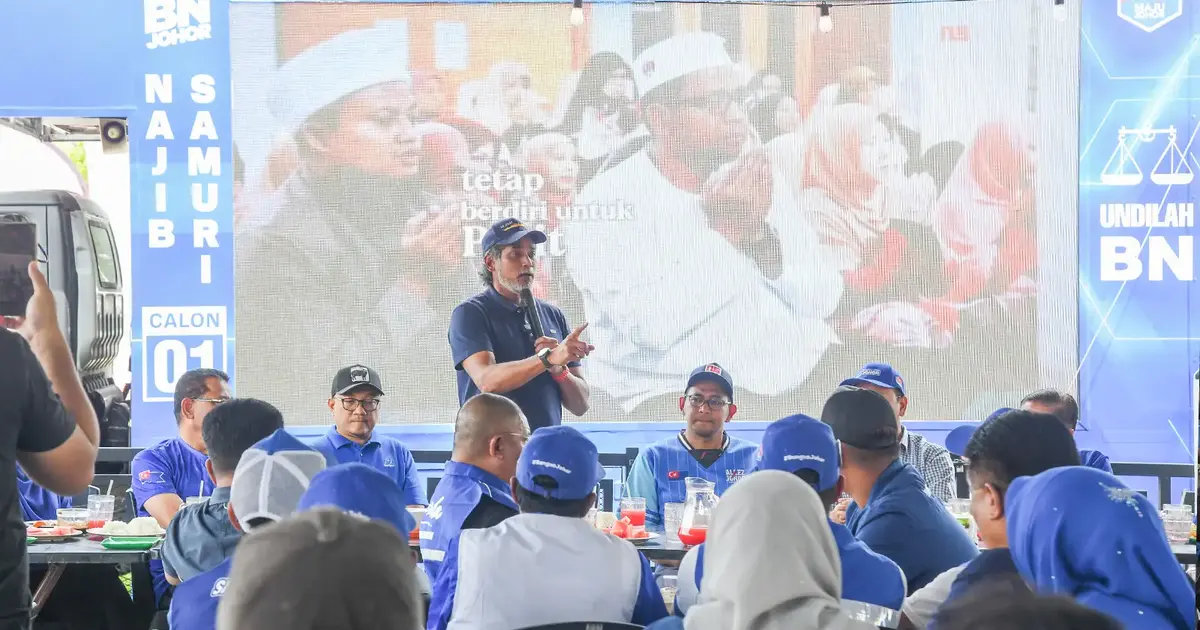
The debate over who should represent Pakatan Harapan in a potential confrontation with Johor's political leadership has crystallised around a fundamental question of equivalent standing. Khairy Jamaluddin, the former Umno Youth chief, has stated that any meaningful exchange between opposition forces and the Barisan Nasional chairman for Johor must pit like against like—specifically, that PH should present its designated candidate for the position of menteri besar if genuine dialogue is to occur.
This demand reflects a deeper political calculus playing out in Johor, where the state remains one of Umno's historic strongholds and where control of the executive remains fiercely contested. The insistence on equivalent representation in any public debate signals the significance BN places on maintaining its institutional advantages and the weight it ascribes to potential challengers from the opposition coalition. Khairy's intervention also underscores the premium placed on formal designations in Malaysian politics, where the menteri besar position represents the apex of state authority.
Pakatan Harapan's response to this positioning carries implications beyond a single debate. The coalition has been rebuilding its presence in several key states following the 2022 general election, but Johor remains particularly challenging terrain. The state's demographic composition, the entrenched networks of BN machinery, and historical voting patterns have all conspired to maintain incumbent advantages. Any weakness in PH's organisational capacity to field a credible, publicly recognised menteri besar candidate could be interpreted as tactical vulnerability.
Khairy's role as a former Umno Youth leader gives his statement particular resonance within Umno circles, even as he navigated independent politics in previous years. His comments reflect a confidence within the BN apparatus about Onn Hafiz's standing and the Johor party machinery's ability to contest any challenger on equal terms. The framing also serves a secondary purpose: it establishes a public position that makes any future debate more conditional and potentially easier to decline if PH cannot or will not meet the stated criteria.
For Pakatan Harapan, the challenge manifests on multiple levels. Internally, the coalition must achieve consensus on who would serve as its menteri besar candidate—a process that often involves delicate negotiations between PKR, DAP, and other component parties over portfolios and representation. Externally, committing to such a candidate before an election carries risks, including giving BN additional time to research opposition positions and develop counter-messaging. PH must weigh the symbolic value of accepting Khairy's implicit challenge against the practical advantages of maintaining flexibility in its candidate announcement.
The Johor political landscape has shifted considerably in recent years, with younger voters potentially more receptive to change and urban constituencies expressing greater electoral volatility. Yet structural advantages remain with the incumbent. The state government's resources, administrative machinery, and deep roots in grassroots communities continue to provide significant advantages. Any debate format would inevitably spotlight these dynamics, with BN capitalising on incumbent performance metrics and opposition forces pushing narratives of change and renewal.
Regionally, the Johor situation influences Malaysian politics far beyond state boundaries. As one of the most economically significant states and a demographic bellwether, shifts in Johor's political complexion reverberate through national calculations. Opposition parties see Johor as essential to any bid for federal power, while BN views it as a non-negotiable bulwark. This elevated stakes environment explains why Khairy's comments about debate protocols matter—they are ultimately about asserting BN's confidence and potentially forestalling opposition momentum.
The menteri besar designation itself carries particular weight in Johor's context. Unlike some states where the position is largely ceremonial or shared power-sharing arrangements complicate authority, Johor's menteri besar traditionally exercises substantial executive power. Onn Hafiz, as BN chairman for the state, occupies a position of considerable influence. Expecting PH to field an equivalent figure for any public confrontation essentially asks the opposition to crystalise its entire state-level strategy around a single personality before optimal timing.
PH's response will likely emerge through careful messaging rather than immediate committal. The coalition may highlight the broader issues it wishes to contest—governance, corruption, service delivery—while questioning why Khairy and BN feel compelled to impose preconditions on democratic dialogue. This rhetorical approach allows PH to maintain flexibility while positioning BN as fearful of open debate. Whether PH ultimately accedes to these terms, proposes alternative debate structures, or declines engagement altogether will reveal much about the coalition's confidence in its Johor machinery and its strategic priorities heading into the next state election cycle.

