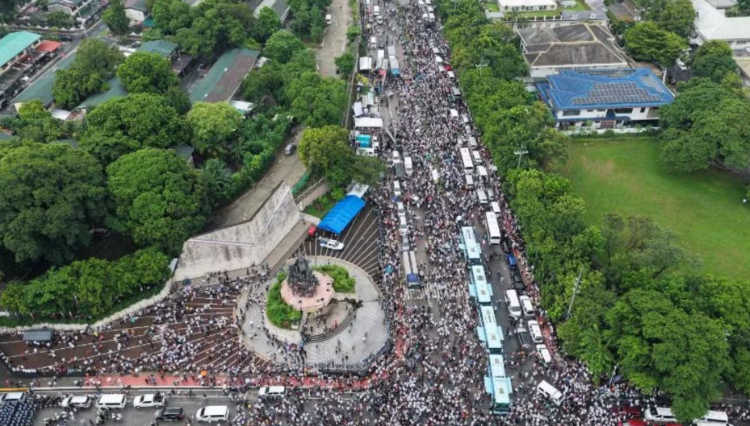
Tens of thousands of followers belonging to the Iglesia Ni Cristo descended upon Manila's main thoroughfare on Tuesday in a show of force that brought the capital's rush-hour traffic to a standstill. The demonstration, which church organisers expect to expand throughout the day, represents a critical test of the religious organisation's political influence at a pivotal moment for Philippine governance. Protesters gathered to register their opposition to the anticipated arrest of Senator Rodante Marcoleta, who faces graft charges tied to his campaign finances, but the rally carries deeper significance than a single lawmaker's legal troubles.
Marcoleta's predicament emerged just 24 hours before the demonstration, when the Government Ombudsman Jesus Remulla announced that the senator would be charged for failing to declare 75 million pesos ($1.2 million) in unused election campaign funds. The INC connection runs deep—Marcoleta is not merely a church member but a symbol of the sect's longstanding alliance with the Duterte political machinery that has shaped Philippine politics for years. This relationship takes on heightened importance given that Marcoleta is widely regarded as nearly certain to vote against conviction when Vice President Sara Duterte faces trial before the Senate beginning July 6, when 16 votes from the 24-seat chamber would be needed to remove her from office.
The timing of Tuesday's rally underscores the INC's strategic calculation regarding the unfolding political drama surrounding Duterte, who has become the target of impeachment proceedings despite her father's former dominance in Philippine politics. The religious body has demonstrated its capacity to mobilise supporters at critical junctures, having previously staged enormous demonstrations in November over a flood-control scandal and again in January when opposing Duterte's initial impeachment. These rallies have allowed the church to position itself as a guardian of what it terms accountability and justice, even as observers question whether the organisation's actions primarily serve the interests of the Duterte faction.
Police estimated the crowd at approximately 8,000 participants by mid-morning, with expectations for growth as the day progressed. The scale of disruption proved immediately apparent, with traffic backed up for several kilometres in all directions along EDSA, Manila's primary arterial route. Regional police spokeswoman Hazel Asilo confirmed that morning commuters faced severe delays, with only bus lanes remaining passable—a disruption that highlighted both the INC's organisational capacity and the challenge of balancing democratic expression with urban functionality. President Ferdinand Marcos deemed the situation significant enough to cancel a scheduled luncheon with foreign press to monitor developments.
Church spokesman Edwil Zabala articulated the INC's framing of the demonstration through a video message posted to Facebook, emphasising demands for transparency and cautioning against what he characterised as selective justice. The rhetoric deployed by church leadership reflects a broader narrative of persecution and institutional bias, positioning Marcoleta's case within a wider framework of alleged government overreach. Zabala's declaration that the church would continue demanding justice regardless of whether Marcoleta faced imprisonment suggests the INC views this matter as extending beyond one senator's legal exposure to encompass fundamental questions about how Philippine institutions treat powerful figures and their allies.
The charges against Marcoleta represent part of a broader accountability effort that has ensnared multiple Duterte loyalists. Senator Jose Estrada, another prominent supporter of the Duterte family, was charged last month in connection with a massive corruption scandal involving fraudulent flood-control infrastructure projects that sparked public outrage across the archipelago. Meanwhile, Senator Ronald Dela Rosa, the former police chief instrumental in implementing Rodrigo Duterte's violent drug war, has gone into hiding to avoid arrest on an International Criminal Court warrant related to that campaign. These parallel prosecutions suggest a coordinated effort to hold accountable key figures from the previous administration.
The INC's intervention in Marcoleta's case must be understood within the context of its historical role as a consequential political actor with demonstrated capacity to influence electoral outcomes and legislative votes. The organisation commands the loyalty of millions of Filipino voters and has cultivated relationships across different political families, though its alignment with the Duterte faction has become increasingly visible in recent years. This public positioning carries risks, as it increasingly associates the church with partisan struggles rather than spiritual matters, potentially affecting its broader standing and moral authority in Philippine society.
The underlying politics reveal fundamental tensions within the Duterte political project following the dramatic estrangement between Vice President Sara Duterte and President Ferdinand Marcos. Once closely allied, these two figures now find themselves in open conflict, with Duterte facing impeachment that many analysts view as politically motivated retaliation. The INC's mobilisation on behalf of Marcoleta therefore represents an effort to preserve Duterte's political viability by ensuring she retains sufficient Senate votes to survive conviction, while also signalling to other potential allies that the church remains willing to deploy its considerable organisational resources on behalf of those deemed worthy of its support.
For Malaysian and broader Southeast Asian observers, the Manila demonstrations illustrate the continuing importance of religious organisations and sectarian networks within electoral politics, a phenomenon that transcends national boundaries throughout the region. The INC's capacity to stage large, coordinated demonstrations highlighting its members' political preferences demonstrates how religious affiliations can supersede conventional civic institutions as vehicles for political mobilisation. As the Philippines navigates an increasingly polarised political environment where Vice President Duterte's impeachment trial will dominate attention for months ahead, the INC's visible backing of key defenders like Marcoleta will likely shape perceptions regarding the legitimacy and actual political strength of competing factions vying for influence.

