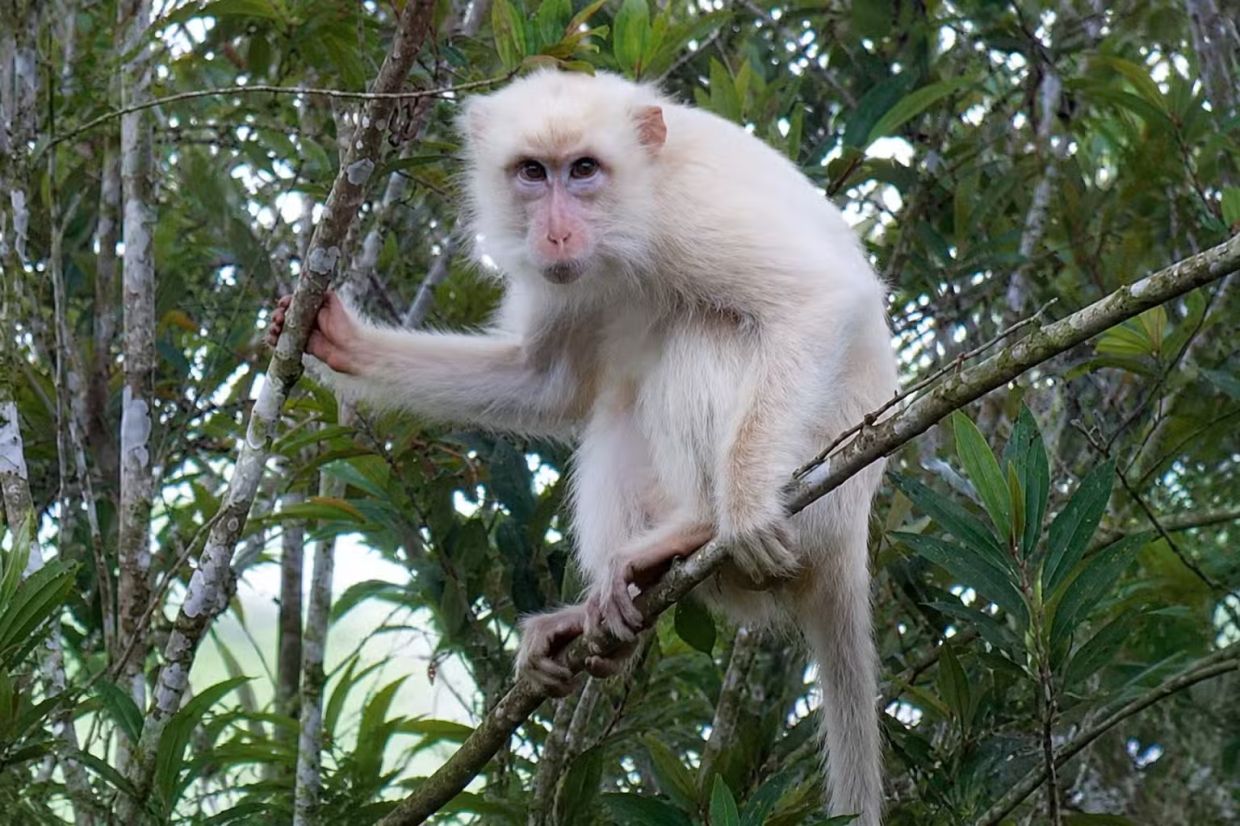
A strikingly pale macaque inhabiting a forested region in Sultan Kudarat has become the focus of an emergency conservation response after nearly a decade of relative obscurity gave way to widespread social media attention. The animal's distinctive colouration distinguishes it markedly from other members of its species in the locality, and the rapid circulation of video and photographic content online transformed what was once a local curiosity into a potential conservation crisis. This shift prompted the Department of Environment and Natural Resources (DENR) Region XII and the municipal government of Senator Ninoy Aquino town to implement urgent protective measures, demonstrating how digital connectivity can both illuminate and endanger wildlife in Southeast Asia's remaining forest ecosystems.
Scientific identification remains incomplete, though researchers have tentatively classified the specimen as a Philippine long-tailed macaque with an unusual pigmentation anomaly. Initial observations suggested the creature might suffer from albinism, a condition that would render it entirely unpigmented. However, a field assessment conducted by a DENR composite monitoring team revealed darker brown eyes, contradicting the albinism hypothesis and suggesting instead that the macaque may exhibit leucism or a related pigmentation disorder. Definitive scientific verification remains pending, pending detailed examination by wildlife specialists who will determine the precise nature of the condition affecting this individual.
Localresident Armando has documented the macaque's presence since 2016, noting that the animal had become a familiar fixture in the immediate forest vicinity, moving predictably through its habitat with little apparent concern for human observers. The creature's extended visibility in the region had somehow escaped broader public notice until recent years, when digital documentation and social media platforms amplified awareness dramatically. This sudden shift from obscurity to viral prominence illustrates a contemporary conservation paradox: the very tools that raise awareness about endangered species simultaneously create vulnerabilities that threaten their survival through increased human pressure.
The risks posed by online exposure are substantial and multifaceted. Poachers and wildlife traffickers now possess detailed documentation of the macaque's location and characteristics, creating immediate danger for an animal whose rarity makes it potentially valuable in illegal wildlife markets. Beyond commercial exploitation, the influx of curiosity-seeking visitors threatens the creature's peaceful existence and its capacity to maintain normal behavioral patterns within its forest home. The convergence of growing tourist interest, potential criminal activity, and simple human disturbance creates a hostile environment that could rapidly prove catastrophic for this genetically unique individual.
Environmental authorities determined that the macaque's immediate habitat retains adequate resources for survival. Secondary forest vegetation persists throughout the area, and natural food sources remain sufficient to sustain the resident monkey population. These encouraging findings suggested that habitat degradation was not the primary threat; rather, human interference generated by heightened attention posed the more pressing danger. This assessment shaped the subsequent response strategy, focusing protection efforts not on ecosystem restoration but on restricting human access and preventing external threats.
To mitigate risks, the municipal government implemented temporary closure of the area frequented by the white macaque, creating a protective barrier against unauthorized disturbance, illegal collection attempts, and wildlife trafficking activities. This precautionary approach recognizes that in an era of instantaneous information sharing, prevention rather than reactive management offers the only viable strategy for protecting vulnerable individuals. The local Barangay Bugso government is advancing an ordinance specifically designed to institutionalize protection for the macaque, its habitat, and the broader forest ecosystem, establishing legal frameworks that will persist long after immediate crisis subsides.
Complementing regulatory measures, Barangay Bugso intends to pursue habitat restoration and tree-planting initiatives that will strengthen local biodiversity while simultaneously creating a framework for responsible ecotourism. This dual approach acknowledges that complete isolation from human activity is neither realistic nor necessarily beneficial for conservation outcomes in contemporary Philippines contexts. Instead, directed management combining strict protection zones with controlled, educational tourism engagement offers a sustainable path that respects both conservation imperatives and local communities' development aspirations. Such initiatives align with broader Southeast Asian efforts to balance preservation with sustainable livelihood generation.
The Philippine legal framework provides substantial foundation for this protection effort. Republic Act No. 9147, formally titled the Wildlife Resources Conservation and Protection Act, explicitly prohibits hunting, capturing, collecting, possessing, transporting, trading or disturbing wildlife without proper authorization. This legislation applies universally to all Philippine fauna, establishing clear legal boundaries that support enforcement of the municipal protective measures. However, regulatory effectiveness depends substantially on public compliance and understanding, necessitating sustained educational campaigns to ensure that residents and visitors comprehend legal obligations surrounding wildlife protection.
Recognizing how digital platforms amplify conservation risks, DENR has appealed directly to content creators, photographers, journalists, and social media users to refrain from publishing precise location data or geotagged imagery associated with protected species. This guidance reflects emerging conservation best practice, acknowledging that in an interconnected world, detailed positional information rapidly travels through global networks and reaches individuals with both benign and malicious intentions. The appeal asks digital stakeholders to exercise restraint and responsibility when documenting wildlife, understanding that environmental protection in the twenty-first century requires careful negotiation between transparency and discretion.
Moving forward, DENR XII will submit comprehensive documentation regarding the white macaque to the Biodiversity Management Bureau for advanced technical evaluation, potentially yielding definitive scientific identification and establishing baseline data for long-term monitoring protocols. Concurrent efforts include sustained habitat surveillance, enhanced coordination among local government units and environmental agencies, and intensified public information campaigns emphasizing wildlife protection principles. These interconnected strategies recognize that conservation success requires alignment across multiple institutional levels and sustained engagement with communities whose daily presence in forest areas positions them as essential stewards.
The white macaque case illuminates broader conservation challenges facing the Philippines and Southeast Asia more broadly. As digital connectivity transforms remote forest regions into globally visible landscapes, wildlife increasingly faces threats unimaginable in prior decades. The creature's transition from local phenomenon to international attention within months demonstrates how rapidly threats can materialize in the digital age. Yet this same rapid response also demonstrates the potential for coordinated governmental action and community engagement to provide meaningful protection. The macaque's future depends on whether Philippine authorities and local communities can sustain the protective measures and behavioral changes necessary to ensure that this genetically remarkable individual survives in the forest ecosystem where it has sheltered for nearly a decade.

