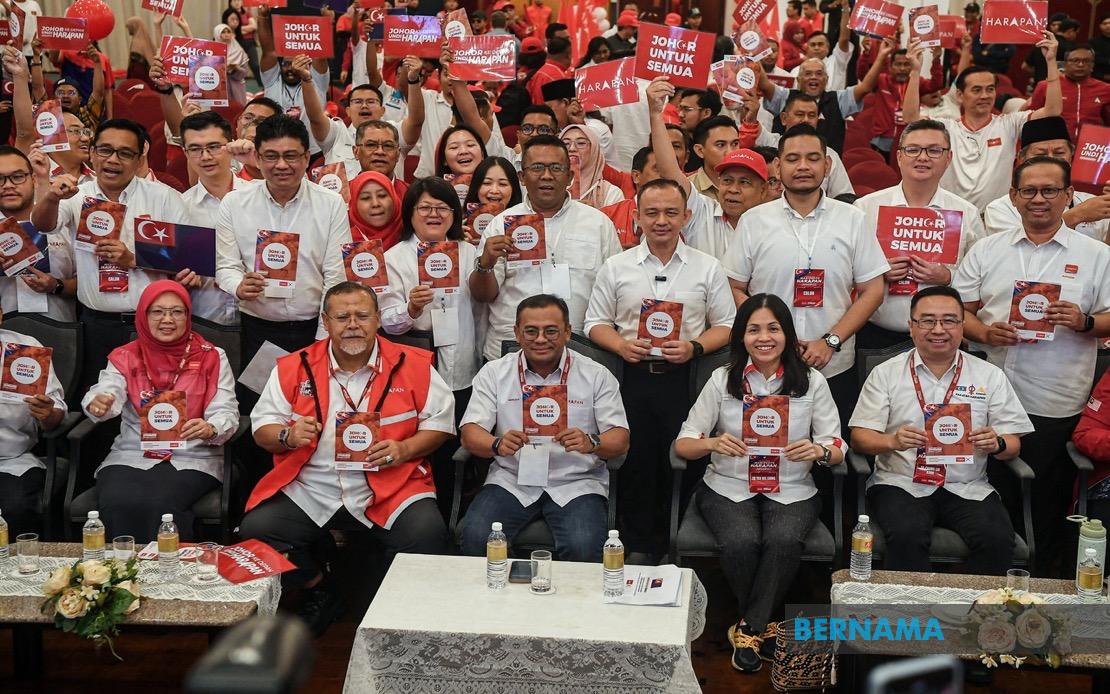
Pakatan Harapan unveiled its manifesto for the 16th Johor state election on July 3, positioning 'Johor Untuk Semua' (Johor For All) as a pragmatic blueprint rooted in concrete community demands and the state's economic landscape rather than aspirational rhetoric. The launch in Johor Bahru underscored the coalition's intention to present voters with achievable commitments backed by implementation experience from its federal and state-level governance record. Johor DAP chairman Teo Nie Ching, who doubles as Deputy Communications Minister, framed the initiative as reflecting a nuanced understanding of diverse demographic priorities across Malaysia's southern gateway.
The manifesto's architecture reveals careful segmentation across multiple voter constituencies. Rather than adopting a one-size-fits-all approach, the document deliberately weaves together provisions targeting distinct life-stage concerns—from youth employment and entrepreneurship to maternal welfare and early childhood development. This granular approach reflects polling data and grassroots feedback gathered during consultation phases, suggesting the coalition conducted substantial listening exercises before crystallising its platform. By explicitly positioning the manifesto as family-inclusive, Teo signalled that PH intends to neutralise common accusations that opposition coalitions overlook household bread-and-butter concerns.
Education emerged as a centrepiece commitment within the broader package. Johor's standing as an economically significant state with substantial manufacturing and services sectors creates competitive pressure around workforce quality. Schools experiencing infrastructure deficits or resource constraints directly impact parental perceptions of government effectiveness. By elevating education to manifesto-level prominence, Pakatan Harapan seeks to challenge the incumbent government's record while demonstrating that opposition governance prioritises long-term human capital development alongside immediate relief measures.
The pledge to halve waiting periods at Johor-Singapore border crossings represents perhaps the most operationally ambitious commitment within the platform. These crossings—Causeway and Second Link—process hundreds of thousands of cross-border commuters and traders monthly. Congestion inflicts measurable economic costs on both sides, frustrating workers, suppliers, and consumers. Teo's confidence that coordination with the federal Home Ministry can deliver this outcome implicitly acknowledges that border management transcends state jurisdiction, requiring cooperative federalism. This framing subtly positions Pakatan Harapan as the coalition best positioned to harmonise federal-state execution, a potentially powerful message if current administration relationships appear fractious.
The Johor Health Scheme represents one of the manifesto's most significant structural proposals. Healthcare accessibility and affordability persistently rank among top voter concerns across Malaysia, particularly among middle-income households ineligible for needs-based assistance but struggling with premium burdens. By referencing Selangor's operational precedent, Teo grounds the proposal in demonstrated feasibility rather than theoretical design. Selangor's experience implementing similar schemes provides a template and confidence-building narrative—voters can visualise how the system functions because a neighbouring state operates comparable infrastructure. This benchmarking strategy converts policy innovation from abstract promise into tangible, observable reality.
First-time homebuyer assistance within the manifesto acknowledges that property affordability challenges have intensified across Malaysia, particularly in growth corridors like Johor where rapid urbanisation has outpaced housing supply responses. Deposit assistance programmes reduce entry barriers for younger workers establishing households. Given that Johor contains significant migrant worker populations and interstate commuters, housing policy directly touches economic migration patterns and labour market efficiency. The proposal signals that Pakatan Harapan recognises property access as foundational to family stability and economic participation.
The RM500 million youth empowerment fund signals substantial fiscal commitment to a demographic cohort often perceived as politically volatile and economically frustrated. Youth underemployment and skills mismatches persist despite overall labour market expansion. A dedicated fund permits targeted interventions—vocational training partnerships, entrepreneurship incubation, digital literacy programmes—rather than diluting youth initiatives across generic economic development budgets. The specificity of allocating identified capital suggests the coalition conducted detailed costing exercises rather than offering aspirational figures.
Teo's framing of the manifesto as 'very balanced' carries implicit competitive messaging. By contrast, this positioning invites voters to scrutinise whether incumbent government platforms equally weight varied constituency interests or concentrate resources within particular demographic or geographic segments. Balance rhetoric appeals to swing voters—those uncertain whether particular parties favour their circumstances—by suggesting equitable attention across diverse groups.
The manifesto's timing within Johor's political context assumes particular significance. The state elections on July 11 represent a mid-term assessment of Johor's governance direction. Pakatan Harapan's approach combines federal ministerial credentials—Teo's position carries national weight—with localized commitment demonstrations. This dual-track presentation attempts to convince voters that opposition governance brings both national-scale experience and grassroots attentiveness.
The coalition's emphasis on deliverability rather than mere promise-making reflects lessons from previous election cycles where unfulfilled pledges damaged credibility. By repeatedly invoking operational precedents, implementation pathways, and federal coordination mechanisms, Teo constructs a narrative where manifesto commitments represent continuations of proven approaches rather than experimental ventures. This defensive posturing acknowledges that voters have grown sceptical of electoral commitments generally, requiring higher evidentiary standards before trusting opposition promises.
For Malaysian observers tracking coalition dynamics regionally, the manifesto illustrates how federal opposition structures navigate state elections. Pakatan Harapan must simultaneously defend Selangor and Penang governance records while advancing Johor ambitions, all whilst maintaining federal opposition institutional coherence. The 'Johor Untuk Semua' framework balances local specificity—addressing border congestion and Johor-specific economic characteristics—against broader coalition messaging emphasizing competent, inclusive governance.
The early voting scheduled for July 7 and election day on July 11 compress campaign periods, placing premium value on manifesto clarity and voter familiarity with platform details. In this compressed timeline, Teo's media engagement and detailed policy explanation serve to ensure the manifesto narrative dominates pre-election discourse rather than allowing implementation doubts to fester unchallenged. Her willingness to engage substantively with specific proposals—border coordination, health scheme precedents—demonstrates confidence that policy substance, not just emotive appeals, can drive electoral outcomes.

