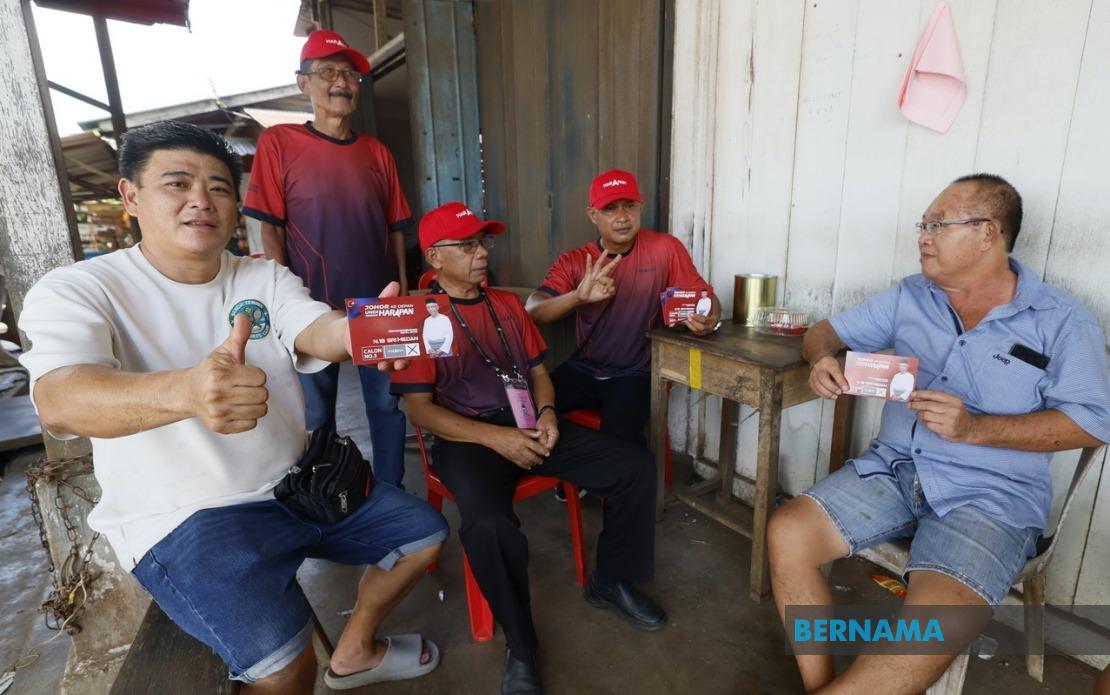
Hishamudin @ Misrin Ishak, the Pakatan Harapan candidate for Sri Medan in the 16th Johor State Election, is pursuing a grassroots campaign strategy centred on addressing the immediate needs of constituents, with particular emphasis on resolving long-standing infrastructure challenges that have plagued the area. The former mathematics educator, known locally as "Cikgu Misrin", has built his electoral pitch around direct engagement with residents and a commitment to translating community concerns into tangible government action.
The candidate's approach reflects a deliberate pivot away from grandiose campaign promises, instead anchoring his message on practical delivery and incremental improvements to residents' daily lives. His stated principle of "work first, talk later" signals an intention to prioritise implementation over political rhetoric, a positioning that seeks to distinguish him from traditional campaign styles. This philosophy extends across his proposed agenda, from tackling recurring flooding issues that continue to burden Sri Medan residents to advancing targeted economic and educational initiatives designed to prevent marginalisation of younger constituents.
Flood management stands prominently in Hishamudin's platform, reflecting genuine distress among residents who have endured repeated inundations. This issue carries particular resonance in Johor, where seasonal flooding remains a persistent governance challenge affecting multiple constituencies and voters across the political spectrum. By elevating this concern, the candidate signals responsiveness to hyperlocal issues that state-level politicians sometimes overlook in favour of broader policy announcements.
Beyond immediate infrastructure, Hishamudin has articulated a vision for balanced development across urban, semi-urban and rural areas within his constituency, recognising that disparities in resource allocation often breed voter resentment. His commitment to serving residents regardless of their political leanings represents a notable stance in an increasingly polarised electoral environment, suggesting that constituent welfare ought to transcend partisan boundaries. This framing appeals particularly to voters fatigued by tribal politics and seeking representatives willing to engage across factional lines.
Education and vocational training feature prominently in his platform, with specific reference to Technical and Vocational Education and Training programmes aimed at youth. This emphasis addresses a critical gap in Malaysia's education ecosystem, where TVET remains underutilised relative to conventional academic pathways, often sidelining capable students who might thrive in technical fields. Digital education exposure represents an additional recognition that Sri Medan's younger generation must develop competencies aligned with contemporary economic demands.
Small and medium enterprises constitute another pillar of his campaign agenda, with Hishamudin proposing intensified support to help local entrepreneurs transcend dependence on purely local market demand. This initiative carries particular significance for Johor's SME sector, which struggles with market access limitations and expansion challenges that constrain economic dynamism in smaller towns. His emphasis on linking entrepreneurs to broader distribution networks and consumer bases addresses a structural weakness affecting communities beyond Sri Medan.
The candidate's background as a village headman provides substantive grounding for his claims about understanding grassroots administration and welfare matters. This experience, spanning community service and local governance, offers concrete credentials that distinguish him from candidates lacking demonstrated administrative track records. His positioning as a bridge between residents and government institutions reflects a traditional conception of representative democracy, emphasising intermediary roles and administrative competence alongside policy advocacy.
Entering his third campaign day at the time of reporting, Hishamudin observed encouraging voter responsiveness, though he confronts the formidable electoral arithmetic of Sri Medan's historical lean toward Barisan Nasional. His status as a new candidate and untested political figure constitutes both vulnerability and potential asset, allowing him to present himself as unburdened by incumbent baggage whilst requiring him to overcome voter scepticism about his capacity to deliver. The three-way contest also involving Perikatan Nasional's Ahmad Rosdi Bahari and BN incumbent Datuk Zulkurnain Kamisan further fragments opposition strength, complicating PH's path to victory in this traditionally competitive state seat.
The Johor state election campaign unfolds against the backdrop of ongoing realignment within Malaysia's political landscape, with Pakatan Harapan attempting to consolidate its recent electoral gains whilst BN and PN compete for voter defection. Johor's state-level contests carry disproportionate weight within this broader competition, given the state's economic importance and historical significance as BN's traditional stronghold. Results from constituencies like Sri Medan will provide granular insight into shifting voter preferences and regional political dynamics.
Early voting is scheduled for July 7, with general polling day set for July 11, providing Hishamudin approximately two weeks to amplify his message among Sri Medan's electorate. His campaign methodology emphasises sustained community engagement through walkabouts and direct constituent interaction rather than media-intensive approaches, a strategy suited to building personal connections in constituencies where incumbent familiarity constitutes significant electoral advantage. This ground-level positioning requires consistent effort and authentic responsiveness to sustain voter interest across the campaign period.
The candidate's emphasis on staying positive despite confronting entrenched opposition support suggests realistic assessment of electoral headwinds whilst maintaining motivational messaging for campaign volunteers and supportive voters. His framing of himself as a fresh face offering continuity of service, rather than radical departure, appeals to voters seeking competent administration without destabilising change. Whether this positioning proves sufficient to overcome Sri Medan's historical political inclinations will emerge when results are tabulated following the July 11 polling day.

