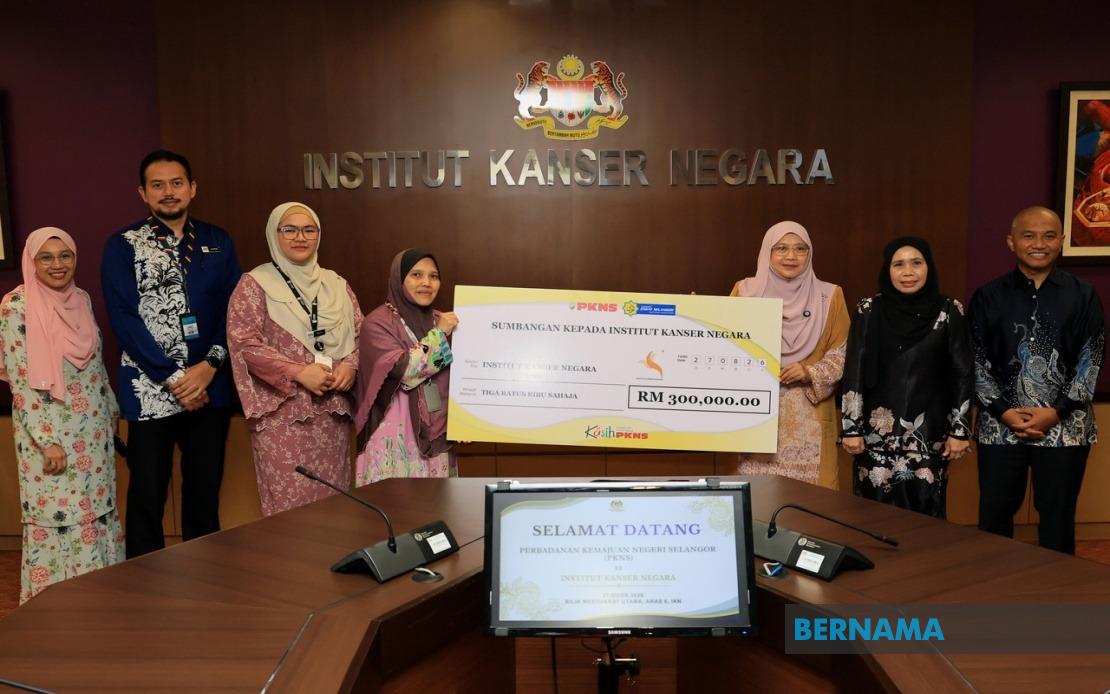
The Selangor State Development Corporation (PKNS) has pledged RM300,000 to alleviate the financial strain experienced by approximately 50 to 100 cancer patients receiving care at the National Cancer Institute (IKN), marking a significant corporate commitment to healthcare support in Malaysia's most developed state. The contribution, announced in Putrajaya, represents a growing recognition among Malaysian corporations that financial hardship remains a substantial obstacle in the cancer treatment journey, particularly for lower-income families navigating one of the nation's most expensive health conditions.
Sapna Turmidi, senior general manager of PKNS Corporate Services, contextualised the donation within a broader philosophy that extends corporate responsibility beyond monetary transactions. Speaking to journalists during the presentation of a symbolic cheque to IKN director Dr Nur Aslina Bahakodin, Turmidi emphasised that the initiative sought to provide psychological and emotional reinforcement alongside tangible financial relief. This framing highlights an increasingly sophisticated understanding within Malaysia's state-owned enterprises that cancer patients and their families require holistic support mechanisms rather than isolated financial interventions. The corporation's messaging explicitly addressed the isolation that affects many patients, promising a form of corporate companionship during periods of acute vulnerability.
The personal motivation underpinning PKNS's decision adds human dimension to the corporate gesture. A PKNS employee diagnosed with glioma in February succumbed to the disease just four months later at IKN, a trajectory that catalysed the agency's recognition of cancer's devastating human and economic costs. This direct institutional loss prompted leadership to transform private grief into systematic charitable action, creating a tangible mechanism through which the organisation's collective experience could translate into meaningful support for others navigating similar devastation. Such catalytic moments often prove instrumental in shifting corporate social responsibility from abstract commitment to concrete programme implementation.
Structurally, the assistance operates through a collaborative framework involving Islamic financing principles. PKNS has channelled the funds via a wakalah zakat arrangement in partnership with the Selangor Zakat Board (LZS), positioning the grant as zakat-compliant charitable giving rather than conventional corporate donation. This structure specifically targets Muslim cancer patients classified under the asnaf al-Gharimin category within Islamic charitable frameworks, demonstrating how state institutions in Malaysia increasingly integrate religious and secular welfare mechanisms. The timing, coinciding with PKNS's 62nd anniversary on 1 August, transforms institutional milestone celebration into occasion for structured generosity.
From the healthcare institution's perspective, the funding addresses a documented and critical gap in cancer care accessibility. Dr Nur Aslina articulated IKN's annual requirement of between RM1 million and RM2 million specifically dedicated to vulnerable patients, a substantial figure that underscores the magnitude of unmet financial need within Malaysia's cancer treatment system. This shortfall extends beyond basic medical interventions to encompass transportation, specialised nutrition, and family welfare arrangements—the comprehensive ecosystem surrounding effective cancer therapy. Without such supplementary funding, financial constraints routinely force patients to defer follow-up appointments and diagnostic procedures, directly compromising treatment efficacy and survival outcomes.
The financial barriers to continuous cancer care represent a particularly acute Malaysian challenge, given the country's economic inequality and the concentration of specialised oncology facilities in urban centres requiring significant patient mobility. Early detection programmes have successfully increased cancer identification rates, with breast cancer predominating among women and colorectal cancer among men, yet these screening successes paradoxically create expanded caseloads for already resource-constrained support systems. The gap between diagnostic capacity and financial support infrastructure has widened precisely as public awareness campaigns have improved screening participation rates across Malaysian demographics.
IKN's Medical Social Work Unit will manage fund distribution following comprehensive socio-economic assessment of individual patients and their family circumstances. This assessment-based approach ensures that assistance reaches those facing the most acute financial vulnerability rather than adopting blanket allocation methods. Such targeted methodology reflects evolving best practices in healthcare charity, prioritising need-based distribution over simplified per-patient formulas. The evaluation process, while administratively rigorous, creates opportunities to connect patients with complementary support services beyond immediate financial relief.
The broader institutional context illuminates why corporate healthcare partnerships have become increasingly prominent in Malaysian governance. PKNS, established on 1 August 1964 as Selangor's primary development agency, operates at the intersection of state economic objectives and social welfare responsibilities. The organisation's decision to direct corporate resources toward cancer care reflects recognition that healthcare infrastructure sustainability depends increasingly on multi-stakeholder engagement rather than government funding alone. This reality, particularly acute in a federal system where healthcare financing remains contested, positions corporate contributions as pragmatic rather than merely altruistic.
Dr Nur Aslina's emphasis on the irreplaceable role of corporate bodies, zakat institutions, and NGOs in complementing hospital-based assistance tacitly acknowledges the limitations of public sector resourcing. Malaysian state healthcare systems, whilst providing foundational access, operate under chronic resource constraints that institutional partnerships help mitigate. The National Cancer Institute's repeated emphasis on ongoing funding requirements signals that single contributions, whilst valuable, represent partial rather than comprehensive solutions to systemic underfunding. This dependency on diverse funding sources creates both collaborative opportunities and vulnerabilities for institutions reliant on unstable philanthropic streams.
For Malaysian cancer patients and their families, such corporate interventions provide tangible if modest relief within a healthcare environment characterised by substantial out-of-pocket expenditures. The RM300,000 commitment, distributed across 50 to 100 patients, provides meaningful assistance for those navigating treatment while managing reduced earning capacity and treatment-related expenses. Yet the scale of need—with annual requirements totalling RM1-2 million merely at one specialised institute—indicates that philanthropic contributions, however generous, cannot replace systematic government investment in cancer care infrastructure and patient support services. The PKNS donation exemplifies both the commitment of Malaysian institutions to social welfare and the incomplete nature of current healthcare support systems for catastrophic illnesses.

