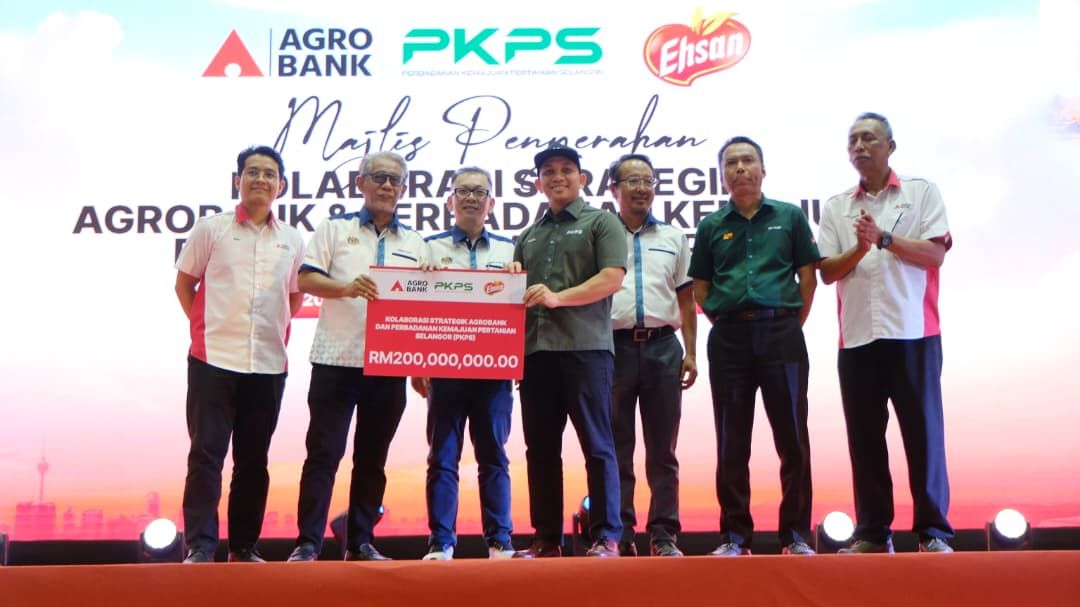
The Selangor Agricultural Development Corporation (PKPS) has secured RM200 million in financing from Agrobank through a newly established trade facility designed to fortify the state's agrifood ecosystem. The agreement, announced during the Malaysia Agriculture, Horticulture and Agrotourism Exhibition at MAEPS Serdang on August 29, represents a significant commitment to addressing infrastructure gaps and working capital constraints within Selangor's agricultural sector. Agrobank group president and chief executive officer Datuk Tengku Ahmad Badli Shah Raja Hussin presented the symbolic handover to PKPS group chief executive officer Datuk Dr Mohamad Khairil Mohamad Razi, with Deputy Agriculture and Food Security Minister Datuk Chan Foong Hin witnessing the ceremony.
For Malaysian stakeholders watching Selangor's agricultural trajectory, this partnership signals a structural shift toward capital-intensive modernisation. The facility will become operational in March 2027 and operates on a disbursement model tied directly to project milestones, ensuring disciplined cash management and accountability throughout the partnership period. This mechanism addresses a longstanding concern in Malaysia's agricultural financing: the need for transparent, performance-linked disbursements rather than lump-sum allocations that can strain working capital planning.
The centrepiece initiative under this facility is the construction of a halal food warehouse that will serve dual functions as both storage and a logistics hub. This facility responds to Selangor's position as a major food-producing state and the growing international demand for halal-certified products from Southeast Asian markets. By establishing a dedicated warehouse with integrated logistics capabilities, PKPS positions itself to capture greater value within the regional halal supply chain, which has become increasingly competitive among Muslim-majority nations and non-Muslim economies seeking to access this growing market segment.
Beyond the flagship warehouse, the facility encompasses a portfolio of complementary infrastructure projects. A halal chicken processing centre addresses the critical need for certified poultry processing capacity, an area where Selangor faces competition from other states and neighbouring countries. Additionally, the Ehsan product processing centre and distributed warehousing network across Selangor's districts represent a deliberate strategy to reduce supply-chain inefficiencies that have historically hampered smaller producers' access to urban markets. The upgraded distribution infrastructure will theoretically allow producers in peripheral districts to reach consumers more cost-effectively, addressing longstanding rural-urban disparities in agricultural profitability.
The financing arrangement extends beyond bricks-and-mortar infrastructure into operational and research dimensions. The RM200 million commitment includes funding for ready-to-eat and ready-to-heat food production under the Ehsan brand, reflecting a broader Malaysian trend toward value-added products. This vertical integration—from primary production through processing and distribution to finished consumer goods—mirrors strategies adopted by larger Asian agricultural corporations and represents PKPS's attempt to compete in higher-margin segments of the food industry.
Innovation and skills development form integral components of the facility's scope. The Ehsan Agricultural Research Centre is designated to intensify smart agriculture research, addressing Malaysia's need to boost yields and sustainability amid climate pressures and land constraints. Concurrently, the Ehsan Agricultural Training Centre represents an investment in human capital, tackling a persistent bottleneck in Malaysian agriculture: the shortage of technically skilled workers willing to pursue farming as a career. By embedding training capacity within the PKPS ecosystem, this facility helps create pathways for younger Malaysians to enter agriculture with modern competencies rather than inherited traditional practices.
The partnership also extends into agritourism development via the Ehsan Resort and Convention Centre, illustrating how contemporary agricultural strategies in Malaysia increasingly blend production, tourism, and education. This diversification model has gained traction across Southeast Asia, where agritourism generates supplementary revenue streams while promoting agricultural literacy among urban populations and international visitors. For Selangor specifically, this approach leverages the state's proximity to the Klang Valley metropolitan area and international airports, positioning agritourism as an accessible experience for foreign and domestic tourists.
Contextually, this agreement arrives during a period when Southeast Asian governments are recalibrating food security strategies in response to supply-chain vulnerabilities exposed by the pandemic, climate volatility, and geopolitical tensions affecting regional trade routes. Malaysia's reliance on food imports remains substantial, and Selangor's agricultural capacity directly influences national food self-sufficiency metrics. By concentrating investment in a single state's infrastructure and capacity, federal policymakers and PKPS leadership are acknowledging that incremental improvements must yield tangible productivity and resilience gains.
The partnership also aligns with Malaysia's broader fintech and digital agriculture initiatives. By tying disbursements to project progress through structured mechanisms, PKPS and Agrobank are establishing precedent for performance-based agricultural financing that could be replicated elsewhere and scaled through digital platforms. This approach contrasts with historical agricultural lending, which often operated on less rigorous monitoring frameworks and consequently bore higher default rates.
For regional observers and Southeast Asian agricultural policymakers, the PKPS-Agrobank model offers instructive lessons in public-private collaboration. By designating Agrobank—a state-owned development bank with agricultural focus—as the financing partner rather than commercial banks optimising for short-term returns, the arrangement balances profitability with sectoral development goals. This hybrid model reflects Malaysia's pragmatic approach to bridging market gaps where commercial incentives alone prove insufficient for strategic sectoral investments.
The facility's emphasis on halal certification and branding underscores Selangor's competitive positioning within global Islamic economy networks. As Muslim-majority consumers and non-Muslim producers alike prioritise halal credentials, Selangor's infrastructure investments in certified processing and storage create multiplicative advantages. The state could emerge as a regional halal food hub, attracting value-chain partners from other ASEAN nations seeking to certify and distribute products through Malaysian platforms.
Operationally, the arrangement's structured disbursement model merits scrutiny as a governance innovation. Rather than allowing accumulated capital to remain idle or subject to discretionary allocation, tying payments to measurable project completion creates accountability incentives for both PKPS management and Agrobank oversight teams. This transparency mechanism addresses historical concerns about agricultural development fund efficacy in Malaysia, where capital allocation to rural projects has sometimes lagged or deviated from stated objectives.
Looking forward, the success of this RM200 million facility will depend on execution discipline and market responsiveness. Selangor's agrifood sector must translate infrastructure investments into actual productivity gains and market share capture. The halal food warehouse and processing centres are only valuable if they achieve high utilisation rates from producers and buyers. The training centre will only demonstrate impact if graduates secure employment in the sector and improve farm-level productivity. These execution risks remain significant despite sound strategic design, and warrant close monitoring as PKPS and Agrobank navigate the implementation phase commencing in March 2027.

