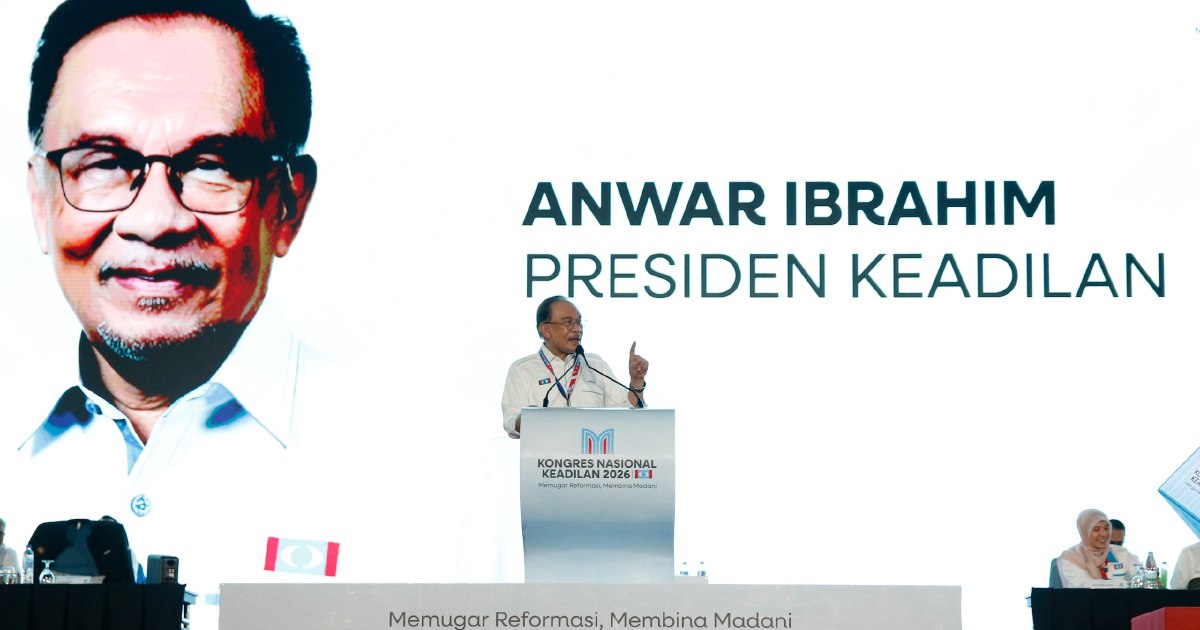
PKR leader Anwar Ibrahim has moved to reassure party members that the People's Justice Party can maintain its working relationship with BN-Umno without betraying its foundational commitment to Pakatan Harapan, a delicate political balancing act that reflects Malaysia's increasingly fragmented parliamentary landscape. The assurance comes amid ongoing questions about the sustainability of Malaysia's current coalition architecture and the tensions inherent in parties attempting to straddle multiple political camps.
Anwar's statement underscores the peculiar reality of contemporary Malaysian politics, where the arithmetic of parliamentary majorities frequently forces erstwhile rivals into uneasy accommodations. Since the 2023 general election transformed the political terrain, coalition mathematics have repeatedly demanded flexibility from major parties, and PKR finds itself in the position of being essential to government formation precisely because it occupies ideological and organisational space between traditional opposition and establishment blocs. This positioning, while strategically valuable, carries inherent contradictions that Anwar must manage publicly and privately.
The PKR leader's articulation that loyalty to PH need not preclude coordination with BN-Umno signals acceptance that the era of binary political competition between clearly demarcated opposing camps has become untenable. Rather than viewing coalitions as mutually exclusive entities, Anwar appears to be arguing for a more fluid understanding of political partnership whereby parties maintain core relationships while simultaneously engaging in tactical coordination with other actors. This conception departs significantly from the zero-sum competition that characterised Malaysian politics during earlier periods.
For Malaysian observers, Anwar's position highlights the practical constraints faced by democratic governance within a system of proportional representation tempered by electoral mechanics that resist decisive single-party majorities. When no coalition commands overwhelming parliamentary dominance, smaller parties or moderate factions within larger groupings gain disproportionate negotiating power. PKR's significance derives substantially from this structural reality rather than from commanding vast electoral support, rendering it attractive to competing coalitions precisely because it can shift parliamentary balance.
The sustainability of this arrangement depends critically on PKR's ability to convince both PH allies and BN-Umno partners that it pursues genuine collective interests rather than narrow factional advantage. Any perception that PKR is instrumentalising its coalition membership primarily to extract concessions or ministerial positions would rapidly undermine the trust necessary for plural coalition governance to function. Anwar's public reassurances thus serve as confidence-building measures directed at both camps, emphasising that PKR views coalition partnerships as substantive commitments rather than transactional arrangements.
Regionally, Malaysia's coalition dynamics carry significance beyond domestic politics. Southeast Asia's established democracies increasingly grapple with fragmentation, minority governments, and the necessity of creating majorities through post-electoral negotiation rather than pre-poll alignment. Thailand, Indonesia, and the Philippines all confront similar challenges, wherein party systems resist traditional left-right or incumbent-opposition binaries. Malaysia's experience navigating plural coalition governance may offer lessons, both positive and cautionary, for neighbours facing comparable parliamentary arithmetic.
For PKR specifically, the challenge involves maintaining internal cohesion while pursuing what might appear to grassroots supporters as an inconsistent political strategy. The party's original identity derived substantially from opposition to Umno-dominated governance and systemic corruption. Coordinating with BN-Umno, regardless of the political rationale, potentially complicates that origin narrative. Anwar must continually demonstrate to PKR members that such cooperation advances the party's substantive policy agenda rather than merely facilitating elite accommodation.
The economic implications of Malaysia's coalition stability extend beyond parliamentary procedure. Investor confidence in governance depends substantially on predictability regarding policy direction and governmental longevity. Coalition arrangements that appear unstable or fundamentally contradictory generate uncertainty that manifests in capital flows and credit assessments. Anwar's emphasis on coalition commitment, therefore, carries material weight for Malaysia's macroeconomic positioning, currency stability, and credit ratings.
Another dimension worth considering is how this framework affects policy-making capacity. Coalition governments comprising multiple partners with divergent ideological orientations frequently experience difficulty implementing coherent reform agendas. Consensus-building becomes essential but time-consuming, potentially slowing governmental responsiveness to urgent challenges. Malaysian policymakers must demonstrate that plural coalition governance can deliver effective administration despite inherent tensions between partner parties.
Future tests of PKR's dual commitment will likely emerge when coalition partners advance contradictory policy proposals or when specific parliamentary votes require PKR to choose between supporting its PH allies or accommodating BN-Umno preferences. How Anwar navigates such scenarios will determine whether his present reassurances prove substantive or merely rhetorical. The credibility of Malaysian coalition governance ultimately depends on political leaders demonstrating capacity to honour commitments even when doing so proves politically costly.
Looking forward, whether PKR can successfully maintain its balancing position depends on factors extending beyond leadership intention. Electoral volatility, economic conditions, and the strategic calculations of larger coalition partners all influence the stability of such plural arrangements. Anwar's current positioning may reflect genuine political philosophy regarding inclusive governance, or it may represent pragmatic adaptation to immediate circumstances. Time will reveal which interpretation proves accurate.

