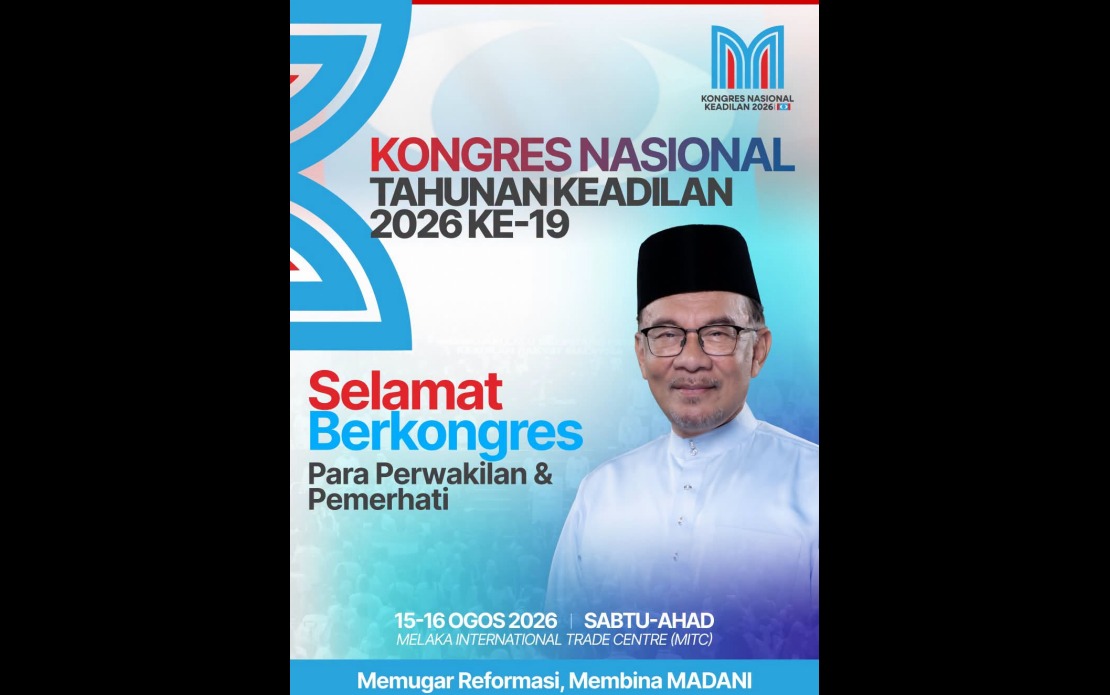
Prime Minister Datuk Seri Anwar Ibrahim has issued a pointed reminder to Parti Keadilan Rakyat that the opposition-turned-government coalition partner must function primarily as a grassroots movement anchored in moral principles rather than merely as a political machine designed to capture electoral victories. In remarks posted on Facebook ahead of the party's major gathering this week, Anwar emphasised that PKR's legitimacy and long-term relevance depend on its unwavering commitment to integrity, social justice, unity, and public trust—values he framed as essential to constructing a Malaysia that is both equitable and dignified for all citizens.
The intervention reflects an ongoing tension within PKR, which has evolved from a street-level reform movement into a cabinet-level player within Malaysia's ruling coalition. As the party approaches its National Congress 2026, scheduled to convene at the Melaka International Trade Centre in Ayer Keroh from August 15 onwards, leadership appears concerned that organisational focus may be drifting away from the ideological moorings that birthed PKR during the Reformasi era of the late 1990s. Anwar's message serves as both encouragement and caution: the party must use this congress as a moment of genuine introspection rather than mere celebration of past electoral successes.
The two-day congress will operate under the banner "Memugar Reformasi, Membina MADANI"—roughly translating as revitalising the reform struggle while building Malaysia's development agenda. This dual framing itself speaks to the balancing act PKR must perform: honouring its radical past while governing within a pragmatic present. For party delegates and observers, the slogan suggests that reformasi principles are not historical relics but living guides for contemporary governance and policymaking. The choice of theme indicates deliberate effort to reconnect grassroots membership with the foundational mission that distinguished PKR from more establishment-oriented political vehicles when it emerged nearly three decades ago.
Anwar's scheduled keynote address at the congress is expected to articulate PKR's strategic priorities and longer-term political direction, offering signals about how the party intends to navigate Malaysia's fractious coalition politics while retaining its identity. As Prime Minister, Anwar holds unique standing to shape this narrative, yet his position also creates inherent contradictions: the man leading the national government cannot simultaneously present PKR as purely oppositional or revolutionary. The congress therefore becomes a space where these tensions must be managed and reconciled for party members.
The timing of Anwar's message is significant within the Malaysian political context. PKR has faced periodic criticism from within its own ranks and from external observers regarding questions about whether the party has compromised its original mission by joining a ruling coalition with parties like UMNO and others across multiple governments. Questions about internal democracy, candidate selection, and ideological coherence have surfaced repeatedly. By explicitly calling for the party to remain a "mass movement" rather than simply an "election vehicle," Anwar is attempting to reset expectations and reaffirm commitments that might otherwise be overlooked in the quotidian business of coalition management and ministerial administration.
For Malaysian readers and regional observers, this moment carries broader significance. PKR's trajectory—from street protests and reform agitation to parliamentary seats and ministerial portfolios—mirrors the evolution of reformist movements across Southeast Asia as they encounter the complexities of power-sharing and governance responsibility. How PKR reconciles these pressures will influence not only Malaysian politics but also regional perceptions about whether reform movements can retain their moral authority and programmatic identity once absorbed into state structures. The Congress 2026 effectively becomes a test of whether that reconciliation is possible.
The congress also provides a platform for PKR to demonstrate internal vitality and democratic processes at a moment when Malaysian political institutions face scrutiny regarding their representativeness and authenticity. If the gathering serves genuinely as a space for delegates to assess achievement and reset direction—rather than functioning as a rubber-stamp exercise—it strengthens the party's claims to embody the democratic principles it professes. Conversely, if proceedings reveal disconnect between leadership rhetoric and grassroots sentiment, or if power dynamics suppress honest debate, the contradiction between Anwar's messaging and organisational practice would become apparent.
The reference to Reformasi in both the congress theme and Anwar's statement carries particular weight for PKR members and supporters who view the movement through historical and ideological lenses. Reformasi emerged from a specific moment of Malaysian political crisis and represented articulation of demands for judicial independence, anti-corruption, and democratic renewal. Whether those demands remain central to PKR's agenda, or whether they have been displaced by questions of coalition management and government programme delivery, remains an open question that the congress may address.
Anwar's invocation of religious blessing—"May Allah SWT bless all our efforts for our beloved homeland, Insya-Allah"—also signals the spiritual and moral dimensions that PKR seeks to maintain within its identity. For a party operating within Malaysia's Muslim-majority context, this framing helps position reform and governance questions within frameworks of faith and national duty rather than purely technical political management. Whether such framing resonates with younger members or urban constituencies accustomed to more secular political discourse remains to be seen.
Moving forward, the Congress 2026 will reveal whether PKR's leadership can genuinely reorient party culture toward grassroots engagement and principled governance, or whether structural pressures toward consolidation and electoral calculation will prove more decisive. Anwar's pre-congress statement sets ambitious expectations. The gathering itself will demonstrate whether the party can meet them.

