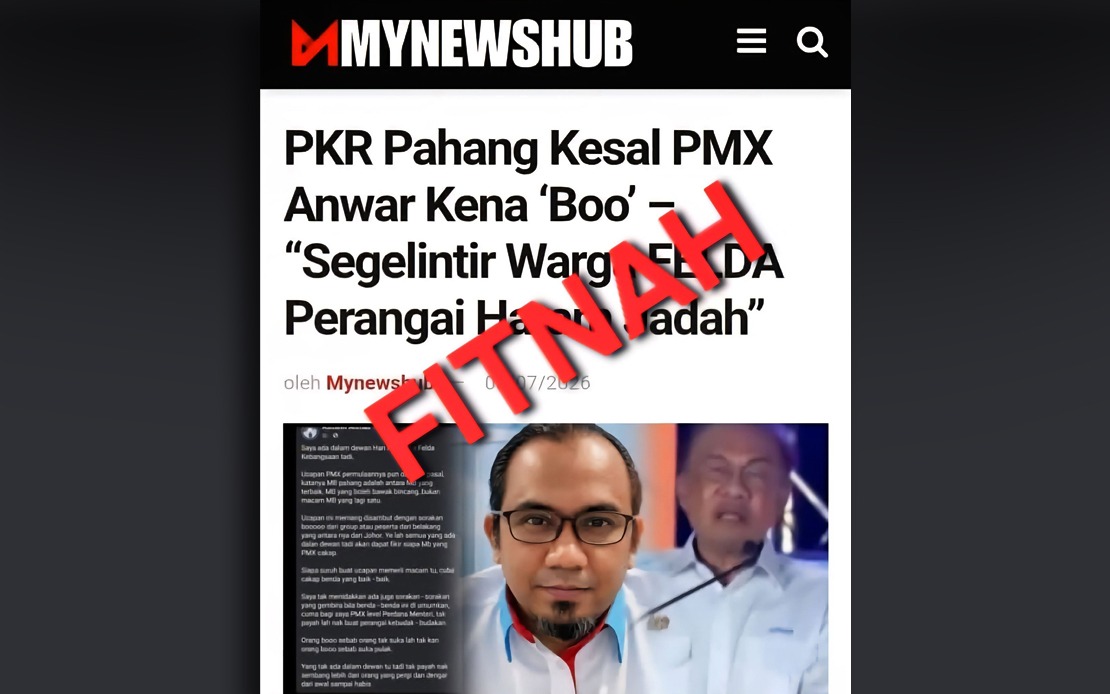
PKR Pahang has categorically refuted claims circulated by an online news portal that the party expressed disappointment over Prime Minister Datuk Seri Anwar Ibrahim's reception during FELDA Settlers' Day and the organisation's 70th anniversary commemoration held in Jengka. The state party leadership moved swiftly to counter the narrative, characterising the report as misleading and insisting that no such official statement had been issued by the party.
Datuk Dr Suhaimi Ibrahim, PKR Pahang's information chief, issued a media statement disputing the allegation after the event at Stadium Tun Abdul Razak. Having attended the gathering personally from beginning to end, Suhaimi provided his first-hand account of proceedings, asserting that the occasion unfolded without incident. He emphasised that allegations the Prime Minister was "booed" represented a distorted and sensationalised interpretation of events that bore no resemblance to what actually occurred during the celebration.
According to Suhaimi's account, the FELDA commemoration was characterised by high energy, meticulous organisation, and enthusiastic participation from thousands of settlers present. The atmosphere, he maintained, remained consistently positive throughout the programme's duration. Each policy announcement focused on settler initiatives and welfare provisions generated applause and constructive responses from the audience, he noted, contradicting the hostile reception narrative that had emerged online.
The PKR Pahang leadership expressed serious concern about the misappropriation of the party's name in generating the disputed report. Suhaimi stressed that attributing such statements to PKR Pahang without authorisation represented irresponsible conduct that could undermine the party's standing and credibility. He also objected to the language used in characterising settler reactions, contending that such terminology demonstrated disrespect toward the FELDA community whose members constitute a significant electoral constituency across the peninsula.
Suhaimi's rebuttal highlighted what he perceived as a fundamental departure from journalistic principles in the original report. Rather than presenting verified facts, he suggested, the online portal appeared primarily concerned with shaping political narratives and perceptions to suit particular interests. This approach, he argued, prioritised sensationalism and agenda-driven coverage over accurate, balanced reporting of actual events as they unfolded.
The incident underscores growing concerns within Malaysian political circles regarding information integrity in the digital age. With social media platforms enabling rapid dissemination of unverified claims and online news outlets sometimes prioritising engagement over accuracy, both political parties and mainstream media institutions face mounting pressure to quickly address misinformation. For voters seeking reliable information about government initiatives and political developments, distinguishing between verified reporting and fabricated narratives has become increasingly challenging.
PKR Pahang's swift response reflects broader strategic considerations for the ruling coalition ahead of potential electoral contests. FELDA communities represent demographically crucial voting blocs, particularly in Pahang and other eastern states. Negative perceptions of prime ministerial reception, even if demonstrably false, could influence settler attitudes toward government policies and party performance evaluations. By promptly addressing the claim, party leadership sought to prevent false narratives from gaining traction within these communities.
During the Jengka event, Anwar Ibrahim unveiled seven fresh incentive packages designed to bolster development initiatives and improve welfare provisions targeting the FELDA membership. These announcements formed the substantive core of the gathering and according to Suhaimi, consistently generated positive audience responses. The policy measures reflected the government's prioritisation of agricultural sector support and rural community development, areas where FELDA settlements concentrate significant population clusters.
Suhaimi extended an appeal to media practitioners and social media users generally, urging greater diligence in information verification before publication or sharing. This call reflects frustrations increasingly expressed by political figures across Malaysia's ideological spectrum regarding the speed and scale at which misinformation proliferates through digital channels. Establishing clearer accountability mechanisms and encouraging responsible verification practices before content distribution remains an ongoing challenge for information ecosystems throughout Southeast Asia.
The episode illustrates the complex interplay between digital media dynamics and traditional political communication in contemporary Malaysia. While online platforms democratise information distribution and enable ordinary citizens to participate in political discourse, the absence of editorial gatekeeping creates space for deliberate falsehoods and careless errors alike. Political organisations must now maintain active monitoring and rapid-response capabilities to counter false claims, diverting resources and attention from proactive messaging.
For Malaysian observers and regional commentators, the incident serves as a reminder of persistent vulnerabilities within the information landscape. As general elections and state-level contests potentially approach, stakeholders should anticipate increasing instances of contested narratives and competing claims regarding political figures and events. Developing critical media literacy and consulting multiple information sources before forming judgments becomes increasingly essential for citizens navigating contemporary political communication.

