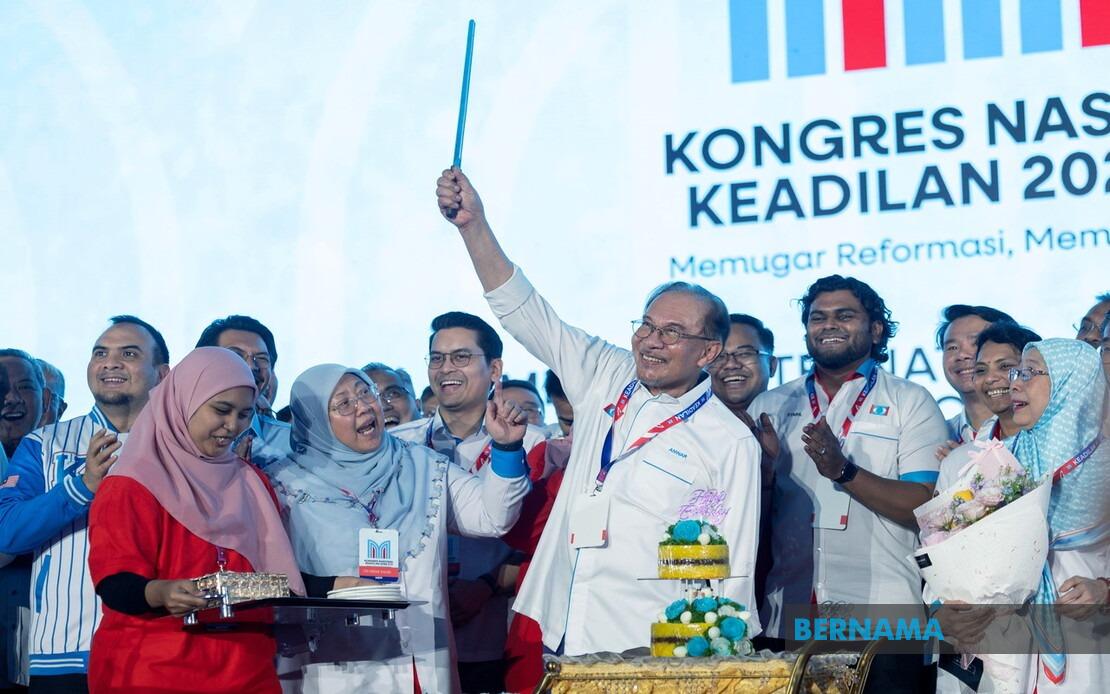
The PKR National Congress 2026 concluded in Melaka with party leadership reasserting its foundational commitment to both political continuity and substantive reform, a delicate balance that has defined the coalition's operation since taking federal office. Throughout the two-day gathering, speakers consistently returned to the theme that stability and progress need not be mutually exclusive—that the party could simultaneously anchor the Unity Government while pursuing the structural changes that distinguish its political identity. This messaging reflects the complex positioning PKR has occupied since joining the federal coalition, where maintaining the fragile consensus among ideologically diverse partners requires constant navigation between reform impulses and pragmatic governance constraints.
PKR president Datuk Seri Anwar Ibrahim used his closing address to signal unwavering support for the Unity Government framework, framing it as essential to sustained economic development and public welfare rather than as a mere political arrangement. His emphasis on cooperation's stability represented a clear statement to coalition partners, particularly given the coalition's vulnerability to defections and shifting parliamentary arithmetic. However, Anwar simultaneously acknowledged that the partnership's longevity depends substantially on decisions made by UMNO and Barisan Nasional leadership, a candid recognition that PKR's influence, while significant, remains constrained within a coalition where larger parties set crucial parameters. This mutual dependency has become a defining feature of Malaysian politics in the post-2022 period, distinguishing the current arrangement from the clearer hierarchies that characterized earlier coalition formations.
A significant portion of Anwar's remarks focused on cautioning coalition members against actions that might destabilize the government's trajectory. His specific warning against excessive steps carried implicit reference to persistent tensions within the coalition regarding policy priorities, resource allocation, and factional positioning. These tensions have periodically surfaced publicly, most notably around matters affecting religious policy, bumiputera protections, and developmental priorities where Barisan Nasional and PKR often hold divergent positions. The Prime Minister's framing of the Unity Government as built on political awareness and national interest rather than divisive politics attempted to elevate the coalition above perceived self-interest, though observers recognize that such rhetoric frequently masks significant underlying disagreements managed through quiet negotiation rather than public resolution.
PKR deputy president Nurul Izzah Anwar articulated what may represent the party's most distinctive contribution to the coalition framework: the insistence that being in government should not require abandoning reform efforts. She argued that administrative reforms, party organizational changes, and progressive policy development must persist even within a coalition context, positioning reform not as oppositional but as integral to effective governance. Her invocation of the Universities and University Colleges Act repeal exemplified this logic—a major structural change achieved through government channels rather than through opposition pressure. The AUKU reform particularly resonates with younger party members and civil society groups that view such changes as validation of PKR's reformist credentials, though the broader question of reform pace and scope within coalition constraints remains contested within the party base.
Anwar's specific reassurance regarding student freedoms and the non-replacement of AUKU with comparably restrictive legislation addressed concerns that had circulated among student activists and educational stakeholders. His assertion that existing criminal law provisions suffice for addressing genuine student misconduct, without requiring specialized restrictions on campus political activity, represents a substantive policy position differentiating PKR's approach from traditional Barisan Nasional preferences on this matter. This commitment, endorsed at the party's highest levels, provides some protection for student organizing and campus debate, though implementation often depends on local administrators' interpretations and enforcement practices. The willingness to discuss such matters openly at a national congress signals that PKR views student welfare and institutional autonomy as central rather than peripheral to its reform platform.
Women's representation and leadership development emerged as a significant congress theme, with PKR Wanita chief and Education Minister Fadhlina Sidek calling for expanded opportunities in decision-making structures. Her emphasis on openness to criticism and improved governance practices suggests recognition that women's participation in leadership requires not merely tokenistic inclusion but substantive influence over policy direction. The specific focus on both party and governmental structures reflects understanding that changes require parallel action across organizational and state levels to prove meaningful. For Malaysian politics more broadly, Fadhlina's prominence as Education Minister combined with her party leadership role illustrates PKR's greater integration of women into senior portfolios compared to most coalition partners, though significant disparities persist at middle management and grassroots organizational levels.
Angkatan Muda Keadilan's focus on Generation Z priorities and emerging economic sectors reflects PKR's attempt to position itself as forward-looking within coalition frameworks oriented toward maintaining established structures. The emphasis on bumiputera participation in technology sectors—particularly artificial intelligence, semiconductors, and biotechnology—attempts to reconcile progressive economic vision with established affirmative action frameworks, rather than positioning them as contradictory. Similarly, the youth wing's attention to gig economy recognition, social protection expansion, skills development, and mental health support addresses material concerns affecting younger workers who have limited experience with stable employment models dominant in earlier economic periods. These policy priorities reflect demographic shifts and labor market transformations that older coalition partners have been slower to address systematically.
The congress's overall messaging reflected PKR's broader strategic calculation: that stability provides necessary foundation for reform, that coalition participation need not require abandoning reformist identity, and that the party remains organizationally prepared for whatever political developments emerge. This framing addresses internal party concerns about whether participation in government has compromised PKR's distinct political character, a question that periodically generates significant internal discussion. By emphasizing readiness independent of parliamentary dissolution timelines or electoral cycle pressures, party leadership attempted to counter suggestions that PKR had become passive or reactive within coalition structures. The explicit rejection of waiting for Parliament dissolution or candidate announcements before mobilizing reflected partly defensive positioning against rumors of potential coalition shifts or realignment scenarios that periodically circulate in Malaysian political commentary.
The two-day gathering demonstrated PKR's continued capacity to maintain internal coherence around dual commitments to stability and reform, though observers recognize increasing complexity in navigating this balance. As the coalition matures beyond its initial post-2022 period, pressures mount from multiple directions: from civil society groups expecting accelerated reform implementation, from coalition partners protecting their political interests, from party rank-and-file managing expectations against visible constraints, and from economic circumstances potentially limiting the government's capacity for distributive policies that might shore up political support. The congress rhetoric emphasized these challenges as manageable through continued organizational focus and leadership commitment, though the medium-term sustainability of this balance remains substantially dependent on factors—including broader economic performance, coalition partner behavior, and international developments—largely outside party control.

