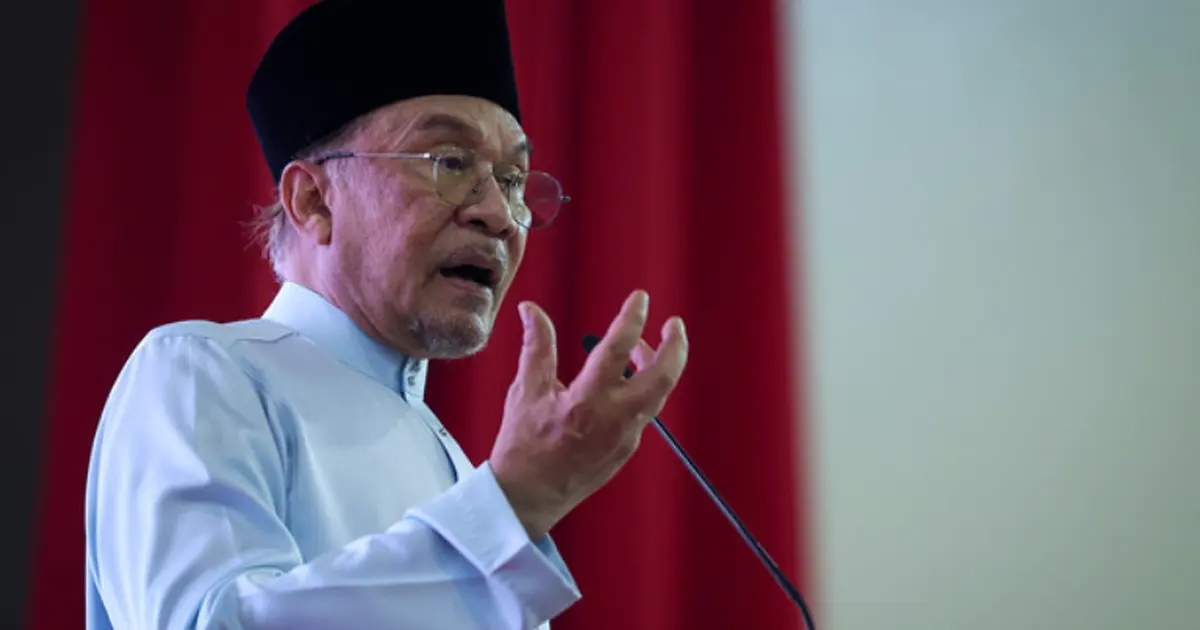
Prime Minister Anwar Ibrahim should be remembered as a stabilising force who extended critical assistance to Umno during one of its most vulnerable periods, according to Huraimi Husri, head of the Kuala Lumpur PKR Youth chapter. Yet instead of reciprocating the support, he argues, the ruling establishment has repaid that crucial intervention with disloyalty—a narrative that reflects deeper tensions within Malaysia's coalition government structure.
Huraimi's assessment touches on a pivotal moment in Malaysian politics. Following the contentious outcome of the 15th general election, Umno found itself isolated and weakened, having suffered significant electoral losses and facing potential marginalisation from government formation. At that juncture, when the party's political future appeared precarious, Anwar's willingness to work collaboratively rather than exploit Umno's weakness proved instrumental in constructing the Pakatan Harapan-Barisan Nasional unity framework that ultimately governed the country.
The PKR Youth leader's remarks underscore a fundamental contradiction that has long plagued Malaysia's coalition politics. The unity government, formed out of pragmatic necessity rather than ideological alignment, brought together parties with divergent interests and historical animosities. Anwar's decision to include Umno—despite decades of personal and political rivalry—represented a strategic choice to prioritise national stability over partisan advantage. From this perspective, the Prime Minister exercised considerable restraint and political maturity by extending an olive branch to a rival party facing internal turbulence.
Umno's trajectory since the 2022 elections reveals the complex dynamics at play. The party, which had dominated Malaysian politics for nearly seven decades, faced existential questions about its relevance and direction. By incorporating Umno into the governing coalition, Anwar effectively prevented a complete political implosion that could have destabilised the country. This decision arguably protected not only Umno's institutional interests but also Malaysia's broader political equilibrium during a period of considerable uncertainty.
However, Huraimi's accusation of betrayal highlights the persistent friction within the unity government. Despite sharing coalition responsibilities and government portfolios, Umno leaders have frequently signalled discontent with their position. Their periodic threats to withdraw support, criticisms of government policy, and apparent reluctance to fully commit to the coalition's agenda suggest that Umno views its participation primarily as a temporary arrangement rather than a genuine partnership. For PKR members like Huraimi, this posture appears ungrateful given Anwar's instrumental role in preserving the party's political viability.
The generational perspective embedded in Huraimi's statement is particularly noteworthy. As a youth leader, he represents voices within PKR that witnessed Anwar's personal persecution during the Mahathir era and his long political journey toward the premiership. For this cohort, Anwar's eventual ascent to the top office after decades of struggle carries profound symbolic weight. The notion that the party he leads is now being taken for granted or undermined by coalition partners strikes at something deeper than mere electoral calculation—it touches questions of historical justice and recognition.
The strategic implications for Malaysia's governance structure are considerable. If Umno continues to maintain ambivalent commitment to the unity government while benefiting from participation in it, this creates structural instability. Anwar's coalitional architecture depends on sufficient cohesion among partners to pass legislation and maintain parliamentary confidence. Umno's ability to threaten withdrawal or withhold support on key votes effectively grants the party disproportionate leverage, allowing it to extract concessions while maintaining the option of exit. This dynamic has already manifested in various policy disputes and ministerial tensions.
From a regional perspective, Malaysia's political instability carries implications for Southeast Asia's broader geopolitical standing. The nation's economic policymaking, diplomatic alignment, and regional leadership depend on government stability and coherent executive authority. When coalition partners operate at cross-purposes or harbour fundamental doubts about their continued participation, this inevitably constrains Malaysia's capacity to pursue consistent policies and project influence internationally. The current configuration, though better than alternative collapse scenarios, remains suboptimal for effective governance.
Huraimi's intervention also reflects PKR's internal pressure to defend Anwar's political legacy and decision-making. Within the party, questions about whether the Prime Minister compromised too much in forming the unity government persist. By publicly articulating the case for Anwar's strategic wisdom and Umno's subsequent ingratitude, PKR Youth leadership is attempting to shape the historical narrative around this pivotal period. They wish to establish that Anwar acted virtuously while coalition partners acted selfishly, thereby protecting his standing with their base.
The broader challenge facing Malaysia's current government remains the tension between coalition necessity and partner reliability. Anwar inherited a fractured parliament where no single party possessed a working majority. His construction of the unity government, however imperfect, represented the only viable path to stable governance. Yet achieving genuine unity requires more than formal agreements—it demands shared commitment to collective success. If major coalition partners like Umno continue viewing participation as a temporary expedient rather than a long-term partnership, the foundation for coherent policymaking remains fundamentally compromised.
Moving forward, the viability of Malaysia's current political arrangement depends significantly on whether coalition partners can evolve beyond zero-sum competition toward genuine collaborative governance. Huraimi's defence of Anwar's earlier generosity implicitly calls for reciprocal commitment from Umno. Without such reciprocation, the government faces mounting pressure from continued coalition instability, parliamentary manoeuvring, and the perpetual threat of political realignment. For Malaysian citizens and international observers alike, whether Malaysia's leaders can transcend historical rivalries to build durable institutions remains the defining question of this political era.

