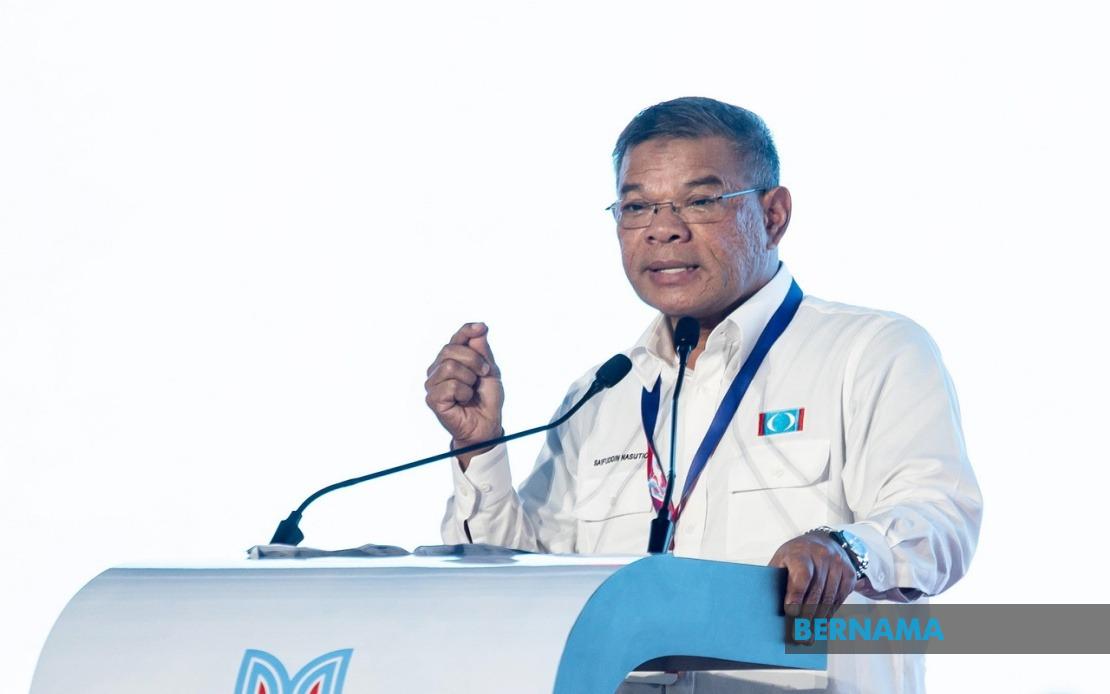
In a forceful speech at PKR's National Congress in Melaka, deputy president Datuk Seri Saifuddin Nasution Ismail has rejected identity and racial politics as a destructive approach that offers nothing to the nation's future prospects. Speaking at the Melaka International Trade Centre, the Home Minister characterised such divisive framing as an unwinnable contest that breeds only conflict without generating tangible benefits for ordinary Malaysians. His remarks signal PKR's attempt to redefine the terms of political competition away from demographic appeals and toward measurable outcomes in household living standards and economic opportunity.
Saifuddin Nasution's intervention addresses a persistent tension in Malaysian politics. While acknowledging that Malaysia's plural society encompasses distinct Malay, Islamic, Chinese, Indian, Sabah and Sarawak identities as an inescapable demographic reality, he drew a critical distinction between identity as a fact and identity as a political weapon. The Home Minister contended that the danger emerges only when political actors weaponise these identities to generate anxiety among communities. This framing attempts to sidestep accusations that PKR, as a multiethnic coalition partner, either ignores or downplays legitimate community concerns, instead recastingthe debate as one about cynical fear-mongering versus constructive governance.
Central to his argument is the metaphor of expanding national prosperity rather than redistribution. Saifuddin Nasution insisted that Malaysian politics should focus on "growing the pie of prosperity" so that all societal segments can benefit simultaneously, rather than treating gains for one community as losses for another. This framing reflects an implicit critique of zero-sum politics, where any policy favouring one group is seen as diminishing others' shares. By emphasising growth over reallocation, the PKR leader appears to propose that rising economic tides can satisfy competing claims without requiring winners and losers. The appeal carries particular weight for middle-income households concerned about economic stagnation but wary of overt redistribution schemes.
The PKR deputy president outlined three concrete policy pillars for the MADANI Government's direction. The first involves accelerating economic expansion through which expanded prosperity becomes accessible across all communities without requiring anyone to surrender rights or security. The second prioritises need-based assistance divorced from ethnic criteria, targeting vulnerable populations according to material circumstances rather than demographic identity. This approach echoes international best practice in social safety nets and potentially positions PKR as technocratic and pragmatic rather than ideological. The third pillar commits to strengthening institutional integrity and reducing corruption that depletes state resources and undermines public trust—a message resonating with urban voters frustrated by governance failures.
Saifuddin Nasution's characterisation of actual threats to communities reveals another layer of PKR's political strategy. Rather than framing threats in communal or religious terms, he redirected attention toward poverty and social dysfunction including narcotics abuse. By defining the enemy as poverty and substance dependency rather than other ethnic or religious groups, he attempts to forge a cross-communal coalition united against common adversaries. This rhetorical move potentially neutralises identity-based appeals by redefining what Malaysians should actually fear and opposing. It positions PKR as the party addressing genuine suffering rather than exploiting manufactured grievances.
The timing of this address carries significance beyond its immediate rhetorical content. Delivered at PKR's National Congress in the lead-up to the next general election, Saifuddin Nasution's remarks appear designed to set the party's electoral platform around governance competence and inclusive prosperity rather than demographic competition. For a coalition government that includes both Bumiputera and non-Bumiputera parties, explicitly rejecting identity-based politics provides essential common ground and shared messaging discipline. It also distinguishes PKR's approach from opposition parties who have sometimes effectively weaponised identity concerns to mobilise their bases.
However, the effectiveness of this reframing depends on whether the MADANI Government can demonstrate tangible economic improvements before voters next cast ballots. Malaysian households face persistent inflation pressures, stagnant wage growth, and housing affordability crises that abstract appeals to inclusive prosperity may struggle to address. Saifuddin Nasution's emphasis on young voters also reflects awareness that younger Malaysians, less shaped by historical communal anxieties, may respond more strongly to material and governance arguments than older generations. Yet younger voters also face particularly acute economic precarity, meaning rhetorical pivots must accompany genuine policy delivery.
The Home Minister's call to party members to amplify MADANI Government success stories underscores the communication challenge facing ruling coalitions everywhere. Success in governance implementation matters less electorally if citizens remain unaware of improvements or attribute them to other causes. For PKR specifically, demonstrating that multiethnic governance produces better outcomes than identity-based competition becomes crucial to validating their political philosophy and maintaining coalition cohesion. This requires not only superior economic management but also effective narrative control and consistent messaging across party machinery and state administrations.
Saifuddin Nasution's framework also implicitly critiques how opposition and competing government coalition members have deployed identity politics during Malaysia's recent turbulent political transitions. By characterising such approaches as inherently sterile and counterproductive, PKR positions itself as forward-thinking and pragmatic while potentially portraying rivals as trapped in destructive patterns. Whether this appeal resonates depends heavily on broader economic conditions and whether voters perceive genuine difference in how competing coalitions govern multiethnic constituencies. In Malaysia's deeply divided political landscape, rhetorical repositioning alone rarely determines electoral outcomes without substantial shifts in material circumstances or voter sentiment.

