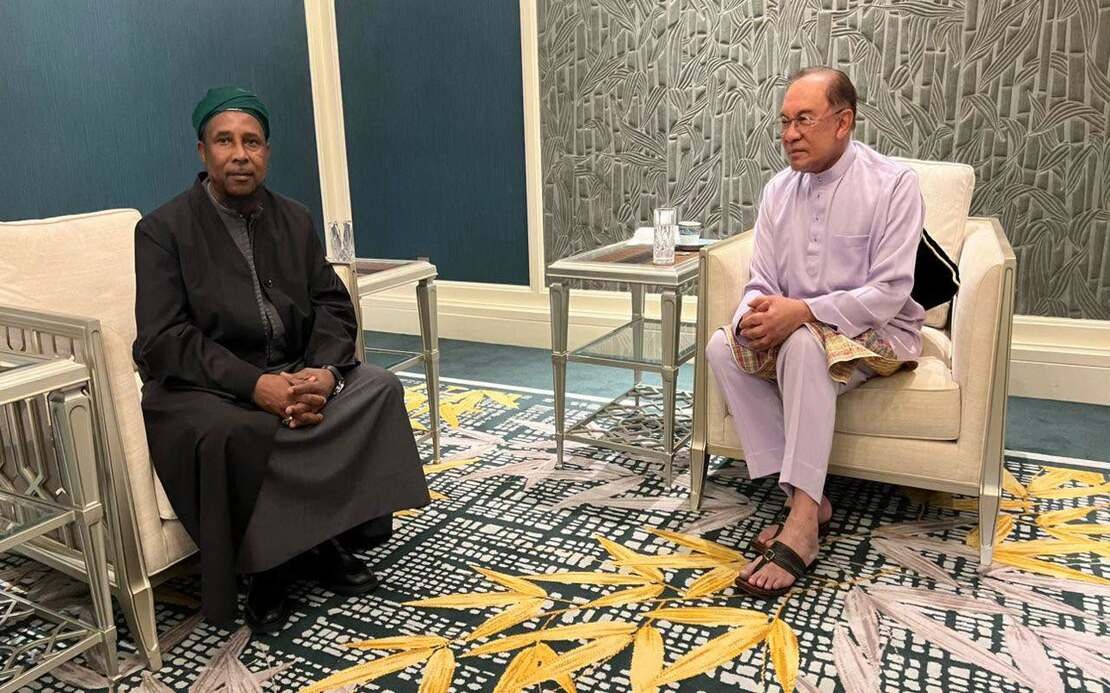
Prime Minister Datuk Seri Anwar Ibrahim received Sheikh Muhammad Haydara Al-Jilani, a prominent Gambian Islamic scholar, for a farewell meeting on June 26 in Kuala Lumpur, marking the conclusion of an extended visit that saw the religious leader conduct extensive spiritual and educational programmes throughout Malaysia. The timing of the encounter held particular significance, as it coincided with the Day of Ashura, a day of religious observance in the Islamic calendar falling on a Friday, lending additional spiritual weight to the occasion.
During his month-long sojourn in Malaysia, Sheikh Muhammad Haydara Al-Jilani undertook a comprehensive tour of the country, organising a series of dhikr gatherings—sessions of collective remembrance of God—and knowledge-sharing programmes at various venues across the nation. These initiatives formed part of a broader dakwah campaign, the Islamic concept of inviting or calling others towards religious understanding and spiritual deepening. The scale and scope of his activities underscore growing interest in Malaysia's Muslim communities regarding engagement with respected international Islamic scholars who bring fresh perspectives and authentic religious instruction.
Anwar shared details of their meeting through his official Facebook page, emphasising the constructive nature of the interaction and its spiritual dimensions. The Prime Minister noted that the farewell audience presented an opportune moment to seek the sheikh's special prayers and blessings for the Malaysian nation. This gesture reflects Malaysia's diplomatic and cultural emphasis on interfaith and intra-faith engagement, particularly with respected religious figures from friendly nations across the Muslim world.
The prayer requests that Anwar sought from the visiting scholar centred on several interconnected themes vital to Malaysia's national aspirations. These included petitions for the country's prosperity and economic wellbeing, the maintenance of peace and social stability within the multiethnic and multireligious Malaysian society, and the general welfare of all Malaysian citizens regardless of their religious background. Such requests demonstrate how Malaysia's leadership continues to frame engagement with international Islamic scholars as part of broader nation-building endeavours that transcend purely religious dimensions.
Sheikh Muhammad Haydara Al-Jilani's background as a Gambian scholar adds an interesting dimension to his Malaysian visit, reflecting the transnational nature of contemporary Islamic learning and practice. West African Islamic scholars have long maintained strong intellectual and spiritual connections with Southeast Asian Muslim communities, a relationship dating back centuries to the era of maritime trade and religious scholarship exchange. The choice to invite such a figure suggests Malaysia's continued openness to Islamic knowledge emanating from diverse geographic and cultural contexts within the broader Muslim world.
The Day of Ashura, coinciding with the Prime Minister's meeting with the visiting scholar, holds significant meaning in Islamic tradition. Falling on the tenth day of Muharram, the Islamic new year month, Ashura carries profound historical and spiritual resonance for Muslim communities worldwide. For Shia Muslims, it commemorates the martyrdom of Husayn ibn Ali at Karbala, while Sunni Muslims observe it as a day of optional fasting and spiritual reflection. The convergence of this important date with Sheikh Muhammad Haydara's farewell visit created a layered spiritual and symbolic occasion.
Malaysia's engagement with international Islamic scholars reflects the country's self-positioning as a hub for Islamic learning and civilisational dialogue in Southeast Asia. The government under Anwar's leadership has consistently sought to project Malaysia as a centre where authentic Islamic teaching coexists with moderate, progressive interpretations of Islam that respect pluralism and democratic values. Hosting scholars like Sheikh Muhammad Haydara Al-Jilani contributes to this broader narrative while also providing Malaysian Muslim communities with opportunities for direct engagement with respected international religious personalities.
The knowledge-sharing and dhikr programmes conducted by the Gambian scholar during his Malaysian stay likely attracted diverse participants ranging from students of Islamic sciences to lay believers seeking spiritual enrichment. Such gatherings serve multiple functions within Muslim communities: they provide structured religious education, facilitate spiritual development through collective remembrance practices, and create spaces for intellectual discussion around Islamic theology and jurisprudence. The nationwide scope of these activities suggests considerable institutional coordination, probably involving major Islamic organisations and educational institutions across Malaysia.
The month-long duration of Sheikh Muhammad Haydara Al-Jilani's visit indicates substantial investment in cultural and religious exchange between Malaysia and the Gambia. This extended timeframe allowed for meaningful interaction with various Malaysian Muslim communities and institutions rather than merely ceremonial encounters. It also reflects the visiting scholar's commitment to substantive engagement and the Malaysian host institutions' confidence in the value of his presence and teachings for local communities.
From a diplomatic perspective, Anwar's public acknowledgment of the visiting scholar through his Facebook post serves to elevate the significance of the engagement beyond purely religious circles. By framing the meeting in terms of national blessings and collective wellbeing, the Prime Minister signals Malaysia's valuing of international Islamic scholarly relationships as strategic components of national development and stability. This approach aligns with broader Malaysian foreign policy orientations emphasising cultural diplomacy and people-to-people engagement alongside traditional state-to-state relations.

